
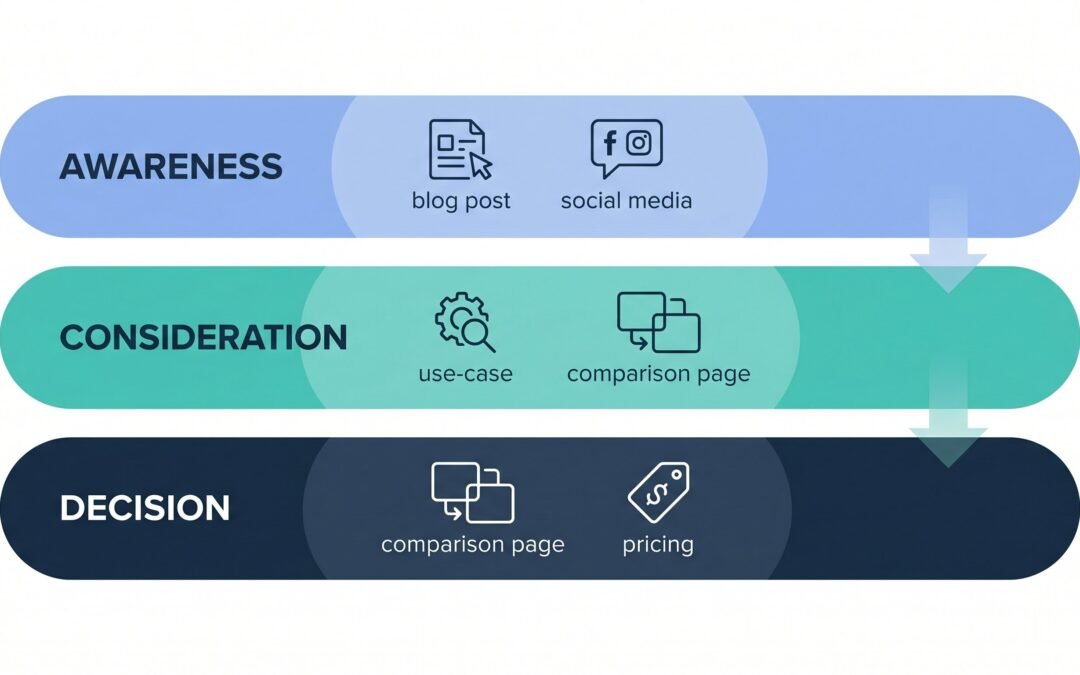
Content Marketing for SaaS: A Strategy That Actually Works
SaaS content marketing is the practice of creating content that attracts, educates, and converts buyers across a longer subscription sales cycle. It differs from general content marketing because you’re not selling a one-time purchase, you’re acquiring recurring revenue, which means content must support trial signups, product adoption, and retention, not just clicks.
The first thing I usually find when I audit a SaaS content program is the same: a blog packed with 80 educational posts and not a single page targeting buyers who are actively comparing tools. One client of mine had been publishing twice a week for two years and ranking well, but their highest-converting page, written in an afternoon, was a simple comparison against their main competitor. That single page brought in more trial signups than the previous six months of top-of-funnel posts combined.
That pattern is the reason I wrote this guide. If you’re running content for a SaaS company, the question isn’t whether to invest in content, it’s where to invest. And in my experience working with SaaS clients, the answer is rarely “more blog posts.”
Why SaaS Content Marketing Is Different
SaaS sells subscriptions, not products. That single fact reshapes everything about how content should work. When you sell a one-time purchase, content’s job is to drive a single conversion. When you sell a recurring subscription, content has to do four jobs: attract the right buyer, convince them to start a trial, help them activate the product, and reinforce the decision so they renew.
The sales cycle is also longer than most marketers expect. A buyer evaluating a $500-per-month tool might read three blog posts, watch a demo, share a comparison page in Slack with their team, ask in a peer community, and then start a trial six weeks after their first visit. Your content has to be there at every one of those touchpoints, which is why a “blog and pray” approach falls apart for SaaS.
There’s also a meaningful split between sales-led and product-led companies. If you’re sales-led, content’s job is largely to generate marketing-qualified leads for sales reps. If you’re product-led, the goal is to drive product signups directly. The implication for content is significant: PLG companies should write content that gets the reader inside the product as fast as possible. That means tutorial-style pieces where the natural next step is “try this in the free plan,” not “download the ebook.” If you have a product-led motion, every blog post should answer a question your product solves, and link directly to the feature that solves it.
Mapping Content to the SaaS Customer Journey
Before I plan any content roadmap, I map content to the five buyer stages. Here’s the version I use with clients:
| Journey Stage | Buyer Mindset | Best Content Types | Example |
|---|---|---|---|
| Unaware | Doesn’t know they have a problem worth solving | Thought leadership, original research, industry reports | “The State of Remote Engineering Teams in 2026” |
| Problem-Aware | Feels the pain but hasn’t named it | Educational blog posts, “what is” definitions, explainer videos | “Why Engineering Teams Miss Sprint Goals” |
| Solution-Aware | Knows a category of tool exists, researching approaches | Buyer’s guides, category overviews, how-to tutorials | “How to Choose a Sprint Planning Tool” |
| Product-Aware (Evaluating) | Comparing specific vendors | Comparison pages, alternative pages, feature deep dives | “Linear vs. Jira: Which Is Right for Your Team?” |
| Decision | Picking a tool, may already be in trial | Case studies, ROI calculators, integration pages, pricing comparisons | “Linear + Slack: Setup Guide and Use Cases” |
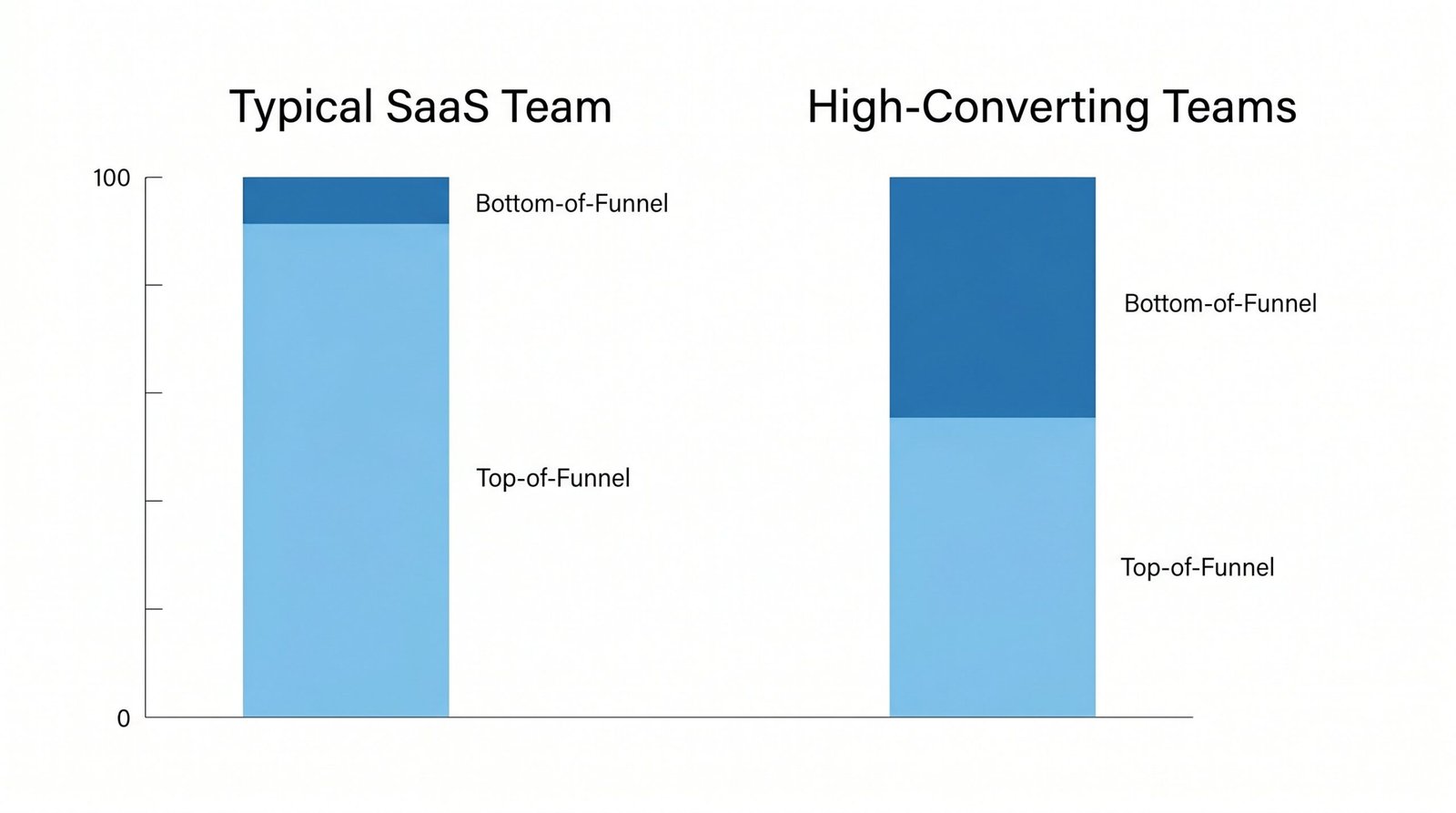
Here’s the pattern I see again and again. SaaS content teams pile resources into rows one and two. They publish definition posts and category explainers because those keywords have the highest search volume and feel “safe” to write. The result is a content library that brings in traffic but converts at a low rate because the people reading those posts are months away from buying anything.
Meanwhile, rows four and five sit nearly empty. Comparison pages, alternative pages, integration pages, the assets that buyers actually search for when they’re days away from picking a tool, get ignored because each one only attracts a few hundred visitors a month. But those few hundred visitors convert at five to ten times the rate of a top-of-funnel post. I’d rather have a page that brings in 300 visitors and 30 trials than one that brings in 3,000 visitors and 5 trials.
If you’re auditing your own content library right now, the test is simple: open a spreadsheet, list every URL, tag each one by journey stage, and look at the distribution. If less than 20 percent of your content targets the Decision stage, you’ve found the highest-leverage gap in your strategy.
Top-of-Funnel Content, Building Awareness
Top-of-funnel content still matters, I want to be clear about that. It builds brand equity, demonstrates expertise, and feeds your retargeting and email list. The mistake isn’t publishing TOF content, it’s expecting it to convert quickly.
The TOF formats that consistently work for SaaS clients I’ve advised: well-researched original studies (survey 200 of your customers, publish the numbers, watch the backlinks roll in), genuine thought leadership written by a credible person on your team, and “what is” definition posts that establish you as the authoritative source for category terms. According to HubSpot’s State of Marketing report, marketers continue to rank original research and educational blog content as among the highest-ROI formats, but the operative word is “original.” The format works when the content is hard to replicate.
What doesn’t work is the listicle treadmill. “Top 10 productivity tips” written by a freelance writer who has never used your product is not going to rank, and even if it does, it won’t convert. Search engines have gotten very good at detecting whether a piece of content actually demonstrates first-hand experience. If your post sounds like it could have been written by anyone on the internet, it probably was, and Google knows it.
The other common mistake is the conversion expectation. I had a founder ask me last year why his “what is product analytics” post wasn’t driving trials. The honest answer was that the people searching that term don’t have budget approval, a defined use case, or any reason to pick a tool yet. That post’s job is to put your brand in their head so when they’re ready to buy in six months, they remember you. Measure TOF content by branded search lift and assisted conversions, not by direct signups.
Middle-of-Funnel Content, Capturing Intent
The middle of the funnel is where content starts paying for itself directly. Buyers here have named their problem and are researching solutions. The content that wins is specific, practical, and tied to a job they’re trying to get done.
Use-case content is the workhorse of the middle funnel. “How to run async standups with a distributed team,” “How to track marketing-attributed revenue in HubSpot,” “How to migrate from Mailchimp to Klaviyo.” These pieces rank for queries with clear intent, the searcher has a specific problem and is hunting for a method. Because your tool solves the problem, the natural CTA in the article is “here’s how to do this with [our product],” and conversions follow.
Integration-themed how-tos are another strong middle-funnel format. If you sell a CRM and someone searches “how to sync HubSpot with Slack,” they’re not just curious, they’re about to set up an integration. A tutorial that walks them through it, ideally featuring your product as the workflow hub, converts because it solves their actual problem in the moment they have it.
This is also a good place to drop in pieces on adjacent topics where you can demonstrate genuine expertise. If you run an email platform, writing the definitive guide to deliverability earns trust with the exact buyer you want. If you sell project software, a piece on team rituals does the same. The bar is that the content has to be useful enough to stand on its own, the kind of thing a senior practitioner would send to a colleague. If you need outside help producing this kind of work, a freelance marketing consultant can often move faster than building a full in-house team.
Bottom-of-Funnel Content, Where Most SaaS Teams Leave Money on the Table
This is the section I want you to read twice. Bottom-of-funnel content is where I see the biggest gap between effort and return at almost every SaaS company I work with. The pages are simple to write, the keywords are low-competition compared to TOF terms, and the visitors convert at rates that would make your CFO smile. And yet most content calendars don’t include a single one.
Comparison Pages
A buyer who searches “Notion vs. Confluence” or “Segment vs. RudderStack” is not browsing. They have a shortlist, they’re about to pick, and they’re looking for one last piece of validation. These are the highest-intent visitors you’ll ever get from organic search.
I tell clients to write comparison pages honestly. Don’t trash the competitor, that approach reads as defensive and turns sophisticated buyers off immediately. Instead, lay out the genuine strengths of both tools, then position your product clearly for the buyer who’s right for you. If the competitor is genuinely better for a certain use case, say so. The buyer will respect you for it, and the ones who fit your product will convert at a much higher rate because they trust your judgment.
The structural pattern that works: a quick summary table comparing pricing, key features, and ideal customer; a short paragraph on when to pick each tool; deeper sections on pricing, integrations, ease of use, support, and any feature your prospects actually ask about; and a clear CTA at the end with a free trial link. Aim for a fair, useful comparison that a buyer could send to their boss.
One strategic note: own this SERP before your competitors do. If you sell a tool and “[your product] vs. [competitor]” doesn’t have a page owned by you, your competitor’s affiliate marketers or comparison sites will fill that void, and they will not represent you fairly. Writing your own comparison page is partly offense and partly defense.
Alternative Pages
“[Competitor] alternatives” searches are arguably the most under-exploited keyword pattern in SaaS. The searcher is already using or evaluating a competitor and is actively looking for options. That’s a buyer with their wallet half-out.
The structure I recommend: start with a short, fair section validating what the competitor does well. Buyers searching for alternatives don’t hate the competitor, they’re often using it and looking for something better-suited to a specific need. Acknowledge the competitor’s strengths, then list five to ten genuine alternatives, including your own product positioned clearly for the buyer who’s a fit.
The temptation is to write a page that’s just a thinly-veiled pitch. Resist it. The pages that rank and convert are the ones that genuinely help the buyer compare options. Your product gets the most detailed treatment, sure, but you’re including real competitors and being honest about who each is for. Buyers can tell the difference, and the page that helps them decide is the one they remember when they’re ready to start a trial.
Integration and Use-Case Pages
If your product integrates with HubSpot, Slack, Salesforce, Stripe, or any other popular tool, each integration deserves its own page. “[Your tool] HubSpot integration,” “[your tool] + Slack,” “Stripe sync with [your tool].” These keywords have low search volume individually but extraordinarily high purchase intent. Someone searching this is already using the other tool, already has the problem, and is hunting for a solution that fits their existing stack.
This is a great fit for programmatic SEO. If your product has 50 integrations, that’s potentially 50 pages, each ranking for a specific query and each converting at high rates. The structure can be templated: what the integration does, common use cases, setup walkthrough, screenshots, and a CTA to start a trial. Even with a template, each page should have at least a few paragraphs of unique content explaining the genuine value of that specific integration, or Google will treat it as thin content.
Use-case pages work similarly but slice the buyer base by job, not by integration. “Project management for engineering teams,” “project management for design agencies,” “project management for nonprofits.” Each page speaks directly to a specific buyer with their language, their workflows, and their proof points. A generic homepage can’t compete with a page written specifically for the buyer’s context.
Building Your SaaS Content SEO Strategy
Once you’ve sorted out the funnel allocation, the next layer is SEO strategy. I want to share three principles that have served my clients well.
First, keyword research should start with jobs-to-be-done, not search volume. Open a spreadsheet and write down 20 actual jobs your customers hire your product to do. For a project management tool, one of those jobs is “get my team to actually update their tasks.” That’s a real human pain point. The search query “how to get my team to update tasks in project management” might have a search volume of 90 a month, but every one of those 90 people is feeling the exact pain your product solves. Compare that to “project management tips,” which has 8,000 searches but vague intent. I’d rather rank for the 90 than the 8,000, because the 90 will convert.
Second, build topical authority through internal linking. Pick three to five core topics you want to own, then build content clusters around each one. Every cluster has a pillar page targeting the head term and 10 to 20 supporting articles linking back to it. Cross-link aggressively between related pieces. Google rewards sites that demonstrate deep expertise on a topic, and internal linking is how you signal that depth. If you’re not confident in your internal linking strategy, this is exactly the kind of work an experienced SEO consultant can map out in a week.
Third, prioritize quality over velocity. I’d rather see a SaaS team publish two genuinely excellent pieces a month than eight mediocre ones. Mediocre content is worse than no content, it dilutes your topical authority, it gives Google a reason to lower the trust score of your domain, and it eats engineering and design time that could go into a piece that actually moves the needle. The “publish constantly” advice you’ll read on most marketing blogs was written for a 2015 internet that no longer exists.
Measuring SaaS Content Performance
Here’s the part where most content programs lose the room internally. The CMO or founder asks “what’s content doing for revenue?” and the content team shows a chart of organic sessions. Sessions are a directional indicator, not a business outcome, and serious operators know the difference.
The metrics that matter for SaaS content, in order of business relevance: trial signups attributed to organic search, paid customers attributed to organic search, content-assisted conversions (the pieces that touched the buyer journey even if they didn’t drive the final click), keyword rankings on your target terms, and yes, organic sessions, but as a leading indicator rather than the headline number.
In GA4, you can set up a custom conversion event for trial signups and segment it by the landing page that started the session. That tells you which pieces of content are actually driving signups. Even better, look at the assisted conversion report, where you’ll see content that touched the journey without being the last click. A comparison page might not always be the entry point, but it might be the page that closes the deal in the buyer’s head before they search your brand name and convert.
The mistake to avoid is reporting up the chain on traffic when leadership cares about pipeline. Translate everything into business outcomes. “We published four pieces this month, organic trial signups grew 18 percent quarter over quarter, and our comparison pages now drive 22 percent of organic trials.” That’s a story a CMO or founder can take to a board meeting. “Sessions were up 12 percent” is a story that gets your headcount cut. The Content Marketing Institute has been writing about the gap between content metrics and business metrics for years, and it’s still the single biggest reason content teams lose budget.
One last note on measurement: a lot of SaaS teams are running paid acquisition alongside content, and the attribution gets messy fast. Set up your tracking so you can separate organic-sourced trials from paid-sourced trials cleanly. If you’re also doing email nurture, layered with a strong marketing automation setup, you’ll see content’s true impact through the assisted-conversion lens, not just first-touch.
If you’re building a content strategy for your SaaS and want a second set of eyes, feel free to reach out. I work with a select number of SaaS clients on exactly this kind of work, usually as a fractional advisor or on a focused engagement to audit and rebuild a content program. The fastest wins for most teams come from the bottom-of-funnel reallocation I described above, and that’s often where I start. If your needs are narrower, I’m also happy to point you toward a specialist email marketing consultant or a freelance email marketer from my network if that’s the gap you’re trying to close.
Frequently Asked Questions
What is SaaS content marketing?
SaaS content marketing is the practice of creating and distributing content, blog posts, comparison pages, integration guides, case studies, and more, to attract, convert, and retain customers for a subscription software business. Because SaaS sells recurring revenue rather than a one-time purchase, the content has to support a longer buying cycle and continue working after the customer signs up.
How do I get started with content marketing for my SaaS?
Start by mapping out the five customer journey stages I described above and auditing what content you already have at each stage. If you’re like most teams, you’ll find a heavy concentration at the top of the funnel and very little at the decision stage. I’d recommend writing your first comparison page and your first integration page before publishing another blog post. Those two assets will likely outperform anything else in your library within 90 days.
How long does content marketing take to show results for SaaS?
Bottom-of-funnel pages, comparisons, alternatives, integrations, can rank and convert in 30 to 90 days because the competition is lower. Top-of-funnel content usually takes six to twelve months to build meaningful traffic, and the full compounding effect of a content engine takes 12 to 24 months. Anyone promising faster results from broad TOF content is either lucky or selling something.
What types of content work best for SaaS?
The mix that works for most B2B SaaS companies: comparison pages, alternative pages, and integration pages at the bottom of the funnel; use-case content and how-to tutorials in the middle; and original research, definition posts, and credible thought leadership at the top. Case studies and customer stories run across the entire funnel and are some of the highest-converting assets you can produce.
How much should a SaaS company invest in content marketing?
It depends on stage and motion, but as a rough benchmark, early-stage SaaS companies I work with typically allocate 15 to 25 percent of total marketing spend to content and SEO. For product-led companies relying on organic acquisition, it can be higher. The cost structure usually breaks down into a writer or strategist (in-house, freelance, or fractional), SEO tooling, and design support for assets. Two strong pieces a month with proper SEO and design support usually runs between $5,000 and $15,000 monthly depending on talent.
What’s the difference between content marketing and SEO for SaaS?
Content marketing is the broader practice of creating valuable content to attract and retain customers across any channel, email, social, video, blog. SEO is the practice of optimizing content and a website so it ranks in search engines. They overlap heavily because most SaaS content lives on the web and needs search traffic to reach buyers cost-effectively, but they’re not synonyms. A strong SaaS program treats them as complementary disciplines: content creates the asset, SEO ensures buyers can find it.
Recent Comments