
SaaS Marketing Strategy: A Practitioner’s Framework for 2026
I’ve spent the last decade building marketing programs for SaaS companies ranging from pre-seed startups to mid-market platforms doing $40M ARR. The single biggest pattern I’ve noticed is this: founders and CMOs read SaaS marketing guides written for companies in completely different stages, then wonder why the tactics don’t work. A playbook for a $20M ARR company will actively destroy a $500K ARR company. The reverse is also true.
This guide is the framework I wish I had when I was building my first SaaS marketing program. It’s opinionated, stage-aware, and grounded in what I’ve actually seen work. If you’re a founder, CMO, or senior marketer trying to build a real strategy rather than a tactics checklist, this is for you.
What Makes SaaS Marketing Fundamentally Different
Before we get into frameworks, I want to address something I see misunderstood constantly. SaaS marketing isn’t just B2B marketing with a software product. The economics are different. The buying journey is different. The retention dynamics change everything downstream.
You’re Selling a Recurring Relationship, Not a Product
When I was building marketing for a vertical SaaS platform serving healthcare operators, I had a board member ask me why our blended CAC payback was 14 months when the industry “average” he’d read about was 12. The answer is that average means almost nothing. Payback depends on your ACV, churn rate, gross margin, and sales cycle. Those four variables alone create wildly different marketing economics.
In traditional product marketing, you sell once and try to maximize transaction value. In SaaS, you’re entering into a recurring relationship where the customer can fire you every month or every year. This means your marketing has to do two jobs simultaneously: acquire the right customers (not just any customers) and build the brand affinity that supports retention. I’ve watched too many SaaS companies optimize for top-of-funnel volume, generate a flood of low-fit signups, and then complain about a 7% monthly churn rate. The two are connected.
The Acquisition-Retention Balance
Here’s the framework I use: every marketing decision should pass the “fit test” before the “volume test.” Can I generate 10,000 trials? Probably. Can I generate 10,000 trials from companies that will activate, expand, and renew? That’s the real question.
I’ve found that for most B2B SaaS companies, somewhere between 60-70% of marketing budget should go to acquisition and 30-40% to retention and expansion. Lifecycle marketing, customer marketing, advocacy programs, these are not afterthoughts. According to OpenView Partners’ product benchmarks research, top-quartile SaaS companies derive nearly 30% of new ARR from existing customer expansion. If your marketing team isn’t supporting that motion, you’re leaving money on the table.
The SaaS Marketing Maturity Model: 3 Stages
This is the model I keep returning to in every engagement. Most SaaS marketing guides assume one approach fits all companies. I disagree. Your strategy should be entirely different depending on which stage you’re in, and the failure mode is almost always trying to execute Stage 3 tactics with Stage 1 resources.
Stage 1, Traction (0 to $1M ARR)
At this stage, you have one job: find product-market fit and prove that someone, anyone, will pay for your product reliably. Marketing at this stage is not about brand. It’s not about funnels. It’s about getting in front of 50 high-fit prospects and learning everything you can from them.
The channels that work at Traction stage are almost always founder-driven and high-touch:
- Founder-led outbound (cold email, LinkedIn DMs, conference networking)
- Niche communities where your ICP already gathers
- One or two hand-crafted case studies from design partners
- A simple website that explains who you serve and what you do
What doesn’t work at Traction stage: SEO (it takes too long), paid ads at scale (you don’t have enough conversion data to optimize), brand campaigns, complex marketing automation. I’ve watched seed-stage founders spend $30K on a “rebrand” before they had 20 paying customers. Don’t do that. The market will tell you what your brand should be once you’ve talked to enough customers.
Marketing team size at this stage: usually 0-1 people, with the founder doing most of the work. If you hire a marketer too early, you’ll either burn them out or give them work they can’t yet execute on because the product story isn’t stable.
Stage 2, Scale ($1M to $10M ARR)
This is where most SaaS marketing breaks. You’ve got some customers, some revenue, and now the pressure is on to grow predictably. Scale stage is about building the marketing engine: repeatable channels, measurable acquisition, and a content engine that compounds.
The channels that work at Scale stage:
- SEO and B2B content writing as the long-term compounding asset
- Paid acquisition with proper attribution and conversion tracking
- Demand generation campaigns targeting your ICP
- Lifecycle email and lead nurturing
- Partner and integration marketing
- First serious hires: a content lead, a demand gen lead, and a marketing ops person
The trap at this stage is trying to do everything. I’ve seen $3M ARR companies running 12 channels poorly. I’d rather see three channels run brilliantly. Pick the two or three that align with your growth motion and pour resources into making them work. Everything else is a distraction.
One pattern I’ve seen consistently: companies hit a wall around $3-5M ARR because the founder-led, high-touch motion that got them to $1M doesn’t scale. The fix is almost always to invest in content and SEO 12-18 months before you need it. That’s why I push every Scale stage CMO to start hiring an SEO copywriter early. The compounding effect doesn’t kick in for a year.
Stage 3, Optimization ($10M+ ARR)
At Optimization stage, you have channels that work. The question is no longer “what works?” but “how do I squeeze 20% more efficiency out of what we already do?” This is where marketing becomes a science as much as a craft.
The work at this stage:
- Attribution modeling and incrementality testing
- CRO across the funnel (landing pages, trials, onboarding)
- Account-based marketing for enterprise segments
- Customer marketing and community programs
- Brand investment (yes, finally)
- International expansion and segment-specific marketing
Marketing teams at this stage are 15-50+ people, with specialist functions for SEO, paid, content, ops, lifecycle, brand, and customer marketing. The CMO’s job shifts from execution to system design.
Choosing Your Growth Motion (PLG vs SLG vs MLG)
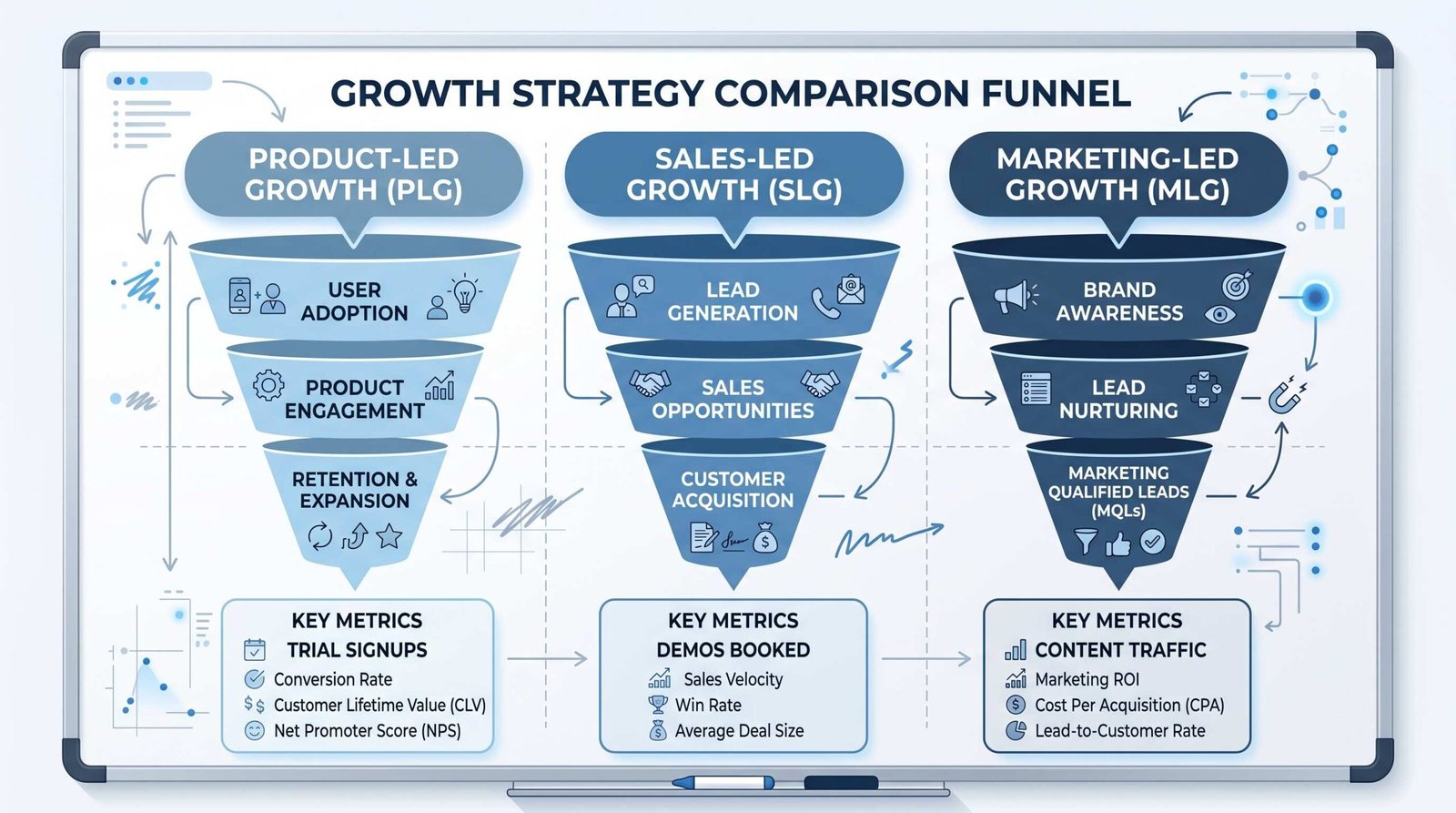
The growth motion question is the most important strategic decision a SaaS company makes, and it’s the one I see founders skip the most. Your growth motion determines your marketing strategy. Get this wrong and nothing else matters.
Product-Led Growth, When It Works and When It Doesn’t
PLG is the strategy where the product itself drives acquisition, conversion, and expansion. Users sign up, get value, and convert to paid without needing to talk to sales. Think Slack, Notion, Figma, Loom.
PLG only works if three conditions are true:
- Your product delivers clear value within the first session (under 10 minutes ideally)
- Your buyer is the end user, or the end user has strong influence over the buying decision
- Your ACV is low enough that a sales-assisted motion would be unprofitable, or your funnel is large enough that self-serve dominates volume
If you’re selling a $50K/year platform to a CFO who’s never going to log in and try it, PLG is a fantasy. I’ve seen founders try to force PLG onto products with 6-month implementation cycles and complex enterprise procurement. It doesn’t work. The product doesn’t sell itself when the buyer never touches it.
For PLG companies, marketing is heavily focused on activation and conversion within the product, content that drives qualified signups, and lifecycle messaging that moves free users to paid. The CAC profile is usually lower but volume must be higher.
Sales-Led Growth, The Right Fit for Complex Products
SLG is the traditional B2B SaaS motion: marketing generates leads, SDRs qualify them, AEs close them. This is the right fit for higher ACV products (typically $25K+ annually), complex products that require demos, and products where the buyer isn’t the end user.
Marketing in an SLG world is about pipeline. You’re measured on MQLs, SQLs, pipeline contribution, and sourced ARR. The risk here is becoming a lead factory that ignores brand. I’ve seen this go wrong many times. Sales teams demand more leads, marketing dilutes targeting, lead quality drops, conversion rates fall, sales demands more leads. The flywheel of doom.
The fix is to align with sales on lead quality definitions, build a tight ICP, and resist the pressure to flood the pipeline with low-fit accounts.
Marketing-Led Growth, Content and Brand as the Engine
MLG is the motion where marketing assets, primarily content and SEO, drive the majority of inbound demand. This works for products with a clear search intent (people Google for solutions), competitive markets where being the trusted voice creates an unfair advantage, and products with mid-range ACV where neither pure PLG nor enterprise SLG quite fits.
HubSpot, Ahrefs, and ConvertKit are classic MLG companies. They built brand and content engines that generate demand at scale. The CAC tends to be moderate, the time to results is long (12-24 months to really see compounding), but the resulting moat is enormous.
When I’m advising mid-market B2B SaaS companies, MLG is often my recommendation because it builds an asset (the content library and domain authority) that competitors can’t easily replicate. Strong SaaS copywriting is the foundation of this motion.
Most SaaS companies actually run a hybrid. Pure PLG without any sales motion is rare. Pure SLG without content is increasingly hard. The question isn’t “which one?” but “which one is dominant, and how do the others support it?”
The Core SaaS Marketing Channels (With Honest CAC Assessments)
I’m going to give you my honest take on each major channel. CAC ranges are based on my own experience and benchmarks from companies I’ve worked with or advised. Your numbers will vary based on ICP, ACV, and execution quality.
SEO and Content Marketing
SEO is the highest-ROI channel for most SaaS companies if you can wait 12-18 months. The CAC is typically 30-60% lower than paid channels at scale, but the upfront investment is significant and the payoff is delayed.
What works in SaaS SEO in 2026: deep, practitioner-written content that answers real questions. The era of thin “10 tips” listicles ranking well is over. Google’s helpful content updates have hammered low-quality content. You need depth, original perspective, and demonstrated expertise.
For a Scale-stage SaaS, I typically budget $15-30K/month for content (writers, editors, SEO tools, distribution). Expect the first six months to feel like nothing is happening. Months 7-12, you’ll see traffic build. Months 12-24, the compounding kicks in and you start generating 30-50% of pipeline from organic.
Paid Acquisition (Google, LinkedIn, Meta)
Paid is the fastest channel to get signal but also the most expensive at scale. CAC inflation in paid channels has been brutal since 2022. LinkedIn CPMs in B2B SaaS are now routinely $80-150. Google Ads for high-intent SaaS keywords frequently exceeds $50 CPC in competitive categories.
My take: paid works as a tactical channel for testing, capturing high-intent demand, and supporting launches. It rarely works as a primary growth engine unless you have extraordinary unit economics. The companies I see succeed with paid as a primary channel have ACVs above $25K and well-built sales motions to convert paid traffic.
LinkedIn is the most useful paid channel for B2B SaaS targeting senior buyers. Meta is increasingly useful for PLG products targeting individual users or SMB segments. Google Search is necessary for capturing branded and bottom-funnel demand but expensive for top-funnel.
Email and Lifecycle Marketing
Email is the most underrated channel in SaaS. I’ve seen companies spend $50K/month on paid acquisition while ignoring the trial-to-paid email sequence, which would have a 10x higher ROI to optimize. Lifecycle marketing, the email and in-product messaging that moves users through your funnel, is where most SaaS companies have the largest unrealized upside.
Key lifecycle stages to optimize:
- Activation: getting users to their first value moment
- Trial to paid conversion
- Onboarding and expansion within first 30 days
- Reactivation of dormant users
- Renewal and expansion campaigns
The CAC contribution from email is essentially zero in incremental terms once you have a list. The leverage is enormous.
Community and Partner Marketing
This is the most underrated channel and the one I most often recommend for Scale-stage SaaS. Community-led growth, the practice of building a community of users, prospects, or industry peers around your product or category, generates compounding returns that no paid channel can match.
Examples I admire: Webflow’s community of designers, dbt’s community of analytics engineers, MongoDB’s developer community. These aren’t marketing add-ons. They’re growth engines.
Partner marketing through integrations, co-marketing, and channel relationships is also wildly underused. If your product integrates with Salesforce, HubSpot, Slack, or any other major platform, you have a built-in distribution channel most companies barely tap.
Channel Comparison: CAC, Time-to-Results, and Scalability
Here’s how the major channels compare across the dimensions that matter. These are honest ranges based on my experience and benchmarks I trust.
| Channel | Avg CAC | Time to Results | Scalability | Best Stage |
|---|---|---|---|---|
| SEO/Content | $200-$800 per qualified lead | 6-18 months | Very High (compounds) | Scale, Optimization |
| Google Ads | $500-$2,000 per SQL | 1-2 weeks | Medium (CAC inflates with scale) | Scale, Optimization |
| LinkedIn Ads | $800-$3,000 per SQL | 2-6 weeks | Medium (audience saturation) | Scale, Optimization |
| Email Marketing | Near zero incremental | 30-60 days | High (limited by list size) | All stages |
| Community/Partner | $50-$300 per qualified lead | 9-18 months | Very High | Scale, Optimization |
| Cold Outbound | $300-$1,500 per SQL | 4-12 weeks | Medium (people-dependent) | Traction, Scale |
| Product-Led Growth | $50-$400 per trial | 3-9 months | Very High | All stages if model fits |
One note on these ranges: a well-run channel can outperform these significantly. A poorly run one can underperform by 3-5x. Execution quality matters more than channel choice in many cases.
SaaS Marketing Metrics That Actually Matter
I’ll be blunt: most SaaS marketing dashboards measure the wrong things. Lead volume, MQL counts, and traffic numbers are vanity metrics that don’t predict revenue. Here are the metrics that actually matter and how to think about them.
CAC, LTV, and the LTV:CAC Ratio
The basic math: Customer Acquisition Cost divided into Lifetime Value should be at least 3:1 for a healthy SaaS business. Below 3:1 and you’re either acquiring inefficiently or retaining poorly. Above 5:1 and you’re probably under-investing in growth.
Most companies calculate CAC wrong. The right way is fully-loaded: all marketing and sales costs (including team salaries) divided by new customers acquired in the same period. The wrong way is just paid media spend divided by signups. Andreessen Horowitz’s framework on SaaS metrics covers this in depth and is worth reading.
CAC payback period matters more than CAC itself for many businesses. If your CAC is $5,000 and your gross margin per customer is $500/month, your payback is 10 months. Above 18 months for B2B SaaS is usually a problem.
Activation Rate, The Most Overlooked Metric
Activation rate, the percentage of signups who reach a defined moment of value, is the single most important metric for most SaaS businesses and the one most marketing teams ignore. Why? Because it sits between marketing and product, and neither team owns it.
I argue that marketing should own activation. You’re the one who promised a specific outcome to the prospect. If they sign up and don’t get it, that’s a marketing problem as much as a product problem.
Best-in-class B2B SaaS activation rates are typically 30-50% from signup to activation event. If yours is below 20%, you have either a messaging problem (you’re attracting the wrong users) or an onboarding problem (you’re losing the right users).
NRR (Net Revenue Retention) as a Marketing Signal
NRR measures how much revenue you keep from existing customers, including expansion and accounting for churn. Above 110% is good. Above 120% is excellent. Above 130% is world-class.
NRR is a marketing signal because it tells you whether you’re acquiring the right customers. Low NRR is often blamed on customer success or product, but the root cause is usually marketing targeting customers who never should have signed up.
The 5 Mistakes I See SaaS Marketers Make Consistently
After watching dozens of SaaS marketing programs up close, I see the same mistakes repeatedly. Here are the ones that cost the most.
Mistake 1: Copying tactics from companies in a different stage. The HubSpot playbook does not work for a $2M ARR company. The Linear playbook does not work for a $30M ARR company. Stop reading case studies from companies that are 10x your size and trying to execute their tactics with 1/10 their resources. Your strategy has to fit your stage.
Mistake 2: Worshipping the funnel and ignoring the cohort. Funnel metrics (visit, lead, MQL, SQL, opportunity, close) are useful but misleading. They optimize for what flows in, not what stays. Cohort metrics (signups in week 1 who activated, paid, retained, expanded) tell you whether your marketing is actually building a business. I’ve seen marketing teams hit every funnel metric while delivering customers with 60% annual churn. That’s not a win.
Mistake 3: Outsourcing strategy to agencies. Agencies are useful for execution. They are terrible at strategy because they don’t have the context, the customer relationships, or the incentive to make hard calls. Your strategy has to be owned in-house, even if you outsource implementation. I’ve seen too many SaaS CMOs hire a “growth agency” hoping they’d solve the strategic problem. They don’t.
Mistake 4: Investing in paid before content. This one drives me up the wall. Paid acquisition is renting attention. Content is owning attention. If you build your demand machine on paid first, you have nothing when you pause spending. If you build on content first, you have an asset that compounds whether you spend or not. I always advise SaaS companies to invest in content and SEO 12-18 months before they need it.
Mistake 5: Hiring a CMO too early. Most Stage 1 SaaS companies don’t need a CMO. They need a hands-on marketer who can execute. Hiring a senior CMO at $2M ARR usually leads to one of two outcomes: the CMO spends a year building a team and dashboards before generating results, or they leave within 18 months because there isn’t enough scope. Hire a Director of Marketing first. Promote or recruit a CMO when you’re at $10M+ ARR.
Building Your 90-Day SaaS Marketing Plan
If you’re starting from scratch or trying to reset, here’s the 90-day plan I run with clients. Adjust based on your stage, but the sequence holds.
Month 1, Foundation
This is diagnostic and strategic. You’re not running campaigns yet. You’re answering questions.
- Define your ICP with specificity. Not “B2B SaaS companies.” Try “Series B-C B2B SaaS companies with 100-500 employees and a sales team of 20+ using HubSpot.”
- Interview 10-15 customers. Ask why they bought, what alternatives they considered, what almost stopped them from buying.
- Audit your current marketing. What’s working, what isn’t, what’s measured, what isn’t.
- Define your growth motion (PLG, SLG, MLG, hybrid) and document it.
- Set 3-5 metrics that matter. Resist the urge to track everything.
Month 2, Distribution
Now you’re building the channels. Pick two or three based on your stage and growth motion.
- For Traction stage: founder-led outbound, design partner case studies, niche community presence
- For Scale stage: SEO content production, paid acquisition test, lifecycle email setup
- For Optimization stage: attribution modeling, ABM for enterprise, brand investment
- Build the basics: website that converts, analytics that work, CRM hygiene
- Hire or contract the specialists you need for your chosen channels
Month 3, Optimization
By month three, you should be generating signal. Now you optimize.
- Review every metric set in month one. What changed?
- Double down on what’s working. Cut what isn’t.
- Build the feedback loop with sales and customer success
- Set the 6-month and 12-month roadmap based on what you’ve learned
- Document what works so the team can repeat it
This plan looks simple because it is. The hard part is discipline, not novelty. Most SaaS marketing teams I see fail because they try to do too much too fast, not because they don’t have enough tactics.
FAQ
What is the difference between PLG and SLG for SaaS?
PLG (product-led growth) is a strategy where the product drives acquisition, conversion, and expansion through self-serve signups and in-product value. SLG (sales-led growth) relies on a sales team to qualify and close prospects, typically for higher-ACV or complex products. PLG works when your product delivers value in the first session and your buyer is the end user. SLG works when ACV is high enough to support sales costs and the product requires education or customization. Many companies run a hybrid: PLG for lower segments, SLG for enterprise.
How much should a SaaS company spend on marketing?
The benchmark range is 10-20% of revenue for established SaaS, and often 30-50% of revenue for early-stage companies in growth mode. The exact number depends on growth targets, gross margin, and growth motion. I’ve seen efficient SaaS companies thrive at 10% and high-growth companies invest 50%+ pre-IPO. The better question is your LTV:CAC ratio and CAC payback period. If your unit economics are healthy, spend more. If they’re not, fix the economics before spending more.
What is the most cost-effective SaaS marketing channel?
Long-term, SEO and content marketing have the lowest blended CAC for most SaaS companies once they reach scale. Short-term, paid acquisition gets you signal fastest but at higher CAC. Email and lifecycle marketing have nearly zero incremental cost once you have a list, making them the highest ROI for retention and expansion. Community-led growth is the most underrated and often the most cost-effective channel for Scale-stage SaaS, though it requires patience and authentic investment.
How do you measure SaaS marketing success?
Track CAC, CAC payback period, LTV:CAC ratio, activation rate, and Net Revenue Retention as your primary metrics. Pipeline metrics (MQLs, SQLs, sourced ARR) are useful operationally but don’t fully capture success. Cohort retention matters more than top-of-funnel volume because it tells you whether the customers you acquire actually stay. Set 3-5 metrics that align with your business goals and resist the urge to track every available number. Vanity metrics create the illusion of progress without driving it.
When should a SaaS startup hire a CMO?
Most SaaS startups should not hire a CMO before $10M ARR. Before that, you need hands-on execution from a Director of Marketing or VP of Marketing who can build and run programs personally. A CMO’s job is strategy, team building, and cross-functional leadership, which requires scale to justify. Hiring a CMO too early often results in slow ramp time, frustration on both sides, and a senior hire who leaves within 18 months. The exception is companies with very high-velocity growth, large rounds of funding, and complex go-to-market motions.
What’s the biggest SaaS marketing mistake early-stage companies make?
The biggest mistake I see is investing in marketing tactics before achieving product-market fit. You cannot fix a fit problem with marketing. If your churn is high, your activation is low, or your customers don’t refer others, the answer is not more leads. The answer is making the product or positioning better. The second biggest mistake is copying tactics from companies 10x your size without recognizing that those tactics rely on resources, brand, and infrastructure you don’t have yet. Stage-appropriate strategy is everything.
Building a SaaS marketing strategy isn’t about finding the perfect tactical checklist. It’s about understanding your stage, choosing the right growth motion, sequencing channels intelligently, and measuring what actually matters. The companies that win in 2026 will be the ones that build compounding assets (content, community, brand) early and resist the temptation to chase short-term metrics that don’t predict long-term growth. If you take one thing from this guide, take this: your strategy must match your stage. Everything else is execution.
Recent Comments