

Quick answer: A go-to-market consultant helps you decide who to sell to, how to position the product, which channels to use, and how to price it. Expect to pay $150 to $350 per hour for an independent freelance GTM consultant, $8,000 to $25,000 for a defined project, or $10,000 to $30,000 per month for boutique retainers. Fractional arrangements sit lower, at $5,000 to $15,000 monthly.

What Is a Go-to-Market Consultant?
A go-to-market consultant is a strategist you hire to figure out how your product reaches paying customers and grows revenue. That includes defining the ideal customer, building the positioning and messaging, picking the right sales and marketing channels, setting the pricing model, and mapping the sales motion. In my experience working with SaaS founders, a good GTM consultant is the person who forces you to stop guessing about the market and start deciding.
The label gets tossed around loosely. So does “marketing consultant.” Here is how I draw the lines when a client asks me what they actually need.
A GTM consultant works upstream. Before you buy ads, before you write copy, before you hire a rep, someone has to decide what you sell, to whom, at what price, through what channel. That is GTM. A general marketing consultant might advise across the full funnel with a heavier lean into campaigns, content, and channel execution. A marketing agency executes, running ads, producing creative, shipping campaigns. A fractional CMO is closer to a GTM consultant, but with a leadership seat: they own the marketing org, hire and manage the team, sit in on board conversations, and stay with you for months or years rather than for a defined engagement.
Here is the fastest way to see the difference.
| Role | Primary job | Time horizon | Typical monthly cost |
|---|---|---|---|
| Go-to-market consultant | Set GTM strategy: ICP, positioning, channels, pricing, sales plan | 4 to 16 weeks | $8K to $30K |
| Fractional CMO | Lead marketing part-time, own team and P&L accountability | 6 to 18 months | $5K to $15K |
| Marketing agency | Execute campaigns, creative, media buying | Retainer, ongoing | $3K to $50K+ |
| In-house hire (Head of Marketing or VP) | Own marketing full-time; build team | Permanent | $18K to $30K loaded |
Most of the confusion I see in founder Slacks is people asking for a “GTM consultant” when they actually want an agency to run their paid social, or asking for an agency when they need a strategist to tell them who to sell to in the first place. Get the diagnosis right before you buy the medicine.
What Does a Go-to-Market Consultant Actually Do?
They deliver specific artifacts, not vague strategy. If a consultant cannot tell you, on a first call, exactly what documents and decisions you will walk away with, that is a signal to end the call.
Here is what a real GTM engagement produces, in the order the work usually happens.
- ICP definition. A written ideal customer profile with firmographics (industry, size, geography), buyer persona (title, mandate, buying triggers), and disqualifiers. Not “SMB SaaS” as a phrase. Named criteria that a rep or marketer can actually use to build a target list.
- Positioning and messaging. A one-page positioning statement, an elevator pitch, three to five proof points, and messaging variants for the two or three highest-priority personas. The Harvard Business School guidance on GTM makes the same point: your messaging must be consistent across every touchpoint, and every team member needs to be aligned on how to write and speak about the product. See the HBS Online GTM framework for the underlying logic.
- Channel selection. A ranked list of the two or three channels most likely to reach your ICP profitably, with justification (cost, buyer behavior, competitive intensity) and specific tactics to test in each. Not “we will try LinkedIn, SEO, and events.” Named plays with hypotheses.
- Pricing and packaging. A recommended pricing model (per seat, per usage, tiered, flat), specific price points, and packaging tiers. This is one of the highest-leverage decisions a GTM consultant can influence, and one of the most commonly rushed.
- Sales playbook. Discovery questions, qualification criteria (BANT, MEDDIC, or a custom framework), objection responses, and a defined sales motion (founder-led, inside sales, PLG, channel partners, hybrid).
- Launch or growth plan. A 30 to 90 day rollout with owners, milestones, and success metrics. This is where the consultant hands the strategy off to your team or an agency to execute.
Engagements usually break into three phases. Discovery, where the consultant talks to your team, your customers, and often lost prospects, and audits your existing marketing and sales data. Strategy, where they synthesize what they learned into the artifacts listed above. Execution support, which is optional and time-boxed, typically 30 to 60 days of coaching your team, sitting in on sales calls, or overseeing the first wave of experiments.
What a GTM consultant does not do: they do not run your ads, write your daily social posts, or manage your CRM. If someone pitches you a GTM strategy engagement plus ongoing campaign execution, you are looking at either an agency in disguise or a scope creep problem. A good GTM engagement ends with your team, or an agency you hire separately, running the plays. When you are ready to layer execution on top of strategy, you can bring in a digital marketing consultant or an agency to run the channels.
How Much Does a Go-to-Market Consultant Cost?
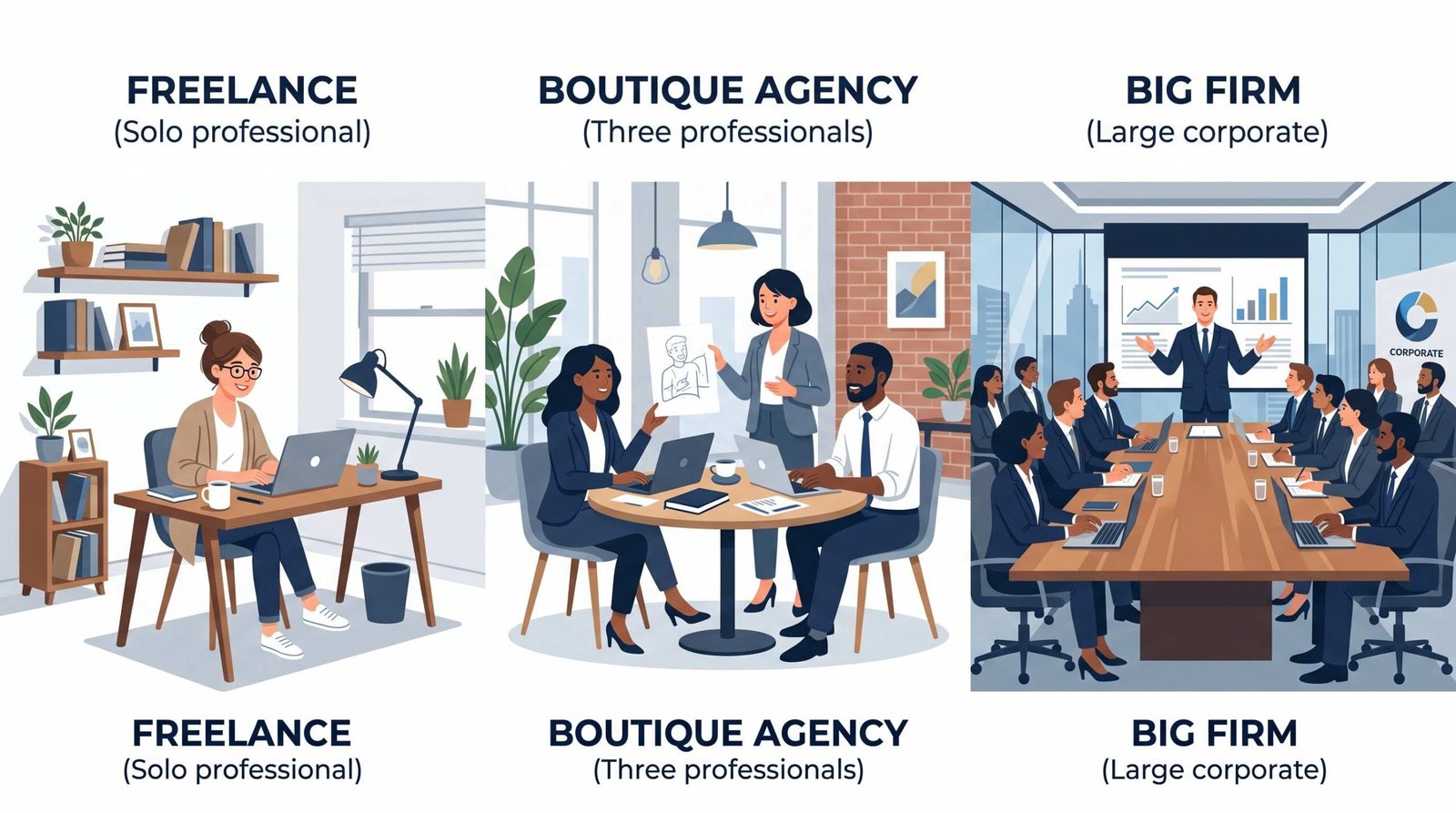
The market ranges roughly from $150 per hour on the low end of independent freelance work to more than $500,000 for a top-tier engagement from a large strategy firm. Most SaaS founders and SMB owners end up somewhere between $10,000 and $60,000 in total spend for a defined GTM engagement.
Here are the four tiers to know, with typical formats and price bands.
| Tier | Typical format | Price range |
|---|---|---|
| Independent freelance GTM consultant | Hourly or fixed-price project | $150 to $350 per hour; $8,000 to $25,000 per project |
| Boutique GTM consultancy (2 to 10 person firm) | Monthly retainer | $10,000 to $30,000 per month |
| Fractional GTM or CMO arrangement | Part-time monthly retainer | $5,000 to $15,000 per month |
| Large consulting firm (Bain, McKinsey, BCG, L.E.K.) | Multi-week engagement, dedicated team | $50,000 to $500,000+ |
The Marketerhire 2026 rates report puts freelance marketing consultants at $50 to $300 per hour and monthly retainers between $3,000 and $20,000, with senior specialists and fractional CMOs at the top of the range. That reflects the broader marketing consultant market, and my read of the GTM slice specifically is that experienced practitioners cluster in the $175 to $300 per hour band, given the strategic scope of the work. You can see the underlying breakdown in the Marketerhire freelance marketing consultant rates report.
Five things drive where you land inside these ranges.
- Company stage. Pre-seed and seed-stage engagements skew smaller and shorter. Series A and B engagements can run $30,000 to $75,000 for a fuller diagnostic and playbook build.
- Scope. “Fix our positioning” is a $10,000 project. “Rebuild our end-to-end GTM including pricing, sales motion, and 90-day launch plan” is a $40,000 project.
- Consultant seniority and track record. Someone who has scaled two SaaS companies from $1M to $20M ARR charges more than a first-time independent, because you are buying pattern recognition. The Marketerhire data pegs 12+ year veterans and fractional CMOs at $250 to $350+ per hour.
- Geography. Bay Area and NYC consultants tend to be 20 to 40 percent higher than the national average. Fully remote work has narrowed this gap but not closed it.
- Cash versus equity. Early-stage startups sometimes offer a mix of cash and equity or advisor shares. A common arrangement I have seen with founders is 50 to 75 percent of a cash rate, plus 0.25 to 0.5 percent equity vesting over 12 to 24 months. Equity is not free money, so treat it like real compensation in your model.
One warning on the low end. If you are quoted under $100 per hour for a GTM engagement, you are almost certainly buying execution labor with a strategy label on it. There are excellent junior marketers at that rate, but they are not doing what a GTM consultant does. Cheap strategy is expensive, because bad strategy compounds.
When You SHOULD Hire a Go-to-Market Consultant
Five scenarios where the math works.
1. You are 30 to 90 days from launching a new product or new business line
You have built something. You have some early conviction. You do not have the answers to: who is our first customer, what do we say, where do we say it, and what do we charge? This is the classic pre-launch scenario. Signal it is time: you keep having the same debate internally about who the customer is, and it never resolves. Expect to pay $15,000 to $35,000 for an 8 to 12 week engagement.
2. You are entering a new market or segment
You are in the US and going to Europe, or you sell to SMB and want to move upmarket. The playbook that worked before does not port. Signal: your existing sales team keeps closing the wrong deals, or your marketing is not resonating with the new segment. Expect $20,000 to $50,000 for a segment-specific GTM diagnostic and plan. Timeline: 8 to 14 weeks.
3. Growth has plateaued and you cannot diagnose why
Revenue was growing 10 to 15 percent month over month, and now it is flat or barely growing. You have tried more of the same, and it is not working. Signal: your CAC has climbed, your win rates are dropping, or your best channel has stopped scaling. Expect $15,000 to $40,000 for a GTM audit and reset. This is one of the highest-ROI engagements a GTM consultant can run, because the cost of doing nothing is very expensive.
4. You just raised, and you need to deploy capital sensibly
You closed a Series A. Your investors expect you to hit a plan you barely understand yet. A GTM consultant can help you translate the pitch deck into an operating plan. Signal: your board is asking about payback periods and channel economics, and you are guessing at the answers. Expect $25,000 to $60,000 over 10 to 16 weeks, often overlapping with your first strategic hires.
5. You are creating a new category
The hardest scenario. There is no category yet. Buyers do not know they need what you sell. Andreessen Horowitz calls this “market annealing,” the deliberate, iterative effort to shape both the company and the market until they hold together. Their partners argue the first $10M ARR in a nascent market is a “ground war,” not a formula. Read the full argument in the a16z piece on market annealing. Signal: buyers keep telling you they love the demo and then not buying, because they cannot get budget for a category that does not exist. Expect $30,000 to $75,000+ for a category creation strategy, typically stretched over 12 to 20 weeks.
When You DON’T Need a Go-to-Market Consultant
This is the section nobody else writes, because most GTM consultants have an incentive to convince you that you need one. Here are four situations where hiring a GTM consultant is a waste of your money, and I will tell any client this to their face.
1. You do not have product-market fit yet
If you cannot get 10 customers to pay you real money without heroic effort, no GTM strategy will save you. The problem is the product or the value proposition, not the go-to-market. A GTM consultant will happily take your money and hand you an ICP document that becomes irrelevant the moment your product changes. Harvard Business Review made this point cleanly a decade ago in a piece on why most startups need GTM discipline earlier: strong GTM plans align with a validated customer problem. Get the customer conversations done first. Then hire the strategist.
2. You only need execution, not strategy
If your ICP, positioning, and channel choice are already settled, and you are trying to figure out how to scale paid social or produce more content, you do not need a GTM consultant. You need a marketing operator or a specialist agency. Buying strategy when you need execution is a classic budget leak. If your bottleneck is content velocity, look at a content marketing for SaaS partner. If it is paid channels, hire a media buyer.
3. You already have strong marketing leadership
If you have a competent VP of Marketing or Head of Growth who has done this before, adding an outside GTM consultant almost always creates friction. It signals to your team that you do not trust the leader you hired. Better use of the same budget: send your VP to a peer group, hire an executive coach, or run a compensation review to make sure you keep them.
4. Your total annual marketing budget is under $30,000
If you have $30,000 to spend for the year across marketing and sales, spending $15,000 on a GTM consultant leaves you with $15,000 to actually run the plan. That is not enough to test anything. At this budget, we suggest spending the money on execution: a part-time marketer, a content specialist, or a paid channel test. Come back for strategy when the budget is bigger or the stakes are higher.
5 Red Flags When Evaluating GTM Consultants
I have watched a lot of GTM engagements go sideways for founders. Here are the patterns that predict trouble.
- They cannot tell you what stage or industry they work in. “I work with everyone from seed to Series C, across SaaS, marketplaces, and services.” That is not a positioning statement, that is a lack of one. A serious GTM consultant has a point of view about where they are best and where they are not.
- The deliverables are vague. “I will help you build your go-to-market strategy” is not a deliverable. “I will deliver a written ICP definition, a positioning statement, a channel plan with two prioritized tests, and a 90-day operating plan” is a deliverable. Ask for the artifact list in writing before you sign.
- No case studies with real metrics. Testimonials are fine, but you want specifics. “We took ACV from $12K to $28K in six months by moving the ICP upmarket.” If the only proof is logos on a slide, keep looking.
- They push a proprietary framework before they listen. If the first meeting is a demo of “The X Method,” and the consultant has not yet asked meaningful questions about your customers, revenue mix, or churn, walk away. Frameworks are useful once, not first.
- They propose a 6-month engagement before discovery. Any consultant quoting a long, expensive engagement before doing meaningful diagnostic work is either lazy or opportunistic. The first engagement should be scoped to the smallest useful unit, usually 4 to 8 weeks, with the option to extend.
How to Vet a Go-to-Market Consultant: 6 Questions to Ask
Use these on your first call. The answers tell you more than any pitch deck.
1. “Walk me through the last three GTM engagements you ran. What was the starting problem, what did you actually deliver, and what happened after?”
What to listen for: specifics on business context, deliverables, and outcomes, ideally with numbers. If the consultant gives you three generic answers or dodges outcomes, they either did not deliver results or they cannot articulate what they did.
2. “What is the ideal engagement size for you, and what should I not hire you for?”
What to listen for: a clear, honest self-assessment. “I am best at Series A B2B SaaS with $1M to $10M ARR trying to move upmarket. I am not the right fit for pre-seed founders still finding PMF or for enterprise category creation.” A consultant who says they are great at everything is great at nothing.
3. “Which of my metrics do you expect to move, and by when?”
What to listen for: specificity and honesty. A GTM consultant should be willing to hypothesize about which metrics they can influence (win rate, ACV, CAC, sales cycle) and be honest about metrics they cannot control alone (retention, expansion revenue, product-driven activation).
4. “How do you work with our internal team and existing agencies?”
What to listen for: a collaborative posture. If they seem to see internal marketers or existing agencies as adversaries, expect a difficult engagement. The best consultants make the people already on your team look smarter.
5. “What does your discovery process include, and what will you need from us to make it work?”
What to listen for: real discovery, not a check-the-box audit. Expect customer interviews (won, lost, and churned), rep and CS interviews, data on funnel performance, and a look at your existing content and messaging. If discovery is a two-hour kickoff call, the strategy will be shallow.
6. “What happens after your engagement ends? Who executes?”
What to listen for: a clear handoff plan. Good consultants do not try to become permanent. They tell you what your team needs to own, what to hire for next, and how they will support the transition. If the answer is “we can stay on retainer indefinitely,” you are being sold a subscription.
FAQ
What’s the difference between a go-to-market consultant and a marketing consultant?
A GTM consultant focuses on the strategic decisions that determine how you reach customers: who is the ideal customer, what is the positioning, which channels, what pricing, what sales motion. A general marketing consultant advises more broadly across the funnel, often with a heavier lean into campaign execution, content, and channel management. GTM is a subset of marketing consulting, but it is upstream and more strategic. If you already know who you are selling to and just need better campaigns, you want a marketing consultant. If the strategy itself is unresolved, you want a GTM consultant.
How long does a GTM consulting engagement typically last?
Most engagements run 6 to 16 weeks, with 8 to 12 weeks being the sweet spot. That is enough time for meaningful discovery (2 to 4 weeks), strategy development (3 to 6 weeks), and a hand-off with early execution support (2 to 4 weeks). Engagements shorter than 6 weeks tend to produce shallow work. Engagements longer than 20 weeks usually mean the scope keeps expanding, which is a sign the initial diagnosis was wrong or the consultant is padding.
Can a go-to-market consultant work with early-stage startups?
Yes, but only if you have product-market fit or something close to it. Pre-PMF, the highest-value help is not GTM strategy but customer discovery, product iteration, and founder-led selling. Once you have 10 or more paying customers and a pattern is emerging, a GTM consultant can compound your learnings into a repeatable motion. Below that threshold, save the money.
What should a GTM consultant deliver in the first 30 days?
Expect a completed discovery phase: customer interviews (at least 10 to 15), team interviews, and a review of your funnel data. By the end of the first month, we suggest requiring a written interim readout with an early hypothesis on ICP, positioning gaps, and the two or three biggest GTM issues to solve. If you are 30 days in with only kickoff slides, that is a bad sign.
Is a fractional GTM consultant worth it for a 10-person startup?
Often yes, if you have raised a seed or Series A and have real revenue. A fractional GTM or CMO at $6,000 to $12,000 per month is significantly cheaper than a full-time senior marketing leader (loaded at $250,000+ per year) and can give you 60 to 70 percent of the strategic value while you decide whether you need a permanent hire. It is worth it if the leader on the team is willing to be coached and taught, and not worth it if the founder wants someone to “just handle it.”
How do I know if our GTM strategy is working?
Four leading indicators to watch in the first 90 days: (1) higher win rates on deals that match your defined ICP, (2) shorter sales cycles as messaging tightens, (3) improving CAC payback within your target channels, and (4) qualitative feedback from prospects and reps that the pitch is landing. If you see none of these within 90 days, the strategy is wrong or execution is broken. Either way, that is a data point, and a good consultant will help you diagnose which one.
Closing thought
Hiring a GTM consultant is not a status move. It is a targeted intervention for specific problems: pre-launch strategy, market entry, growth plateau, post-fundraise planning, or category creation. If your problem is one of those, and you have the budget to actually run the resulting plan, a good GTM consultant will pay for themselves several times over. If your problem is something else, a GTM consultant is the wrong tool.
I am Ian Adair. I work with SaaS founders and SMB owners as an independent marketing consultant. If you want a straight read on whether GTM strategy is the right fit for what you are working on, or you would rather talk through SaaS marketing strategy or brand strategy consultant options, reach out. No pitch, no framework demo. Just a call.
Recent Comments