
Email Marketing for SaaS: The 4-Sequence Framework
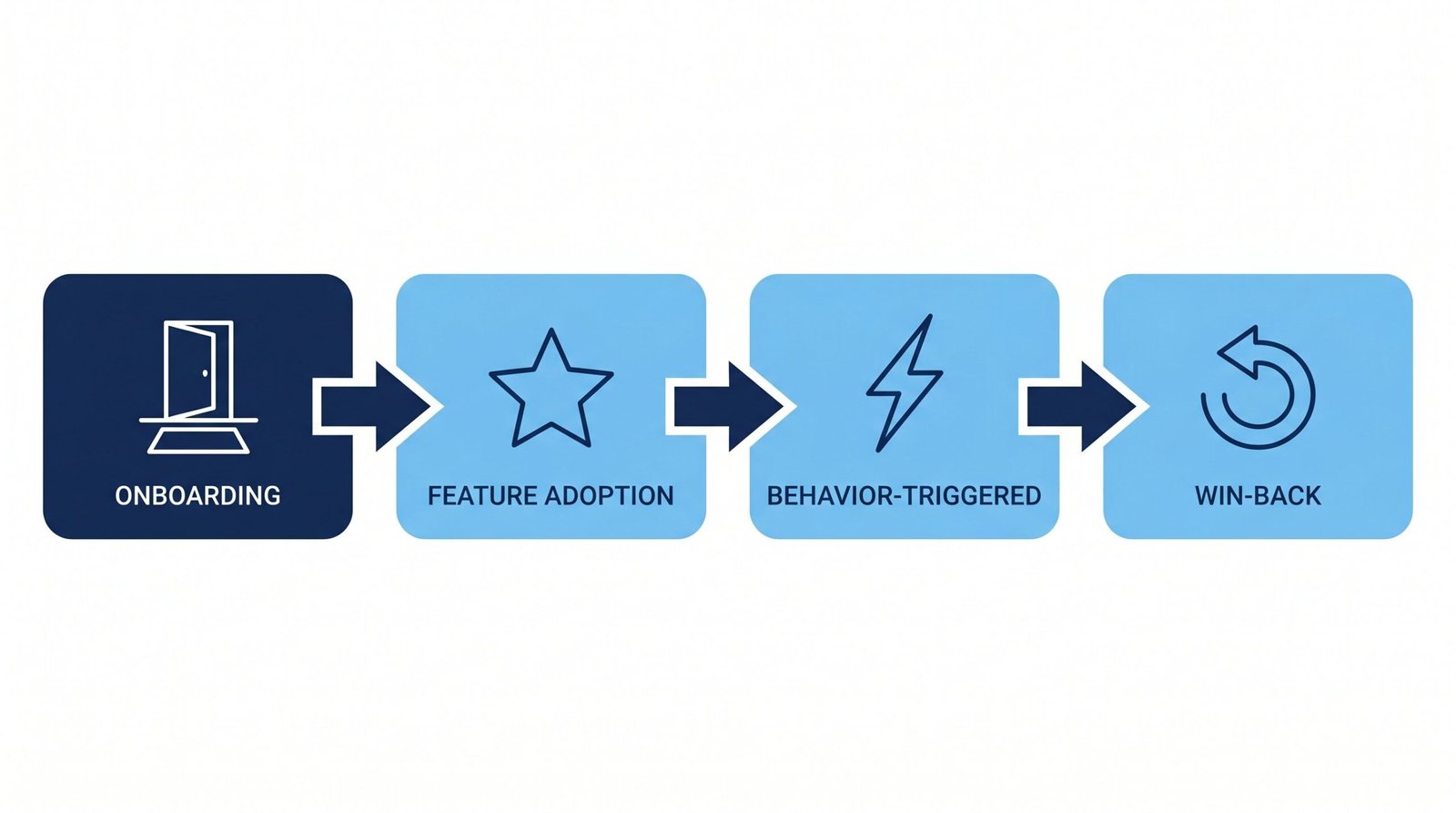
Email marketing for SaaS works when it mirrors user behavior across the customer lifecycle. The four sequences that cover that lifecycle are onboarding, nurture, expansion, and win-back. Each is triggered by an in-product event rather than a calendar date, and each has its own success metric. Get those four right and email becomes your highest-ROI channel.

I have spent the last decade running marketing for SaaS companies and freelancing for founders who were stuck on the same problem: their email program looked like a blog newsletter strapped onto a product. Updates fired into the same list. Trial users got the same emails as paying customers. The team measured success in opens. Trial-to-paid conversion sat at 2 or 3 percent and nobody knew why.
When I rebuild a SaaS email program, I throw out the broadcast model and replace it with four behavioral sequences. That is the framework this guide walks through, with benchmarks, common mistakes, and a tooling section so you can pick the right platform the first time. If you want a practitioner to do this work for you, that is what my freelance email marketing practice exists for.
Why SaaS Email Marketing Is Different From E-commerce or Newsletter Email
E-commerce email is built around purchase intent. Newsletter email is built around content consumption. SaaS email has a harder job: it has to drive activation inside a product, prove value across recurring usage, expand accounts, and recover users who go quiet. The customer relationship is ongoing, not transactional, and the email program has to reflect that.
The practical consequence is that good SaaS email is triggered by in-product events, not by send calendars. A user signs up, an event fires, and a sequence starts. A paying user invites a third teammate, and an expansion email fires. A user has not logged in for fourteen days, and a win-back sequence starts. Calendar-based “Tuesday newsletter” sending still has a place inside nurture, but it cannot carry the program on its own.
This is also why generic open rate benchmarks mislead SaaS marketers. According to the Sona 2025 email benchmarks by industry, SaaS and technology averages 32 percent open rate, 2.8 percent click-through, and 1.8 percent conversion. Those are useful starting points, but a transactional onboarding email firing within five minutes of signup will land closer to 60 percent open, while a one-to-many product newsletter will sit in the high twenties. You need benchmarks per sequence, not per industry.
The 4-Sequence Framework for SaaS Email
Here is the framework I use as the spine of every SaaS email program I build. The four sequences cover every lifecycle stage from signup to win-back. Each one has a trigger, a timing window, a goal, and a primary metric.
| Sequence | Trigger | Timing | Goal | Key Metric | Benchmark |
|---|---|---|---|---|---|
| Onboarding | Signup or trial start | Day 0-14 | Hit the aha moment, activate | Activation rate | 40-60% open, 8-15% CTR |
| Nurture | Activated but not converted, or engaged paying user | Ongoing, weekly to bi-weekly | Maintain engagement, push conversion | Click-to-open rate | 30-40% open, 6-8% CTOR |
| Expansion | In-product event signaling upgrade fit (plan limit, team size, new feature use) | Triggered, single send + follow-up | Upgrade, add seats, cross-sell | Upgrade conversion rate | 35-45% open, 3-5% conversion |
| Win-back | No login or no key action for 14-30 days, or cancellation | 3-5 emails over 30 days | Re-engage or recover | Reactivation rate | 25-35% open, 5-10% reactivation |
Benchmarks above are aggregated from my own client work plus published data from the Sona, Mailchimp, and HubSpot industry reports referenced throughout this article. The point is not to hit the number exactly, it is to know whether a specific sequence is winning or losing.
Sequence 1 – Onboarding (getting users to the “aha moment”)
Onboarding is the single highest-leverage sequence in a SaaS email program. According to the Customer.io lifecycle marketing guide, the goal is to drive a new user to their first meaningful product result as fast as possible. Industry research suggests users who hit a key activation milestone in the first week retain 3 to 5 times better than those who do not.
The mistake most SaaS founders make here is sending a single welcome email and stopping. The second mistake is sending seven “feature tour” emails that teach the product instead of moving users toward one specific action.
What I run for clients:
- Email 1 (within 5 minutes of signup): Welcome, confirm signup, one clear CTA pointing to the single fastest path to value. No company history.
- Email 2 (Day 1, behavioral): Fires only if the activation action is not complete. Shows the feature solving the user’s job, not the feature itself.
- Email 3 (Day 3): Social proof. A short case study from a customer with a similar use case, plus an alternative path in (book a 15-minute setup call, watch a 3-minute quickstart).
- Email 4 (Day 5): Feature discovery. Surface a secondary feature that correlates with retention based on your usage data.
- Email 5 (Day 7): Mid-trial momentum. Show what they have done and what is still unlocked.
- Email 6 (Day 10): Loss aversion. “You will lose access to [report they built] when your trial ends.” Concrete artifacts beat feature lists.
- Email 7 (Day 13, trial-end): One CTA: upgrade. Add an incentive only if the data shows it lifts conversion.
Two rules from experience. First, behavioral exclusions matter more than copy. If a user has already done the action an email is prompting, suppress that email or send a different one. Second, define one activation metric for the whole program (first project created, first integration connected, first invoice sent) and tie every onboarding email to it.
Sequence 2 – Nurture (keeping engaged users moving toward conversion)
Nurture is for the in-between users. Trial users who activated but have not paid. Free-plan users using the product but not upgrading. Paying customers you want to keep engaged. A good nurture sequence is segmented by lifecycle stage and behavior, then layered with content that pulls users toward the next step.
The benchmark to watch here is click-to-open rate, not open rate. Apple Mail Privacy Protection inflates opens by 15 to 25 percentage points across most lists, as HubSpot’s 2025 email benchmarks guide notes, which makes CTOR the more reliable engagement signal. For SaaS, HubSpot cites an average CTOR of 6.81 percent (drawn from MailerLite data). A nurture sequence below 5 percent CTOR usually has a relevance problem rather than a creative problem.
What works in nurture:
- Segmented newsletter: Same shell, different content blocks by segment. Power users get advanced tips. Free users get upgrade-adjacent content. Enterprise users get security and scale stories.
- Educational series: A finite, 4 to 6 email course tied to a job your product solves. Higher engagement than open-ended newsletters because there is a beginning and an end.
- Behavioral nudges: “You haven’t tried X yet” emails triggered by usage gaps, not calendar dates.
- Case studies: One per month, mapped to a segment. Specifics about the company, the problem, the configuration, and the result.
If you are pairing nurture with other channels (paid retargeting, in-app, organic content), make sure the segmentation logic is shared. I cover the broader system on my page about marketing automation for small business, but the core principle is the same: behavioral data feeds the email program, the email program feeds the other channels, and none of them run in silos.
Sequence 3 – Expansion (upsell/cross-sell to paying customers)
Expansion is where most SaaS email programs leave money on the table. Customers are paying you, but the email program is still treating them like trial users or, worse, ignoring them. Expansion emails fire on specific in-product signals that suggest a user is ready for more.
Typical expansion triggers I configure for clients:
- Plan limit approached (e.g., 80 percent of seats used, 80 percent of API calls used, 80 percent of storage used).
- Third or fourth teammate invited (signal of team expansion).
- A feature only available on a higher plan tried via paywall, sales call, or trial flag.
- Sustained heavy usage over 60 days (signal of high LTV and upgrade readiness).
- Anniversary milestones tied to value delivered (e.g., “you have processed $2M in invoices this year”).
The copy formula is simple: name the signal, name the specific limit or pain about to hit, and offer the upgrade as the obvious next step. Avoid generic “have you considered upgrading” emails. Customers see those as sales pressure, and they unsubscribe. The Sona 2025 benchmark suggests SaaS unsubscribe rates around 0.12 percent are healthy. Bad expansion email pushes that number up fast.
Cross-sell sits inside the same sequence for multi-product companies. A user who has bought your core product and is showing usage in an adjacent area is a near-zero-cost cross-sell opportunity. The trigger is the in-product behavior, not the calendar.
Sequence 4 – Win-back (re-engaging churned or inactive users)
Win-back covers two distinct populations: inactive users (still on the list, not using the product) and churned users (canceled or downgraded). The strategies differ.
For inactive users, the trigger is usage drop, not cancellation. I usually set this at no login for 14 to 30 days depending on the product’s natural cadence. The sequence has three to five emails over 30 days: a check-in (“anything we can help with?”), a value reminder (a personalized stat about what they built or did), and a clear off-ramp. The off-ramp matters. If they are not going to come back, an honest unsubscribe protects your sender reputation and your data. The same Sona benchmark above notes deliverability health and CTOR are now the metrics that matter, and inactive recipients drag both down.
For churned users, the email plays out over a longer arc. Day 1 after cancellation is an exit survey, sent as a personal-looking plain-text email. Day 7 is a thank-you with the door left open. Day 30, 60, and 90 are checking back in with new features or use cases that map to their original problem. The Customer.io product-led growth guide on lifecycle marketing for PLG makes the case bluntly: a 5 percent improvement in retention can drive 25 percent more revenue. Win-back is one of the cheapest places to find that 5 percent.
Choosing the Right Email Tool for SaaS
The tooling decision is where SaaS founders get stuck. Mailchimp and HubSpot are the defaults most teams reach for. They work for broadcasts and content emails. They struggle with behavioral triggers based on in-product events.
Here is the practical decision tree I use with clients:
- Pre-product-market-fit, very small list, no engineering bandwidth: Loops, MailerLite, or ConvertKit. Simple, cheap, fine for the first 90 days. You will outgrow them.
- Post-PMF, behavioral triggers needed, dedicated marketer: Customer.io, Vero, or Encharge. These were built for SaaS lifecycle email. They ingest product events natively and let you build segments off in-product behavior.
- You also need in-app messaging and live chat: Intercom. Heavier and more expensive, but the integrated in-app plus email plus support flow is hard to replicate.
- Marketing-led SaaS with heavy content and a sales team: HubSpot. Good for nurture, weaker on product-event triggers. Often paired with a behavioral tool for lifecycle emails.
- Engineering-led, custom-everything: Postmark or SendGrid for transactional plus Customer.io for marketing. Two systems, clean separation.
The mistake to avoid is building your whole program on a tool that cannot receive product events. If your email tool does not know what users are doing in your product, you cannot run the 4-sequence framework. Either pick a behavioral platform from the start or budget the engineering time to pipe events into a general ESP.
SaaS Email Marketing Benchmarks (with data citations)
Benchmarks vary by source and methodology. The most credible recent numbers I see consistently cited are:
- Open rate (SaaS): 32 percent per the Sona 2025 industry benchmark; 38.14 percent per ActiveCampaign data cited in HubSpot’s 2025 benchmarks guide; 38 percent per Mailchimp’s SaaS and technology slice. Apple MPP inflation accounts for roughly 15 to 25 points across all of these.
- Click-through rate (SaaS): 1.19 percent per ActiveCampaign data via HubSpot; 2.8 percent per Sona; 2.7 percent per Mailchimp benchmark data. CTR varies more by email type than industry, with onboarding emails commonly hitting 10 percent or higher.
- Click-to-open rate (SaaS): 6.81 percent per MailerLite data cited by HubSpot; 7.1 percent per Mailchimp’s SaaS slice. This is the metric I push clients to track instead of open rate.
- Conversion rate (SaaS email): 1.8 percent average per Sona, with a wider 5 to 7 percent range cited by Keevee for SaaS. Triggered sequences run materially higher than broadcasts.
- Unsubscribe rate (SaaS): 0.12 to 0.14 percent per Sona and ActiveCampaign data. Anything above 0.5 percent on a single send is a signal worth investigating.
- Bounce rate (SaaS): 0.5 to 0.66 percent per SalesHive and ClickDimensions data. Above 2 percent risks sender reputation.
I treat these as a sanity check, not a target. The more useful comparison is your sequence-by-sequence performance against itself over time. An onboarding sequence that hit 12 percent CTR last quarter and 8 percent this quarter has a problem the industry average will not surface.
Common Mistakes That Kill SaaS Email Performance
From auditing SaaS programs over the past few years, the same six mistakes show up over and over:
- Treating email as a broadcast channel. Same email to free users, trial users, paying users. The unsubscribe rate tells you immediately when this is happening.
- Time-based onboarding instead of behavior-based. “Day 3: feature tour” gets sent to everyone, including users who have already mastered the feature. Behavioral triggers are 3 to 4x more effective in my experience.
- No activation metric. If you cannot name the one action that predicts retention, your onboarding sequence is guessing. Pick the metric, instrument it, then build emails around it.
- Optimizing for open rate. Post-MPP, open rate is a vanity number. CTOR, conversion rate, and downstream product actions matter.
- Tool sprawl. Marketing in Mailchimp, transactional in Postmark, in-app in Intercom, lifecycle stitched together with Zapier. Pick fewer tools, integrate them properly.
- No win-back. Most SaaS programs stop at conversion. Win-back is the cheapest revenue lever you have and almost nobody runs it well.
How Email Fits Into the Larger SaaS Marketing Mix
Email is the connective tissue of a SaaS marketing program, not the whole program. It works best when it is fed by other channels (search, content, paid) and feeds them back. If your acquisition is light, no email program will save you, which is why I also write about SaaS SEO strategy as the upstream input. If your activation is broken inside the product, no email will fix that either; the product team has work to do first.
The right way to think about it: email is the lifecycle layer. It runs alongside the product to push users through stages they would otherwise stall in. When that layer is missing, founders see acquisition without retention. When it is working, the same acquisition spend compounds into significantly more revenue.
A Soft Note If You Want Help
If you are building out a SaaS email program and want a practitioner to set it up or audit what you have, I am happy to talk through your specific situation. I have run this 4-sequence framework for SaaS companies from pre-revenue through Series B, and the audit alone usually surfaces the two or three sequences that are leaking the most revenue. Reach out here and we can take a look together.
Frequently Asked Questions
What is the best email marketing tool for SaaS?
For most SaaS teams past product-market fit, a behavioral tool like Customer.io, Vero, or Intercom outperforms a general ESP because it triggers emails off in-product events. Early-stage SaaS with simple lifecycles can start in HubSpot, ActiveCampaign, or Loops and migrate later.
What is a good open rate for SaaS email marketing?
Industry data places the SaaS average open rate around 32 to 38 percent according to Sona and HubSpot, with Mailchimp benchmark data nearer 38 percent. Triggered transactional and onboarding emails typically clear 50 to 60 percent. Apple Mail Privacy Protection inflates raw opens by 15 to 25 points, so click-to-open rate is a more reliable signal.
How many onboarding emails should a SaaS company send?
Five to seven emails over the first 14 days is the range I see work consistently. The exact cadence matters less than tying each email to an in-product milestone (signup, first key action, aha moment, second use, trial end) rather than a fixed calendar.
How is SaaS email marketing different from B2B email?
B2B email typically nurtures a lead toward a sales conversation. SaaS email runs the full customer lifecycle: it has to drive activation inside a product, support expansion, and prevent churn. The triggers come from in-product behavior, not just marketing form fills.
What is the aha moment in SaaS onboarding?
The aha moment is the first time a user experiences the core value of your product, like sending a first invoice in an accounting tool or running a first report in an analytics product. Onboarding emails should drive users to that moment as fast as possible.
What is a healthy unsubscribe rate for SaaS?
Under 0.5 percent per send is healthy, and the Sona 2025 benchmark for SaaS sits near 0.12 percent. Anything climbing above 0.5 percent usually points to a list-content mismatch or frequency problem rather than a creative issue.
Should SaaS companies send newsletters?
Yes, but only as part of the nurture sequence and segmented by lifecycle stage. A blanket weekly newsletter to free, trial, and paying users typically underperforms a segmented nurture flow tied to user behavior.
Recent Comments