
B2B Copywriting: What It Is, Types, and When to Hire a B2B Copywriter

Most B2B copy reads like it was written by someone who has never sat in on a sales call. It’s stuffed with feature lists, generic “solutions” language, and the same five adjectives every competitor uses. The buyer reads it, feels nothing, and clicks away.
That’s the actual problem. Not tone, not SEO, not headline formulas. The problem is that most B2B copywriters have never heard a real prospect explain why they almost didn’t buy, or what they were quietly worried about when they signed the contract. When I look at a B2B company’s copy and I can’t tell what the buyer is actually scared of, I know the copy isn’t going to convert.
This guide is for the people writing the checks, not the people writing the words. If you’re a founder, marketing lead, or operator deciding whether to invest in B2B copywriting, which types matter most, and how to hire someone who will actually move your pipeline numbers, this is the deep dive.
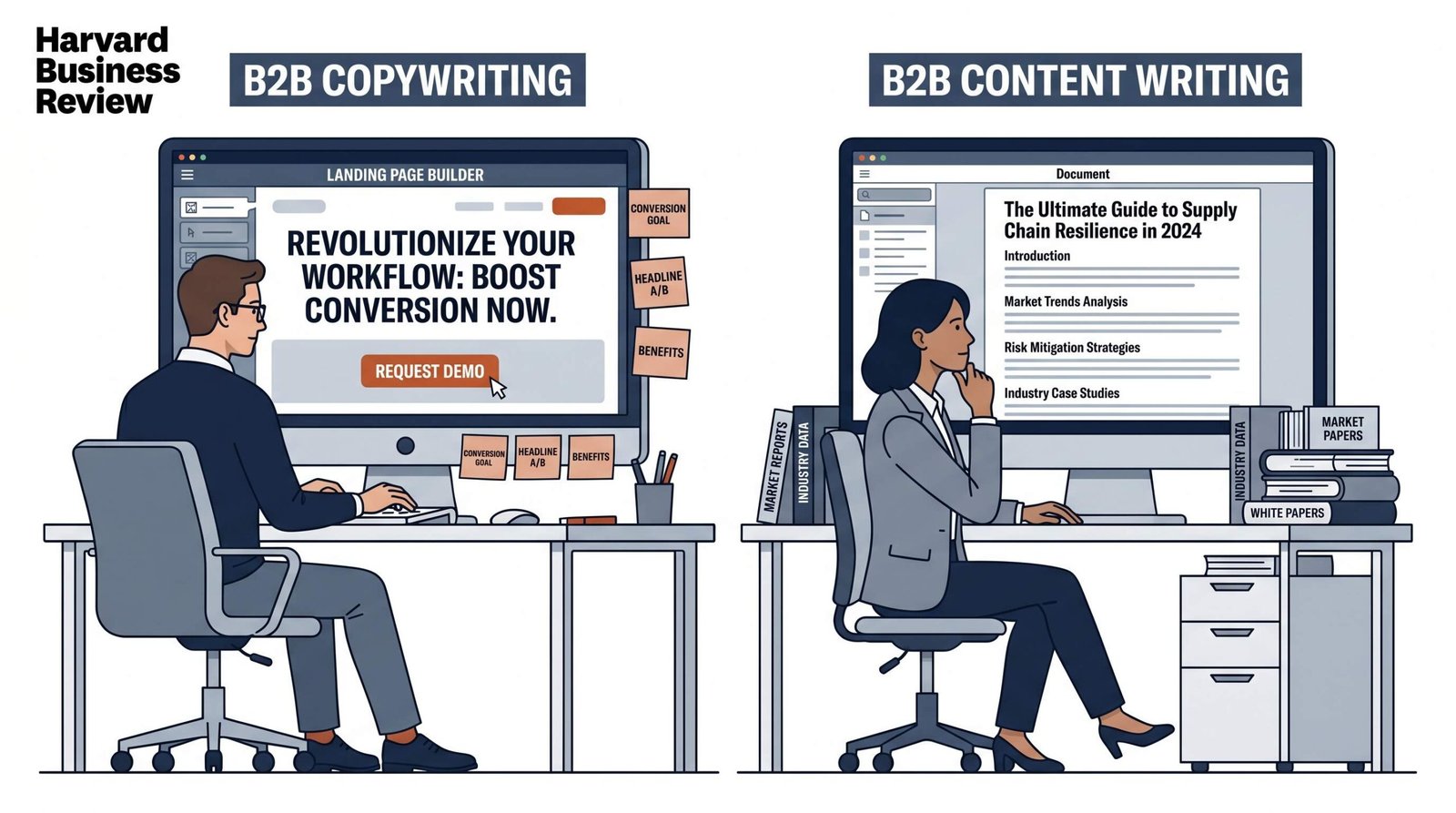
B2B copywriting is persuasive writing aimed at business buyers and designed to drive a specific action: a demo booked, a trial started, a meeting accepted, a contract signed. Unlike B2B content writing, which educates over time to build trust and rankings, B2B copy is direct response writing. Good B2B copy is built on real buyer research and tied to measurable revenue outcomes.
B2B Copywriting vs. B2B Content Writing: What’s the Difference?
The fastest way to waste budget in B2B marketing is hiring the wrong type of writer for the job in front of you. A content writer asked to write a sales page will produce a 1,800-word essay with a CTA stapled to the end. A copywriter asked to write a thought leadership piece will give you 600 words of punchy hooks that won’t rank for anything.
The simple distinction I use with clients: B2B content writing builds awareness, trust, and search visibility over months and years. B2B copywriting drives a specific action right now. They work together, but they are different disciplines with different success metrics and different rate cards.
Most B2B companies I work with need both. Content brings the buyer in the door. Copy closes them. Skipping either side of that equation is how marketing budgets quietly underperform for years.
| Aspect | B2B Copywriting | B2B Content Writing |
|---|---|---|
| Primary Purpose | Convert a reader into a buyer, lead, or signup | Build trust, authority, and organic search traffic |
| Tone | Direct, persuasive, outcome-focused | Educational, analytical, helpful |
| Output Examples | Landing pages, sales emails, ad copy, sales decks, product pages | Blog articles, guides, white papers, ebooks, newsletters |
| Success Metric | Conversion rate, demo bookings, pipeline created, revenue influenced | Organic traffic, time on page, backlinks, MQLs over 90+ days |
| Typical Project Cost | $800 to $6,000 per project (one landing page, one email sequence) | $0.40 to $1.50 per word, or $400 to $2,500 per article |
| Timeline to ROI | Days to weeks (you can measure conversions immediately) | 3 to 12 months (compounds with publishing volume) |
If you’re trying to fix a launch that flopped or a pricing page that isn’t converting, you need a copywriter. If you’re trying to be the company a buyer thinks of in 14 months when they’re ready to switch vendors, you need B2B content writers publishing consistently. Most companies under-invest in copywriting because content writing has a clearer SEO story attached to it. That’s a mistake. A landing page that lifts conversion by two points often pays for itself in the first week.
The 7 Types of B2B Copywriting Every Business Should Know
B2B copywriting isn’t one job. It’s seven different disciplines, and very few writers are excellent at all of them. When I scope projects with clients, the first question is which of these we’re actually solving for, because the writer, the rate, and the brief look different for each one.
1. Landing Pages and Conversion Copy
A landing page exists to do one thing: convert a specific traffic source into a specific action. Demo requests, trial signups, gated downloads, event registrations. Good B2B landing pages are built around a single, urgent buyer problem and prove the case with specifics: numbers, names, quotes from real customers in the buyer’s industry.
What good looks like: A landing page that reads like it was written for one specific persona, leads with the outcome the buyer cares about, includes three to five proof points pulled from real customer interviews, and asks for one action.
What mediocre looks like: A generic “Welcome to [Product]” hero, a features list, a wall of logos, and a contact form that asks for 12 fields. I see this maybe four times a week.
2. Sales Emails and Cold Outreach Sequences
Cold email is a high-volume game where copy quality is the difference between a 1% reply rate and an 8% reply rate. The math on that gap is significant. According to Mailchimp’s email marketing benchmarks, B2B average open rates sit around 32% across most industries, but reply rates on cold outreach are far lower and far more sensitive to the copy itself.
What good looks like: Short emails (under 90 words), a specific reason for the outreach tied to the prospect’s company, a soft ask, and no jargon. Each email in the sequence has one job.
What mediocre looks like: “I hope this email finds you well.” Three paragraphs of company background. A calendar link before any value has been offered.
3. Case Studies
Case studies are arguably the most under-resourced asset in B2B marketing. They’re treated like a content task and given to a junior writer with a template, when they should be treated as conversion-grade sales collateral. A great B2B case study moves deals through middle-of-funnel faster than any other asset I’ve seen.
What good looks like: A specific business outcome in the headline (real numbers), a real before-state with friction the buyer recognizes, a clear narrative arc, and quotes that sound like a human said them out loud.
What mediocre looks like: “Acme Corp Achieves Success with [Product].” Three vague stats with no methodology. A quote from the buyer that reads like marketing wrote it.
4. White Papers
White papers blur the line between content and copy. They’re long-form, but they exist to move enterprise buyers through a specific stage of the funnel. The good ones are research-backed, opinionated, and gated behind a form that delivers actual sales-qualified leads.
What good looks like: A defensible point of view, primary research or proprietary data, and a clear thesis a senior buyer would share internally.
What mediocre looks like: A summary of publicly available statistics with the company logo on the cover.
5. Product and Service Pages
Product pages are where most B2B websites quietly bleed conversions. They’re written by product marketing teams who know the product too well and forget what the buyer doesn’t know. The job of a product page is to translate features into outcomes the buyer’s boss will care about.
What good looks like: A clear answer to “what does this do for me?” within five seconds, social proof from buyers in the same industry, and copy that maps every feature to a job the buyer is trying to get done.
What mediocre looks like: A feature matrix without context, three rotating customer logos with no quotes, and a CTA that says “Learn More.”
6. LinkedIn and Social Copy
B2B social copy has its own physics. LinkedIn rewards punchy, opinionated, story-driven posts that get saved and reshared. Most B2B brands write LinkedIn copy that sounds like a press release because the same person who writes the website is writing the social feed.
What good looks like: A hook in the first two lines, a single insight or story, a clear takeaway, and a tone that sounds like a person, not a brand.
What mediocre looks like: “We’re excited to announce…” followed by a link and four hashtags.
7. Sales Decks and Proposal Copy
Sales decks are the most expensive copy in any B2B company because they’re sitting in the room when six-figure deals close or stall. Yet they’re almost always written by the sales team in a hurry. A good B2B copywriter rewriting a sales deck can change close rates measurably within a quarter.
What good looks like: A clear story arc (problem, stakes, solution, proof, next step), language that mirrors how the buyer talks about their problem, and zero stock photography.
What mediocre looks like: An “About Us” slide in slot two. A feature list in slot four. A pricing slide with no anchor.
| Type | Primary Goal | Best Used When | Typical Freelance Cost Range |
|---|---|---|---|
| Landing Page | Convert paid or organic traffic into a defined action | Launching a campaign, fixing a poor-performing page | $1,200 to $5,000 per page |
| Sales Email Sequence | Book meetings from cold or warm lists | Building outbound motion or fixing low reply rates | $800 to $3,500 per 5-email sequence |
| Case Study | Move mid-funnel buyers toward decision | Closing more SQLs, supporting sales team | $1,200 to $3,000 per case study |
| White Paper | Generate qualified leads in enterprise sales cycles | Selling to enterprise, long sales cycles | $3,000 to $10,000 per paper |
| Product or Service Page | Convert direct traffic and search visitors | Refreshing core site copy, repositioning | $1,500 to $6,000 per page |
| LinkedIn or Social Copy | Build founder or company brand presence | When the founder is the brand and pipeline source | $1,000 to $4,000 per month, ghostwritten |
| Sales Deck | Improve close rates on active opportunities | When deals are stalling at proposal stage | $2,500 to $8,000 per deck |
What Good B2B Copywriting Actually Looks Like (Most Gets This Wrong)
Here’s the pattern I see in nearly every B2B website I audit: the copy could be lifted off the page, dropped onto a competitor’s site, and nobody would notice. Same adjectives (“innovative,” “scalable,” “industry-leading”), same value propositions, same vague promises. The buyer reads three sites in a row and remembers none of them.
The reason is specificity, or rather, the absence of it. Mediocre B2B copy is feature-focused because features are easy to write about. The product team gives you a list, you turn the list into bullet points, and you ship the page. Good B2B copy is outcome-focused, which is harder because it requires understanding what the buyer is actually trying to achieve and what’s stopping them.
Lead with Business Outcomes, Not Product Features
Here’s a real example I worked on last year. A SaaS company selling employee onboarding software had a homepage hero that read: “Automated workflows for modern HR teams.” That’s a feature description dressed up as a value proposition. It tells you nothing about why a buyer should care.
We rewrote it to: “Cut new hire ramp time from 90 days to 45 without adding headcount.” Same product, completely different sentence. The first version describes the software. The second version describes the outcome the buyer’s CEO wants. Demo requests on the homepage roughly doubled in the following quarter, and the conversion lift held.
The framework I use: every claim in B2B copy needs to answer “so what does that mean for the business?” If “automated workflows” means “less time onboarding,” and “less time onboarding” means “new hires are productive faster,” and “productive faster” means “lower cost per hire and faster revenue contribution,” then the headline should be about the cost or the revenue, not the automation.
Voice-of-Customer Research Separates Good from Average
The single biggest difference between a B2B copywriter who delivers and one who doesn’t is whether they do real customer research before writing. Not a kickoff call with the marketing team. Actual interviews with five to ten of your customers, ideally including some who almost didn’t buy and some you lost.
What you’re listening for in those interviews: the words and phrases the buyer used to describe the problem, the moment they decided they needed a solution, what they were quietly worried about, what almost stopped them, and what made them confident in the end. Those quotes become the headlines, the subheads, the objection-handling sections, the proof points.
In my experience, the writers who skip this step produce copy that sounds like the marketing team thinks the product should sound. The writers who do this step produce copy that sounds like your best customer describing why they buy. Those two things are not the same, and the second one converts.
Before and After: Three Mini-Examples
Example 1 (SaaS):
Weak: “Our platform leverages AI to streamline your sales operations and boost productivity.”
Strong: “Sales reps at companies using our platform spend 6 hours less per week on CRM data entry. That’s 240 hours a year back per rep, going toward actual selling.”
Example 2 (Professional Services):
Weak: “We offer comprehensive financial advisory services for growing businesses.”
Strong: “We work with founders running $5M to $50M businesses who hit the wall every founder hits: the books are messy, the cash flow is unpredictable, and the next round of investors will not tolerate either. We fix both within 90 days.”
Example 3 (Consulting):
Weak: “Our experienced consultants help organizations achieve their transformation goals.”
Strong: “Most transformation initiatives stall at the same place: the operating model never actually changes. We embed for 12 weeks with your leadership team and we don’t leave until the new model is running on its own.”
The strong versions are not stylistic upgrades. They’re research-driven specificity. Every detail (the hours, the revenue band, the 12-week timeline) was pulled from buyer interviews. That’s the work.
B2B Copywriting Rates: What to Expect in 2026
B2B copywriting rates have a wider spread than almost any other professional service. You can hire a freelancer for $0.30 a word on a content marketplace, or pay $50,000 for a senior conversion copywriter to rewrite your product page. Both will deliver a deliverable. Only one will move the metric.
The actual cost driver isn’t quality alone. It’s how much the writer’s work is tied to a measurable business outcome, how senior they are, how niche your industry is, and how strategic the asset is. A homepage at a $20M ARR SaaS company should not be a $400 project. A $400 blog post might be appropriate, depending on the content.
| Copy Type | Freelance Range | Agency Range | Best Use Case |
|---|---|---|---|
| Homepage Copy | $2,500 to $8,000 | $8,000 to $25,000 | Repositioning, fundraising, major product shift |
| Product or Service Page | $1,500 to $6,000 | $5,000 to $15,000 | Underperforming pages, new launches |
| Landing Page | $1,200 to $5,000 | $4,000 to $12,000 | Paid campaigns, lead magnets, event registration |
| Sales Email Sequence (5 emails) | $800 to $3,500 | $3,000 to $10,000 | Outbound sales, nurture, re-engagement |
| Case Study | $1,200 to $3,000 | $3,000 to $6,500 | Sales enablement, mid-funnel content |
| White Paper or Research Report | $3,000 to $10,000 | $8,000 to $30,000 | Enterprise lead gen, thought leadership |
| Sales Deck | $2,500 to $8,000 | $6,000 to $20,000 | Improving close rates on active deals |
| Monthly Retainer | $3,000 to $12,000/month | $8,000 to $30,000/month | Ongoing copy needs, embedded support |
What Drives Price Variation
Three factors move rates more than anything else. First, industry expertise. A copywriter who has written for fintech, healthcare, or cybersecurity for years will charge more, and that premium is usually worth it because you skip the ramp-up. Second, the strategic depth of the engagement. A writer who runs the customer interviews, builds the messaging framework, and writes the copy is doing three jobs and should be paid accordingly. Third, turnaround time. Rush work commands a 30 to 50% premium, and you don’t want a rushed sales page anyway.
Where B2B Companies Get the Most ROI from Copy Spend
If a client asked me where to put their first $10,000 in copywriting budget, my answer is almost always the same. We suggest fixing the highest-traffic page that isn’t converting (usually the homepage or a core product page), then rewriting the first cold email sequence that sales is running, then producing two or three case studies that map to your highest-value buyer personas.
That sequence works because each piece is measurable, each compounds on the others, and each one is fixable inside a quarter. Spending the same money on a quarterly white paper or a brand refresh might be the right call later, but it rarely pays back as quickly. For broader context on where marketing dollars perform, HubSpot’s marketing statistics consistently show that conversion-focused assets and case studies outperform general brand content on most pipeline metrics.
If you’re a software company specifically, the calculus is slightly different. A B2B SaaS copywriter who knows your funnel, your free-to-paid conversion rate, and your activation metrics is going to deliver a different kind of value than a generalist. Same goes for content marketing for SaaS, which has its own playbook around product-led growth, lifecycle emails, and customer education that doesn’t transfer cleanly from other B2B verticals.
How to Hire a B2B Copywriter: What I Look For
I’ve been on both sides of this. I’ve been the freelancer being hired and the marketing lead doing the hiring. The pattern that separates the writers who deliver from the ones who don’t shows up in three places: their portfolio, the brief you give them, and the way they answer a few specific questions in the first call.
Portfolio Red Flags
When I look at a copywriter’s portfolio, I’m looking for a few specific things to avoid.
Red flag one: Every sample looks the same. Same hero structure, same three-column features grid, same testimonial layout. That tells me they have a template, not a process. Real B2B copy looks different on a sales-led enterprise deal than on a self-serve SaaS signup, and a senior writer will show you that range.
Red flag two: No outcomes attached to the work. If the case studies in their portfolio say “wrote a landing page for X company” and don’t mention what happened to conversion, demos, signups, or revenue, they probably don’t track that, which means they don’t think about it. Skip.
Red flag three: The writing reads like AI output dressed up in adjectives. Generic openers, hedge phrases, no concrete examples, no specific customers. If the writer can’t write specifically about their own work, they can’t write specifically about yours.
Red flag four: No B2B in the portfolio at all. B2C and DTC copywriting are different jobs. Buying for yourself emotionally and buying for your company rationally are different acts, and the copy that drives them is structured differently. A writer with only consumer experience is going to have to learn on your dime.
The Brief Quality Test
Here’s the part most companies get wrong before the writer even starts: the brief determines roughly 80% of the output quality. I’ve seen brilliant writers turn in mediocre work because the brief was three sentences and a Google Doc of competitor links. I’ve seen average writers turn in great work because the brief was tight, specific, and included real customer quotes.
A good B2B copy brief includes: the single action the copy needs to drive, the specific persona (not “marketers” but “VP of Marketing at $20M to $100M ARR SaaS companies who own pipeline targets”), the buyer’s actual words from real interviews, the competitive context, the proof points available, and what success looks like measurably. If you can’t write that brief, the writer can’t write the copy. That’s not a writer problem.
Four Screening Questions That Reveal Real Skill
When I interview copywriters, I have a short list of questions that surface the difference between people who can write words and people who can move metrics.
1. Walk me through how you start a project. Listen for whether they mention customer research. If they jump straight to writing or competitor reviews, they’re missing the most important step.
2. Tell me about a project where the copy didn’t work, and what you did about it. Strong writers know which of their work underperformed and why. Weak writers tell you everything they’ve ever written was successful.
3. How do you handle a brief that’s incomplete or vague? Senior writers push back, ask for customer interviews, or build the missing pieces themselves. Junior writers ship whatever the brief says.
4. What’s the difference between a feature and an outcome, in your own words? This sounds basic. It will tell you in 30 seconds whether the writer thinks like a marketer or just a wordsmith.
If you’re at the point where you’re seriously considering bringing someone in, the practical mechanics of how to hire a freelance writer matter as much as the screening: scoping the project properly, structuring payment around milestones, and setting up the review process so revisions don’t drag for weeks. The buyer’s side of the engagement is usually where things get expensive, not the writing side. If you’d rather skip the search entirely and hire a freelance copywriter who already works this way, that’s an option too.
Frequently Asked Questions
What is B2B copywriting?
B2B copywriting is persuasive writing aimed at business buyers and built to drive a specific commercial action, like a demo booked, a trial started, a meeting accepted, or a contract signed. It includes landing pages, sales emails, product pages, case studies, sales decks, and any other asset where the goal is conversion rather than education or entertainment. Good B2B copy is grounded in real buyer research and written to be measured against revenue outcomes, not vanity metrics. It’s a specialized discipline within marketing that sits closer to the sales process than most other writing functions.
What is the difference between B2B copywriting and B2B content writing?
B2B copywriting drives a specific action right now: a click, a signup, a demo request, a closed deal. B2B content writing builds trust, search rankings, and authority over weeks and months, usually through blog articles, guides, and educational content. The two work together, but they have different success metrics, different rate cards, and usually different writers. A landing page is copy. A 2,000-word guide on how to evaluate a vendor in your category is content. Most companies need both, but they should be scoped, briefed, and measured separately.
How much does a B2B copywriter charge?
Freelance B2B copywriters typically charge between $800 and $8,000 per project depending on the asset, with high-value work like homepage rewrites, sales decks, and white papers at the top of the range. Hourly rates for freelancers usually run $100 to $300, and senior conversion specialists can charge $400 an hour or more. Agencies usually charge two to four times what freelancers do for the same deliverable, which is sometimes justified by depth of strategy and sometimes not. The biggest cost driver isn’t the writing itself but how much customer research, messaging strategy, and revision the engagement includes.
Do B2B copywriters need to understand my specific industry?
Mostly yes, especially in regulated or technically complex industries like fintech, healthcare, cybersecurity, or industrial software. A writer who already knows your category skips the ramp-up and produces stronger work in the first draft. That said, a senior generalist with strong research skills can come up to speed on a new industry within a project or two, and they often see your category more clearly than someone who has been in it for a decade. We suggest weighing industry depth against research process: a writer who interviews five of your customers in week one will get up to speed faster than you’d expect.
Should I hire a B2B copywriter or a B2B content writer?
The question to ask yourself is what you’re trying to fix or build. If you have a conversion problem (low demo bookings, weak landing pages, a homepage that isn’t generating leads), you need a copywriter. If you have an awareness or organic traffic problem and your sales cycle is long enough that compounding content makes sense, you need a content writer. Most B2B companies need both, but rarely from the same person. We suggest starting with whichever discipline maps to your most urgent revenue problem and building from there.
What type of B2B copy should I invest in first?
For most B2B companies, the first dollar should go to the highest-traffic page on the site that isn’t converting, which is usually the homepage or a primary product page. After that, fixing the first cold email sequence sales is running is often the next highest-leverage move because it compounds across every outbound prospect you touch. Case studies come third, since they sit in the middle of the funnel and help close deals already in motion. White papers, blog content, and brand-level work are usually better second-year investments once the conversion fundamentals are working.
The Bottom Line on B2B Copywriting
Good B2B copy pays for itself fast when it’s specific, tied to business outcomes, and built on real buyer research. The companies that get this right treat copy as a measurable revenue lever and hire accordingly. The companies that don’t treat it as a checkbox and wonder why their conversion numbers stay flat year after year.
If you’re working through B2B copy or content strategy and want to talk it through with someone who has been on both sides of the brief, you can reach out via ianadair.com. I work with SMBs and SaaS companies on the messaging, the assets, and the systems that turn copy into pipeline. Happy to take a look at what you’re working on.
Recent Comments