
How to Hire a Freelance Copywriter: A Complete Guide for Businesses
To hire a freelance copywriter, define your project scope and target audience, find candidates through specialized platforms or referrals, evaluate their portfolio for measurable results, run a small paid test project, and write a detailed creative brief. The quality of your brief determines the quality of your copy more than any other factor, so businesses that master briefing get dramatically better results from the same copywriter.

Most businesses approach copywriter hiring as a sourcing problem. They scour platforms, collect bids, review portfolios, and pick the candidate with the cleanest samples. Then the copy underperforms, and they blame the writer.
After 15 years building marketing programs for businesses across SaaS, e-commerce, professional services, and B2B, I can tell you the sourcing decision matters far less than people think. The real variable, the one that separates copy that converts from copy that gets ignored, is the brief you hand the writer on day one. A skilled copywriter working from a vague brief produces vague copy. The same copywriter, given a precise brief that names the audience, the objection, and the desired action, produces work that moves the metrics that matter.
This guide walks through the full hiring process, from finding qualified candidates to setting up a productive working relationship. I’ll cover rates, portfolio evaluation, test projects, and the briefing framework I use with every copywriter I bring onto a client engagement.
What to Look for in a Freelance Copywriter
Before you start sourcing, decide what kind of writer you actually need. The copywriting market is fragmented into specializations that look similar from the outside but require genuinely different skills.
Specialization vs. Generalist: Which Do You Need?
A B2B SaaS copywriter who has written 200 product pages for engineering tools thinks differently than an e-commerce copywriter who has written 5,000 product descriptions for fashion brands. Both are excellent at their jobs. Neither would do the other’s work well without a steep learning curve.
The major specializations you’ll encounter include:
- Conversion copywriters who focus on landing pages, sales pages, and high-stakes pages where the metric is conversion rate
- Email copywriters who write nurture sequences, welcome flows, and broadcast campaigns
- Long-form content writers who produce blog posts, white papers, and pillar pages for SEO and thought leadership
- Product description writers who specialize in e-commerce and can produce at scale
- Brand and tone writers who shape voice guidelines, taglines, and brand-level messaging
A copywriter with a 5-year track record in your specific industry is worth significantly more than a generalist with broad experience across categories. To identify true specialization, look beyond the “I write for SaaS” claim on a homepage. Ask which products, which audience segments, which funnel stages. A specialist will name competitors, describe buyer personas without prompting, and recognize the messaging conventions of your category.
Portfolio Red Flags and Green Flags
A copywriter’s portfolio tells you more about their thinking than their finished prose. Read it for signal, not just style.
Green flags to look for:
- Case studies with measurable results: conversion rate lifts, email open rate improvements, revenue attribution, time-on-page increases
- Variety in voice across clients, which proves the writer can adapt rather than imposing their own style on every brand
- Testimonials from recognizable companies or named individuals with titles, not anonymous “Sarah M., Founder” snippets
- A clear explanation of strategy alongside each piece, showing the writer can articulate why the copy works
- Recent work, ideally within the past 12 to 18 months
Red flags that should give you pause:
- Only spec work or personal projects that were never published or tested with real audiences
- All samples in one narrow niche when applying for work outside it
- No quantified results anywhere, only subjective claims about “engaging” or “powerful” copy
- Portfolios that read like generic content rather than persuasion: pretty paragraphs that don’t ask the reader to do anything
- Inconsistent quality, where some samples are sharp and others read like first drafts
Where to Find Qualified Freelance Copywriters
Once you know what you’re looking for, the sourcing step becomes more targeted. Each channel has tradeoffs, and the best hires usually come from a mix.
Platform Hiring: Pros and Cons
Freelance platforms remain the most common starting point. The major options worth considering include Upwork for general-purpose hiring, Clearvoice and Contently for managed talent pools, Scripted for content writing at scale, and the CopyHackers job board for conversion-focused specialists.
Platforms offer volume and built-in payment protection, but they also create noise. For every qualified writer on Upwork, there are 50 generalists bidding on the same posting. To filter effectively, set hard minimums before you even read profiles:
- Minimum 4.8 stars across at least 50 completed jobs
- Job success rate above 95 percent
- A portfolio that includes published, attributable work for real companies
- Hourly or project rates in the upper third of the platform’s range for your category
The cheapest writer on a platform is almost never the most cost-effective. A copywriter charging $25 per hour will spend three times as long producing work that converts at half the rate. The math rarely favors the bargain.
Referrals and Direct Outreach
The highest-quality hires I’ve made came from referrals or direct outreach, not platforms. Ask your network, particularly other marketers and founders, who they’ve worked with and would hire again. Check LinkedIn for copywriters who post analytical content about their work, since the writers who can explain their thinking are usually the ones who think the hardest.
Look at bylines on content you admire. If a SaaS company’s blog consistently produces sharp posts that read like the writer understands the audience, find out who wrote them. Many in-house writers also take on freelance work, and a cold outreach message to someone whose published work you already respect beats any platform search for fit.
LinkedIn Boolean search is a useful tactic here. A search like ("freelance copywriter" OR "freelance writer") AND "SaaS" AND "conversion" filters to specialists with the exact background you want. Reach out with specifics about why their work caught your eye and the project you have in mind.
Marketing Agencies vs. Freelancers
Agencies offer consistency, project management, and the ability to absorb personnel changes without disrupting your timeline. They also carry overhead. You’re paying for account managers, creative directors, and administrative layers, which can mean 2x to 3x the cost for the same final copy a freelancer would produce.
For most small and mid-sized businesses, a vetted freelancer is the better choice for ongoing content work, website copy, and email campaigns. Direct access to the person doing the writing means faster iteration and clearer feedback loops. Agencies become genuinely valuable when you need rapid turnaround across multiple deliverables, when you need creative direction along with copy, or when you’re running a large campaign that requires coordination across writers, designers, and strategists.
Evaluating and Selecting Your Copywriter
You’ve shortlisted three to five candidates. Now the evaluation gets specific.
How to Read a Portfolio Critically
Most clients read portfolios for polish. They notice clean sentences, consistent voice, and pleasant rhythm. That’s the wrong lens. Read for persuasive structure instead.
Open a sample landing page and ask: Does the headline make a specific promise to a specific audience, or is it generic? Does the opening address the reader’s actual problem in their language, or does it lead with the product? Does the body anticipate and answer objections, or does it ignore them? Does the call to action make logical sense given everything before it, or does it feel arbitrary?
Then, in your interview, ask the candidate to walk you through the strategy behind one of their pieces. The answer tells you whether they wrote intuitively or with intent. “I wanted to lead with the founder’s story because the audience trusts personal narratives more than feature claims at this stage” is a real strategic answer. “I just thought it sounded good” is not.
The Paid Test Project: How to Structure It
Always pay for test projects. The best copywriters won’t work for free, and the ones who will are signaling that their time isn’t valued by other clients either. A reasonable test fee is between $150 and $400 depending on scope.
Keep the test small but real: a single 300-word landing page section, one welcome email, or a short product description. Give them an actual brief, the same one you’d use for a real project. The point isn’t just to evaluate the output, it’s to evaluate the process.
Watch what happens after you send the brief. How many clarifying questions did the writer ask? Did they push back on weak points in the brief, like a vague audience definition or a missing objection? Did they ask to see existing copy, competitor pages, or customer interviews? A copywriter who accepts a thin brief without question will produce thin copy. A copywriter who interrogates the brief before writing a word is one you want.
Red Flags in the Hiring Process Itself
Some warning signs appear in how a candidate handles the hiring conversation itself:
- They promise results without asking about your audience. Anyone guaranteeing a conversion lift before learning about your customers is selling, not consulting.
- They don’t ask for a brief or examples of current copy. A copywriter who’s ready to write without understanding context is going to default to generic.
- They quote a price before understanding scope. Real project pricing requires understanding the deliverable, the audience, the brand, and the goal. A quick quote means a quick assumption.
- They send the same pitch you’ve seen from three other writers. Generic outreach predicts generic work.
The Brief: Why This Step Determines Everything
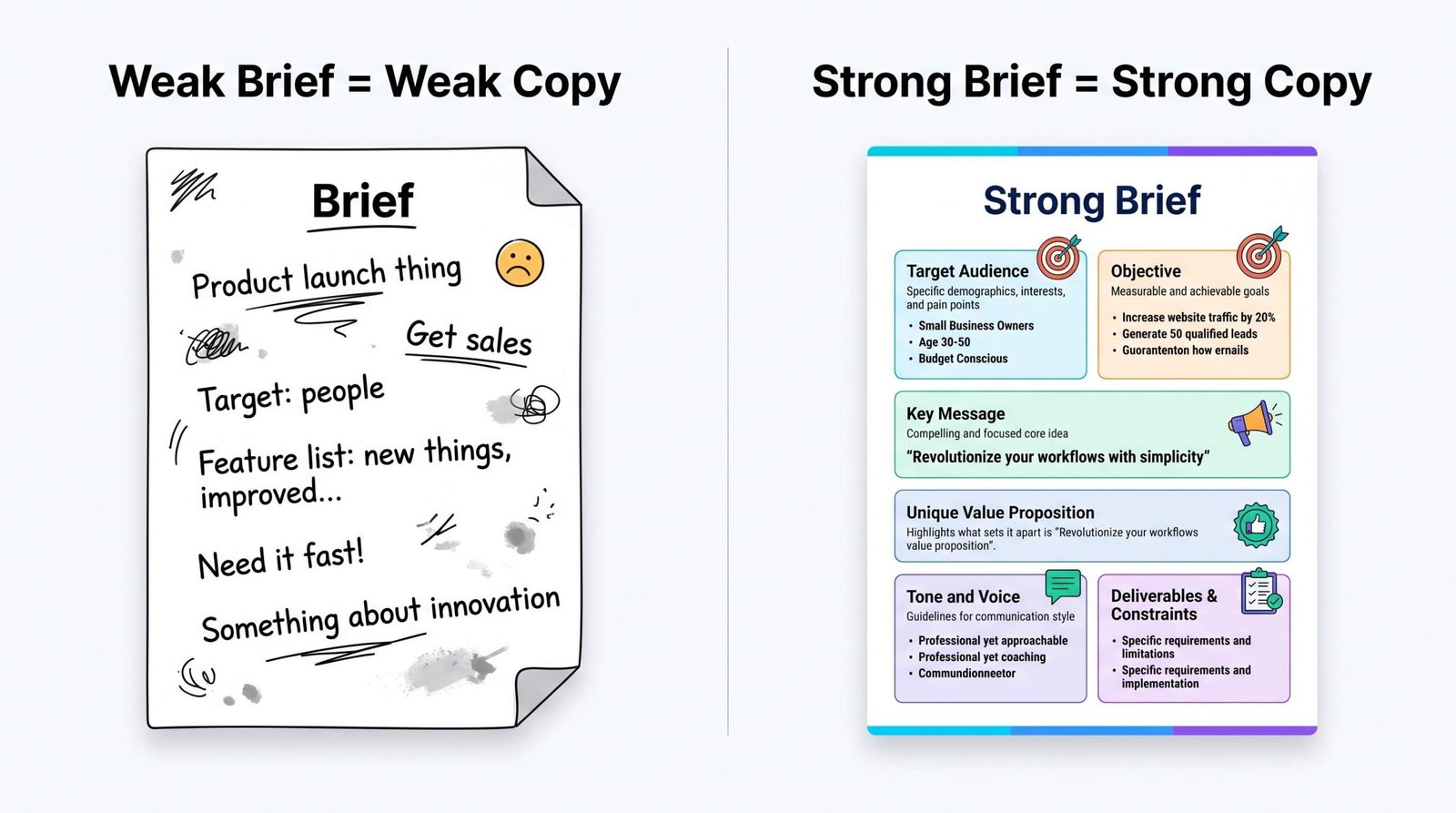
Here’s the part most hiring guides skip, and it’s the single most important section of this article. The quality of your brief sets a ceiling on the quality of the copy you’ll get back. A talented copywriter working from a bad brief produces bad copy. The same copywriter, given a precise brief, produces work that moves business metrics. I’ve seen the same writer deliver radically different output for two clients in the same week, and the variable was never their skill. It was the inputs.
Most clients underinvest in briefing because it feels like extra work. They send a Google Doc with bullet points: target audience, key features, tone of voice. The copywriter writes. The copy comes back generic. The client revises. The copy comes back slightly less generic. Six rounds later, everyone is frustrated and the project ships at 60 percent of its potential. The fix is upstream. Spend an hour on the brief and save twelve hours on revisions.
What Every Copywriting Brief Must Include
A complete brief contains these elements, each described with enough specificity that the writer can’t guess wrong:
- Target audience, named at the persona level. Not “business owners” but “VP of Engineering at a 50 to 200 person SaaS company, two to four years in role, currently using Jira and frustrated with reporting limitations.”
- The one job the copy needs to do. Not “explain our product” but “get a VP of Engineering to book a 20-minute demo within 30 days of landing on this page.”
- The key objection the copy must overcome. What is the audience already thinking that prevents them from acting? “We don’t have time to migrate from our current tool” is an objection that shapes every paragraph.
- Tone guidance with concrete examples. Not “professional but friendly” but “the warmth of Basecamp’s marketing combined with the technical precision of Linear’s product pages.” Link to specific examples of voice you want and voice you want to avoid.
- Competitive context. Who else is in the audience’s consideration set, and what messages are they using? Your copy positions against this landscape whether you acknowledge it or not.
- Proven messaging that already works. If a particular value proposition has tested well in ads, sales calls, or onboarding flows, the writer should know. Don’t make them rediscover what you already learned.
- What the audience already believes. Copy that argues against existing beliefs is harder to write and harder to convert. Knowing what beliefs to reinforce versus what beliefs to challenge changes the entire approach.
- Constraints and non-negotiables. Legal language, brand terms, words you don’t use, formats you’re committed to. Surface these upfront, not in revision round three.
If you want to go deeper on the craft of briefing, Copyhackers publishes extensive resources on conversion-focused briefs, and American Writers and Artists Inc. (AWAI) covers copywriting best practices for a broader range of formats.
The Common Briefing Mistakes That Produce Bad Copy
The mistakes I see most often share a common root: clients give writers their internal product perspective instead of their customer’s perspective.
The most common briefing failure is handing the copywriter an internal product spec sheet and expecting them to translate it into customer language. The spec sheet is written for engineers and product managers. The customer doesn’t think in features and architecture. They think in problems and outcomes. If you want the writer to produce customer language, your brief needs to contain it: actual quotes from sales calls, support tickets, user interviews, and reviews.
Asking for “professional but friendly” without examples is another reliable producer of bland copy. Those words mean different things to different people. Without reference points, the writer guesses, and the guess is usually a safe middle that pleases no one.
Leaving out competitive context forces the writer to position in a vacuum. They’ll make assumptions about what differentiates you, and those assumptions may not match how your customers actually compare options. Naming three competitors and describing how you want to position against each takes ten minutes and saves the entire piece.
Not telling the writer what the audience already believes is the subtlest mistake. If your audience already believes their current tool is inadequate, you don’t need to convince them of the problem, you need to convince them of your solution. If they don’t yet see the problem, the copy has to start much earlier in the persuasion sequence. Fix this single element in your brief and you double the output quality before the copywriter writes a single word.
Freelance Copywriter Rates: What to Expect
Freelance copywriter rates vary widely by specialization, experience, and the stakes of the deliverable. A conversion copywriter who specializes in SaaS free trials will charge significantly more than a generalist content writer producing blog posts, and that premium is usually justified by the revenue at stake. The table below covers typical 2026 rate ranges for common project types.
| Project Type | Typical Rate Range | Notes |
|---|---|---|
| Website homepage copy | $1,000 to $3,500 | Includes customer research, messaging framework, and revisions. Specialists in SaaS or financial services price at the high end. |
| Landing page | $750 to $2,500 | Conversion copywriters with documented results charge more. Long-form sales pages can exceed this range. |
| Email sequence (5 emails) | $800 to $2,500 | Welcome sequences, abandoned cart flows, and nurture campaigns. Strategy work pushes pricing upward. |
| Blog post (1,500 words) | $200 to $600 | SEO-focused content. Higher rates apply when the writer handles keyword research, interviews, or technical subject matter. |
| Product descriptions (per item) | $50 to $150 each | Volume discounts common at 25+ items. Premium positioning and luxury brands sit at the top of the range. |
| White paper or case study | $1,500 to $5,000 | Requires interviews, research, and design coordination. B2B technical pieces often exceed $3,000. |
Hourly rates exist but are less common for skilled copywriters. Most senior freelancers price by project because hourly billing penalizes efficiency. A writer who can produce a homepage in 8 hours at $150 per hour costs less than one who takes 30 hours at $50 per hour, and the faster writer is usually faster because they’re better.
Building a Productive Working Relationship
You’ve hired well. Now the question is how to work with the writer in a way that produces consistently strong output across multiple projects.
Feedback That Actually Helps (and What to Avoid)
Bad feedback is the single biggest killer of productive copywriter relationships. “I don’t like it” tells the writer nothing. “Make it more punchy” tells them less than nothing, because punchy means different things to different people, and they’re now guessing at your taste instead of solving the actual problem.
Directional feedback names the gap between what the copy does and what you wanted it to do. Compare these two notes on the same revision:
- Unhelpful: “This intro doesn’t grab me. Can you make it stronger?”
- Helpful: “This intro assumes the reader already knows they have a workflow problem. Our research shows most of them haven’t named the problem yet, so we need to start by helping them recognize it. Can you open with a specific scenario instead of the value claim?”
The second version gives the writer something to act on. The first sends them on a fishing expedition for what’s in your head. Train yourself to identify the specific gap before giving feedback, and your revision rounds shrink dramatically.
Revision Scope and Expectations
Set revision rounds upfront in the contract. Two rounds of revisions included in the project fee is standard. Additional rounds get billed at an hourly rate, typically the writer’s standard rate.
It’s also worth defining the difference between a revision and a rewrite. A revision refines the approved direction: tightening sentences, adjusting tone, sharpening a specific section. A rewrite restarts the project from a new brief, because the original direction wasn’t right. Rewrites cost more because they’re effectively a new project. Surface this distinction in the contract so it doesn’t surprise anyone when scope changes mid-project.
If you’re working with a copywriter on an ongoing basis, consider a monthly retainer arrangement. Retainers give you priority on the writer’s schedule, build accumulated context that improves every subsequent piece, and typically come in 10 to 20 percent below per-project rates. They also work well alongside other freelance digital marketing services when you need integrated execution across copy, paid acquisition, and content strategy.
Frequently Asked Questions About Hiring a Freelance Copywriter
How much does a freelance copywriter charge per hour vs. per project?
Hourly rates for experienced copywriters range from $75 to $250, with conversion specialists at the top of the range. Project pricing is generally better for both parties. Hourly billing penalizes efficiency and creates incentives to drag work out, while project pricing aligns the writer’s payment with delivery rather than time spent. For any deliverable larger than a single email, ask for a project quote.
What’s the difference between a copywriter and a content writer?
Copywriters write persuasive copy designed to drive a specific action: a click, a sign-up, a purchase. Their work is measured by conversion. Content writers produce informational pieces like blog posts, articles, and guides, measured by traffic, engagement, and search ranking. The skill sets overlap but the priorities differ. Hire a copywriter for landing pages, sales pages, and emails. Hire a content writer for editorial calendars and SEO-focused content. Some writers do both well, but most specialize.
Do I need to give copywriters an NDA?
For most projects, no. Standard freelance contracts include confidentiality clauses that cover client information adequately. NDAs become appropriate when you’re sharing unreleased product details, financial data, or strategic information that would create real harm if disclosed. Asking for an NDA on a routine homepage rewrite signals overcaution to experienced writers and may scare off candidates who view it as a sign of difficult client behavior.
How long does it take to get copy from a freelance copywriter?
Typical turnaround varies by deliverable. A landing page or homepage usually takes two to four weeks from brief to final draft, including a research phase. A blog post takes 5 to 10 business days. An email sequence takes two to three weeks. Rush turnarounds are possible at 25 to 50 percent rush fees, but most senior writers book out two to six weeks in advance, so plan accordingly.
Can one copywriter handle all my copy needs?
Sometimes, but rarely well. A copywriter who excels at long-form sales pages may produce mediocre product descriptions, and vice versa. For ongoing programs, most businesses end up with a small bench of two or three specialists rather than one generalist. A retainer with a primary copywriter who handles the high-stakes work, plus one or two specialists for specific formats, gives you better output than asking one person to do everything.
How do I know if copywriting is working?
Set the success metric before the project starts. For landing pages, it’s conversion rate. For emails, it’s open rate, click rate, and revenue attribution. For blog content, it’s organic traffic, time on page, and assisted conversions. Track the baseline before the copy ships and measure for a statistically meaningful window after. Single-day comparisons mislead. Give new copy at least two weeks of traffic before evaluating, longer if your volume is lower.
Hiring a freelance copywriter well is less about finding the right person and more about creating the conditions for any good writer to do their best work. Spend the time on your brief. Pay fairly. Give directional feedback. Set clear scope. The writers you want to work with respond to that environment, and the results show up in the metrics you care about. If you’re also evaluating broader digital marketing services for your business, the same principle applies: clarity of brief beats sourcing nearly every time.
Recent Comments