
Quick answer: A sales copywriter is a specialist who writes copy engineered to produce one specific action, usually a purchase, signup, or call. Unlike a content writer chasing traffic, a sales copywriter is measured on conversion and revenue. I write the words that turn attention into money.
Sales Copywriter: What They Do, What They Cost, and When to Hire One
If you’re reading this, you already suspect your copy is leaving money on the table. Maybe your sales page gets traffic but nobody buys. Maybe your ads are burning budget with a landing page that doesn’t close. Or maybe you’re launching something new and you know, deep down, that “just writing it yourself over the weekend” is going to cost you far more than hiring a pro.

This is a buyer’s guide. Not a “what is sales copywriting” explainer, and not a list of tips for copywriters to write better. It’s written for the person on the other side of the invoice: the founder, the marketing manager, the business owner trying to decide whether to hire a sales copywriter, what a fair rate looks like, and how to avoid getting burned. I’ve been on both sides of that brief for years, and I’m going to tell you what I’d want to know if I were spending my own money.
Let’s get into it.
What Does a Sales Copywriter Do?
A sales copywriter writes to produce a decision. Everything on the page bends toward a single action: click buy, book the call, enter your card, hit subscribe. That constraint changes the entire job. A content writer can succeed by being interesting. A sales copywriter only succeeds when a stranger does something they weren’t planning to do thirty seconds ago.
This is the discipline sometimes called direct response copywriting, and it has a lineage that goes back to mail-order catalogs and magazine ads that had to pay for themselves or die. A direct response copywriter doesn’t write to be admired. They write to be counted, in orders, opt-ins, and revenue. That heritage matters, because the craft is built on measurement, not vibes.
Here’s what actually goes into the work before a single sentence gets written. A good sales copywriter spends more time on research than on prose. They study the offer until they understand it better than you do. They interview your customers or read every review, support ticket, and sales call transcript they can get their hands on. They map the exact objections a buyer has at each moment of doubt. They study what your competitors are saying so they can position against it. Only then do they write, because the words are downstream of the thinking. Anyone who opens a blank document and starts writing headlines on day one isn’t a sales copywriter. They’re a typist with a thesaurus.
The persuasion itself isn’t a dark art, either. It’s marketing in its most concentrated form. The American Marketing Association defines marketing as the activity of creating, communicating, and delivering offerings that have value for customers. A sales copywriter lives inside the “communicating” half of that sentence, translating real value into words that make a real person act. When the offer is good and the message is sharp, persuasion is just clarity with a deadline.
What a Sales Copywriter Actually Writes
The deliverables vary by business, but most of my work as a sales copywriter falls into a handful of high-leverage formats:
- Sales pages. The long-form workhorse. A single page that carries a prospect from cold curiosity to checkout, handling every objection along the way.
- VSL scripts. Video sales letter scripts, the spoken-word version of a sales page. Common in info products, coaching, and supplement funnels where a talking head or slide deck does the selling.
- Email sequences. Welcome series, launch sequences, and abandoned-cart flows that nurture and close over days or weeks. This is where a specialist email copywriter earns their keep, because email is often the highest-ROI channel a business owns.
- Landing pages. Focused, single-goal pages built to convert paid or referral traffic into leads or sales.
- Ad copy. The hooks, headlines, and primary text for Meta, Google, and native ads. Small word counts, enormous financial consequences.
- Direct mail packages. Still alive, still profitable in the right niches. Physical sales letters that arrive in a mailbox and sell.
Notice what’s not on that list: blog posts, thought-leadership articles, and SEO pages designed to rank. Those are valuable, but they’re a different job with a different goal, which brings us to the comparison every buyer should understand before spending a dollar.
Sales Copywriter vs Content Writer
The single most expensive mistake I see business owners make is hiring the wrong type of writer for the job. A content writer and a sales copywriter both “write words,” the way a family doctor and a surgeon both “practice medicine.” You do not want one doing the other’s work. Here’s how they differ.
| Sales / Direct Response Copywriter | Content Writer | |
|---|---|---|
| Primary goal | Drive a specific action (sale, signup, call) | Build awareness, educate, earn SEO traffic |
| What they write | Sales pages, VSLs, email sequences, ad copy, landing pages | Blog posts, guides, case studies, social content |
| How they’re measured | Conversion rate, revenue generated | Traffic, time-on-page, leads |
| Typical client | DTC brands, SaaS, info product creators, B2B lead gen | Brands building organic traffic and authority |
| Rate premium | Significantly higher, results-based | Lower, volume-based |
The rate premium row is the one that surprises people, so let me explain it plainly. A sales copywriter charges more because the output is tied directly to money. If a sales page lifts conversion from 2% to 3% on a page doing $500,000 a year, that one percentage point is worth $250,000. Against that number, a $15,000 fee is a rounding error. Content writing is priced on volume and effort because its return is diffuse and slow. Neither is “better.” They’re priced differently because they do different things.
If your goal is organic traffic and long-term authority, you want a content writer or an SEO copywriter, and you should not pay direct-response rates for it. If your goal is to make a specific page or funnel convert, you want a sales copywriter, and trying to save money with a generalist usually costs more in lost sales than you’d ever save on the invoice.
What Does a Sales Copywriter Cost?
This is the section everyone scrolls to, so let’s be direct about it. Sales copywriter rates vary enormously, and the range is not arbitrary. It tracks experience, proven results, and how much revenue the copy is responsible for.
Before the numbers, one clarification that trips people up. If you search salary sites, you’ll see figures like ZipRecruiter’s median of roughly $36.74 per hour for a “sales copywriter.” That number describes employees in staff roles, often junior, often writing product descriptions and internal marketing. It has almost nothing to do with what an experienced freelance direct response copywriter charges to build a funnel that prints money. Do not anchor your budget to salary data. It will lead you badly astray.
Here’s how freelance rates actually break down by experience tier:
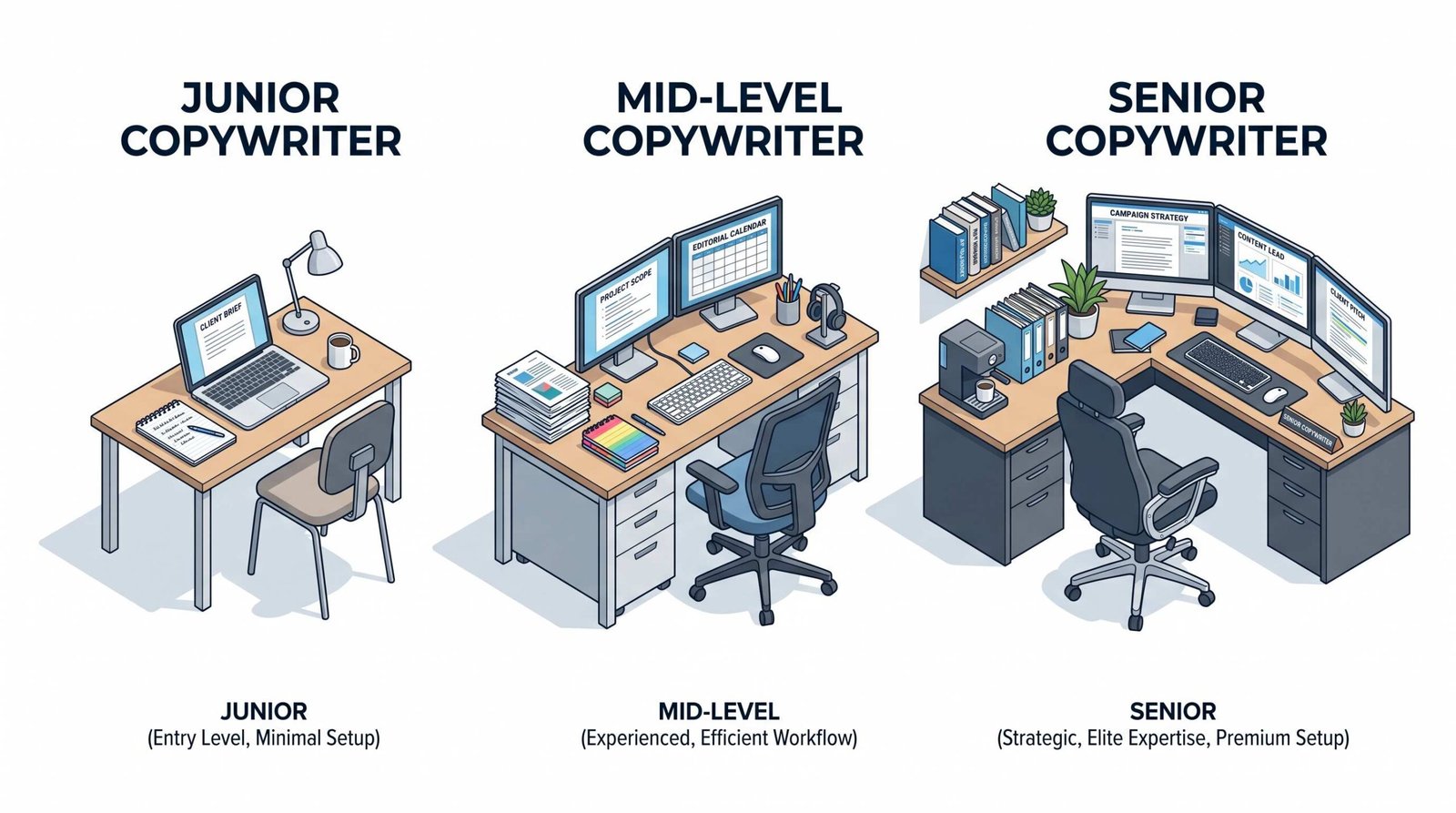
- Junior (0-2 years): $50-$85/hr. Sales pages run $2,000-$5,000 per project. Good for lower-stakes work, testing the waters, or businesses on a tight budget who can afford to iterate.
- Mid-level (3-5 years): $85-$160/hr. Sales pages run $5,000-$15,000 per project. This is the sweet spot for most growing SaaS and DTC businesses, enough craft and pattern-recognition to move the needle without elite pricing.
- Senior (6-10 years): $160-$250/hr. Sales pages run $15,000-$35,000+ per project. You’re paying for judgment, a track record, and someone who has seen your situation before and knows what works.
- Elite direct response specialist (10+ years): $250-$500+/hr. Sales pages run $20,000-$50,000+, often with royalties on top. These are the people writing eight-figure VSLs and supplement funnels. They pick their clients, not the other way around.
Sales Copywriter Rates by Deliverable
Experience tiers are useful, but most projects get quoted by deliverable. Here’s what you can expect to pay across the three tiers most buyers actually work with. Junior pricing sits below these ranges; use the tier list above for that end of the market.
| Deliverable | Mid-Level | Senior | Elite |
|---|---|---|---|
| Sales page | $5,000-$15,000 | $15,000-$35,000+ | $20,000-$50,000+ |
| VSL script | $3,000-$7,500 | $7,500-$20,000 | $20,000-$50,000+ |
| Email sequence (5-10 emails) | $1,500-$5,000 | $5,000-$10,000 | $7,500-$15,000+ |
| Landing page | $1,200-$3,000 | $3,000-$6,000 | $5,000-$10,000+ |
| Ad copy (set of variations) | $500-$1,500 | $1,500-$3,500 | $3,500-$7,500+ |
| Monthly retainer | $3,000-$6,000 | $6,000-$12,000 | $12,000-$20,000+ |
A few honest notes on these numbers. First, the ranges overlap because pricing is negotiable and situational. A senior copywriter might quote at the low end for a project they find interesting or a client they want to build a relationship with. Second, “elite” pricing usually comes with strings, a discovery fee, a waitlist, and frequently a royalty. Third, cheap is not the same as affordable. A $2,000 sales page that doesn’t convert is infinitely more expensive than a $15,000 page that doubles your revenue, because the first one cost you every sale it failed to make.
The reason experienced copywriters can command these fees comes down to a single lever: conversion. Copy is one of the highest-leverage inputs in your entire funnel, which is why HubSpot’s conversion rate optimization research keeps returning to messaging and copy as primary drivers of improvement. When the same traffic converts at a higher rate, everything downstream, ad spend efficiency, customer acquisition cost, lifetime value, gets better at once. That’s what you’re buying. Not words. Better math.
Pricing Models: How Sales Copywriters Charge
Beyond the raw numbers, it helps to understand the four ways a sales copywriter structures the deal. Each has trade-offs, and knowing them makes you a smarter buyer.
1. Per-Project
The industry standard for experienced direct-response work, and my default. You agree on a scope and a flat fee upfront. This ties cost to value rather than to time, which is exactly what you want. If I write a killer sales page in a week instead of three, that’s my efficiency working for you, not a discount you have to fight for. Per-project pricing also gives you a fixed number to plan around, which finance teams love.
2. Hourly
Common at the junior end, less common at the senior level, and for a good reason: hourly billing penalizes efficiency. The faster and better a copywriter gets, the less they earn per project, which is a backwards incentive. As a buyer, hourly also exposes you to open-ended costs. You’ll occasionally see it used for consulting, editing existing copy, or ambiguous scopes where a flat fee is hard to set. For a defined deliverable, prefer per-project.
3. Monthly Retainer
The right model when you have ongoing copy needs, a steady stream of emails, new ad variations every week, landing pages for each campaign. A retainer buys you priority access and continuity, so the copywriter builds deep knowledge of your brand and voice over time. Retainers reward relationships. If you’re running perpetual campaigns rather than one-off launches, this is usually the most economical structure, and it’s how a lot of my longest client relationships are built.
4. Royalty and Performance Deals
The high-stakes option, typically 3-10% of net sales, and most common with elite copywriters on high-volume offers like VSLs or supplement funnels. Here the copywriter takes on risk alongside you, betting that their copy will perform. Done right, it lines up incentives beautifully: they only win big when you win big. Two cautions. Royalty deals only make sense on offers with real volume and clean attribution, and elite copywriters will only take them on offers they believe in. If someone with a track record wants a piece of your funnel, that’s a strong signal your offer is worth backing. If they only want a flat fee and won’t touch a royalty, ask yourself why.
When to Hire a Sales Copywriter
Hiring a sales copywriter is an investment, and like any investment it pays off in specific conditions. Here are the scenarios where, in my experience working with SaaS founders and DTC operators, bringing in a pro reliably earns its fee.
- You’re launching a new product or funnel. A launch has one shot at a first impression. Getting the sales page, VSL, and email sequence right at launch compounds for the life of the product. This is the single highest-ROI moment to hire a specialist.
- Your existing copy converts below expectations. You have traffic, you have a decent product, and the numbers still disappoint. That gap between traffic and sales is almost always a messaging problem, and a sales copywriter’s entire job is closing it.
- You’re scaling paid traffic. When you pour budget into ads, the cohesion between your ad and your landing page determines whether that spend converts or evaporates. A copywriter who writes both keeps the message tight from click to checkout, which is often the difference between a profitable campaign and a money pit.
- You’re building an email sales sequence. Email consistently returns more per dollar than almost any other channel, but only if the sequence is built to sell rather than just “keep in touch.” A launch sequence or evergreen nurture flow written by a specialist can become one of the most durable revenue assets you own.
- You’re entering a more competitive market. When bigger, better-funded competitors show up, sharper positioning and messaging is how a smaller player punches above its weight. Copy is where that fight is won or lost.
- Your time is worth more elsewhere. Founders can often write passable copy, eventually, after weeks of avoidance. If your hours are better spent on product, sales, or fundraising, outsourcing the copy is simple math.
If two or three of these describe your situation, you’ll likely make your money back and then some. But hiring isn’t always the right call, and the next section is the one no competitor bothers to write.
When NOT to Hire a Sales Copywriter
I’d rather lose a project than take money from someone who won’t see a return. Copywriting is powerful, but it is not magic, and there are situations where hiring a sales copywriter is a waste of money no matter how good the writer is. Here’s when to keep your budget in your pocket.
- Your product-market fit isn’t proven. This is the big one. Copy amplifies demand that already exists; it does not manufacture it from nothing. If people who try your product don’t love it, or you haven’t yet found a group who genuinely wants it, no sales page will save you. Great copy in front of a weak offer just helps more people discover, faster, that they don’t want it. Fix the offer first.
- You have no traffic to test against. A sales copywriter’s work is validated by real visitors converting or not. If you’re getting a trickle of visitors a week, you can’t tell whether new copy worked or you just got unlucky. Build a traffic source first, even a small paid one, so you have something to measure. Otherwise you’re paying for an experiment you can’t read the results of.
- Your budget is under $2,000 and you need a full funnel. A complete funnel, sales page, VSL, and email sequence, is real work at real rates. If your entire budget is a few hundred dollars, you can’t afford a specialist for the whole thing, and stretching a junior across all of it will get you a funnel that’s cheap everywhere and good nowhere. Better to spend it all on the single highest-leverage piece, usually the sales page or the main ad, and DIY the rest for now.
- You actually need long-form SEO content. If what you want is blog posts that rank on Google and pull in organic traffic over months, a direct-response sales copywriter is the wrong hire and an expensive one. That’s a job for an SEO copywriter or a content marketing consultant, priced and skilled for a completely different outcome.
- You want to “test” a copywriter on a tiny throwaway task. Good copywriters research before they write, and that research doesn’t fit into a $200 “quick project.” A serious sales copywriter needs the whole offer to do their job. If you’re not ready to hand over that context, you’re not ready to hire.
Be honest with yourself about which list you’re on. The founders who get the most out of hiring me are the ones who came in at the right moment, with a proven offer, real traffic, and a clear goal. The ones who leave disappointed almost always hired too early, hoping copy would fix something copy can’t fix.
Freelance vs Agency vs In-House
Once you’ve decided you need sales copy, the next question is who provides it. There are three roads, and the right one depends on your volume, budget, and how central copy is to your business.
| Freelance | Agency | In-House | |
|---|---|---|---|
| Cost | $50-$500+/hr or per-project | 2-4x freelance rates | $88,000-$128,000/yr fully loaded |
| Speed | Fast, low admin | Slower, more process | Slowest to onboard |
| Specialization | High, you pick exactly who | Varies | Generalist |
| Best for | Specific high-stakes deliverables | Ongoing multi-channel campaigns | Very high volume, brand-critical copy |
| Risk | Availability, key-person | Cost, account-manager gaps | Headcount, training, retention |
Let me translate the table into plain advice.
Freelance is the right choice for most small and medium businesses, especially for specific high-stakes deliverables. You pick exactly the person whose track record fits your offer, you pay only for the work, and you skip the agency overhead. The trade-off is key-person risk: a great freelancer gets booked up, so lock in your timeline early. If you want a deeper walk-through of the process, I’ve written a full guide on how to hire a freelance copywriter that covers scoping, contracts, and expectations.
Agencies make sense when you’re running ongoing, multi-channel campaigns and want a team rather than an individual, coordinated copy, design, and media buying under one roof. You’ll pay two to four times freelance rates for that coordination, and the writer doing your work may not be the person you met in the pitch. Agencies buy you capacity and process. They cost you margin and, sometimes, the direct line to the actual writer.
In-house only pencils out at very high volume, or when copy is so brand-critical you need it owned internally. A fully loaded copywriter salary lands somewhere around $88,000 to $128,000 a year once you add benefits, taxes, and overhead, and an employee is a generalist by necessity, one person can’t be elite at sales pages, SEO, and brand voice all at once. Hire in-house when you have enough continuous work to keep that person busy and productive. Below that threshold, you’re paying full-time money for part-time value.
My honest take: unless you’re running a copy-heavy operation, start freelance. It’s the fastest, most flexible, and most specialized option, and it lets you match the exact skill to the exact job, an ecommerce copywriter for your product pages, an email specialist for your flows, without committing to a salary or an agency contract.
How to Find and Vet a Sales Copywriter
Good sales copywriters are rarely the ones with the loudest marketing. The best are often quietly booked out on referrals. Here’s where to look and, more importantly, how to tell the real ones from the pretenders.
Where to Find Them
- Referrals. The single best source. Ask other founders in your niche who wrote their best-performing page. A warm referral comes with proof attached.
- Copywriting communities. Serious direct-response copywriters cluster in a few well-known circles. The American Writers & Artists Institute is the industry’s leading training organization, and copywriters who’ve come through its programs tend to understand professional copywriting standards and the mechanics of direct response, not just pretty prose.
- Specialist job boards. Boards focused on marketing and copywriting talent surface people who identify as sales copywriters specifically, rather than general freelancers who’ll write anything.
- LinkedIn. Search for “direct response copywriter” or “sales copywriter” and read the content they post. A copywriter who can’t market themselves well is a yellow flag.
How to Vet Them
Samples are the beginning of the conversation, not the end. Anyone can show you a nicely designed page. What you actually want to know is whether that page made money, and whether the writer thinks like a marketer or just a wordsmith. Ask for conversion data from past projects, not just the pretty artifacts. Ask how they research an offer before writing. Ask for their process, step by step. The answers tell you almost everything.
Here are the questions I’d put to every candidate before signing anything:
- “Can you show me a project where you have before-and-after conversion numbers?” You’re looking for evidence of results, not just a portfolio. A confident copywriter will happily talk about what a page did, or explain honestly why the data is under NDA and offer a reference instead.
- “Walk me through how you’d research my offer before writing a word.” The answer should include customer research, review mining, objection mapping, and competitor analysis. If they jump straight to “I’d write you a great headline,” keep looking.
- “What do you need from me to do your best work?” A pro will ask for access to customers, data, past copy, and your funnel. Someone who says “just send me the product name” doesn’t understand the job.
- “How do you handle it when the copy doesn’t convert?” Nobody hits a home run every time. You want a writer who talks about testing, iteration, and reading the data, not one who guarantees perfection.
- “What’s your revision and testing process after launch?” The first draft is a hypothesis. The best copywriters expect to refine based on real performance, and they’ll tell you how.
The pattern to watch for across all these answers: does the person think in terms of the buyer and the numbers, or in terms of clever writing? Sales copywriting is a business skill that happens to use words. Hire the marketer, not the poet.
Red Flags to Watch For
For every excellent sales copywriter, there are ten who talk a good game and deliver generic filler. Here are the warning signs that should end the conversation, or at least make you dig much deeper.
- They won’t share any conversion data from past work. A results-focused copywriter lives for the numbers. Total silence on performance, even in ranges or under NDA with a reference to back it up, suggests there aren’t any wins to point to.
- They charge per word. This is the clearest tell that someone doesn’t understand sales copy. The best sales copy is often the most concise, a five-word headline can outperform a paragraph. Charging per word penalizes exactly the tight, high-impact writing you’re paying for. Sales copy is priced on value and results, never by the pound.
- They have no discovery process. If a copywriter quotes you a price and a timeline without first asking about your offer, your audience, and your competition, run. You cannot scope real sales copy without understanding the offer. A quote with no questions is a quote for filler.
- They don’t ask to see your traffic numbers or funnel. A serious sales copywriter wants to know where the traffic comes from, how warm it is, and what happens before and after the page they’re writing. If none of that comes up before scoping, they’re not thinking about conversion. They’re thinking about word count.
- Their samples are generic. Read their portfolio and ask: could this exact copy be dropped onto any product in the category? If the writing has no specific hook, no research-driven angle, no sign they understood a particular buyer, that’s what you’ll get too. Great sales copy is unmistakably about one offer for one audience.
- They promise a specific conversion rate before seeing your offer. “I’ll get you a 5% conversion rate” from someone who hasn’t looked at your product, price, or traffic is a fantasy, or a lie. Real copywriters give ranges based on evidence and set expectations honestly. Guarantees made in the dark are a sales tactic aimed at you, which is a strange thing to trust from someone selling you persuasion.
How to Brief a Sales Copywriter
Here’s something most buyers don’t realize: the quality of the copy you get back is capped by the quality of the brief you send in. When I review briefs from new clients, the thin ones, “here’s the product, make it sell”, always produce more back-and-forth and weaker first drafts than the detailed ones. Give a good copywriter rich raw material and they’ll give you copy that converts. Give them a product name and a prayer, and you’ll get generic writing, because that’s all they had to work with.
A strong brief includes all of the following:
- The offer in detail. Not just the product, but the full offer: price, guarantee, bonuses, payment options, what’s included, what makes it different. The offer is the foundation everything else sits on.
- The specific action you want. Buy now? Book a call? Start a trial? Opt in? Name the single action, because a page that tries to do two things does neither well.
- Who the audience is, described as a specific person. Not “small business owners.” A specific person: “Sarah, 42, runs a six-person marketing agency, drowning in client work, tried three project-management tools that her team abandoned.” Specificity is what lets a copywriter write to someone instead of everyone.
- The objections your audience has. Every reason a prospect hesitates: too expensive, no time to implement, been burned before, not sure it works for their situation. Copy is largely the art of answering objections before they’re spoken.
- Proof and testimonials available. Reviews, case studies, data, screenshots, expert endorsements, anything that makes a claim believable. Proof is the currency of persuasion, and the copywriter needs your reserves.
- Competitor messaging. What your main competitors say and how they position. Your copy has to give a reason to choose you over them, which means knowing what “them” sounds like.
- The traffic source. Is this page for cold paid traffic from Meta, or a warm email list that already knows you? Cold and warm audiences need very different copy, and the writer has to know which they’re writing for.
A Sample Brief Outline
Copy and paste this structure the next time you hire. It’ll save you money by getting you a stronger first draft.
Project: [Sales page / VSL / email sequence / etc.]
The offer: [Product, price, guarantee, bonuses, what’s included, key differentiator]
The goal action: [The one thing you want the reader to do]
Target reader: [A specific person: name, role, situation, what keeps them up at night]
Top objections: [The 3-5 reasons this person hesitates to buy]
Proof on hand: [Testimonials, case studies, data, endorsements, guarantees]
Competitors and their angle: [Who else they’re considering and how those competitors position]
Traffic source and temperature: [Where readers come from and how familiar they already are with you]
Voice and tone: [How your brand sounds, with a link or two to examples]
Deadline and budget: [Be upfront about both]
Fill that out honestly and you’ve done the single most valuable thing a client can do. You’ve handed your copywriter the raw material for great work instead of asking them to invent your business from scratch.
Frequently Asked Questions
What is the difference between a sales copywriter and a content writer?
A sales copywriter writes to drive a specific action, a purchase, signup, or call, and is measured on conversion rate and revenue. A content writer writes to build awareness, educate, and earn organic traffic, and is measured on traffic, engagement, and leads. Sales copywriters produce sales pages, VSLs, email sequences, and ad copy; content writers produce blog posts, guides, and case studies. Because sales copy ties directly to revenue, it commands significantly higher rates than volume-based content work.
How much does a sales copywriter charge per project?
It depends on experience and deliverable. A sales page runs roughly $2,000-$5,000 from a junior copywriter, $5,000-$15,000 mid-level, $15,000-$35,000+ from a senior, and $20,000-$50,000+ from an elite direct-response specialist, sometimes with royalties on top. Smaller deliverables cost less: email sequences typically run $1,500-$10,000 and ad copy sets $500-$3,500, again scaling with experience. Ignore salary-site figures like the ~$36.74/hr median often cited for staff copywriters; that reflects junior employees, not experienced freelance direct-response work.
When should I hire a sales copywriter vs write the copy myself?
Hire one when the stakes are high and the conditions are right: you’re launching a proven product, your existing copy converts below expectations, you’re scaling paid traffic, or your time is worth more elsewhere. Write it yourself when product-market fit isn’t proven yet, you have no traffic to test against, or your budget can’t cover a specialist for the work you need. Copy amplifies demand that exists; it can’t manufacture demand for an offer people don’t want, so fix the offer before you hire.
What does a good sales copywriter need to know before starting?
The full offer (price, guarantee, bonuses, differentiator), the single action you want readers to take, a specific description of the target buyer, that buyer’s top objections, any proof and testimonials you have, how competitors position themselves, and where your traffic comes from and how warm it is. A skilled copywriter will ask for all of this in a discovery process before quoting. If someone quotes you without asking any of it, that’s a red flag, they’re pricing filler, not sales copy.
How do I know if my sales copy is working?
Measure conversion rate, the percentage of visitors who take your goal action, and the revenue that copy generates, ideally against a before-and-after baseline or an A/B test. Traffic and time-on-page don’t tell you whether copy sells; only conversions and revenue do. Give any new copy enough traffic to reach statistical significance before judging it, and treat the first draft as a hypothesis you refine based on real performance rather than a finished artifact.
What is a royalty deal with a copywriter?
A royalty deal pays the copywriter a percentage of net sales the copy generates, typically 3-10%, instead of or on top of a flat fee. It’s most common with elite copywriters on high-volume offers like VSLs and supplement funnels, where the upside is large and attribution is clean. Royalty deals align incentives, the copywriter only earns big when you do, and an experienced writer willing to take one is signaling real confidence in your offer. They only make sense on offers with genuine volume and reliable tracking.
Should I hire a freelance sales copywriter or a copywriting agency?
For most small and medium businesses, freelance is the better first choice, especially for specific high-stakes deliverables. You pick exactly the specialist whose track record fits your offer, you pay only for the work, and you avoid agency overhead that runs two to four times freelance rates. Choose an agency when you need ongoing, coordinated, multi-channel campaigns and want a whole team rather than an individual. Consider in-house only at very high, continuous volume, where a fully loaded salary of roughly $88,000-$128,000 a year is justified.
Ready to Turn Attention Into Revenue?
If you’ve read this far, you’re taking your copy seriously, and that instinct is usually worth money. I help SaaS founders, ecommerce brands, and coaches and consultants build sales copy that converts, from sales pages and VSLs to full email sequences and ad campaigns. If you’ve got a proven offer and traffic to match, and you want a sharper message doing the selling, take a look at Ian Adair’s freelance marketing practice and send me a note about what you’re working on. I’ll tell you honestly whether hiring a copywriter is the right move for where you are, even if the answer is “not yet.”
Recent Comments