

Email Copywriter: A Business Owner’s Guide to Hiring the Right One

Most business owners I talk to have a budget for email, a half-finished welcome sequence, and a gnawing suspicion their emails are leaving money on the table. They’re right. Email still returns about $36 for every $1 spent, which makes it the single highest-ROI channel most businesses ignore. The problem isn’t the channel. It’s the copy.
If you’ve landed here searching “email copywriter,” you probably don’t want to become one. You want to hire one. This guide walks through what email copywriters actually do, what they should cost, how to vet them, and when you should hold off and hire someone else first.
What Is an Email Copywriter?
An email copywriter is a specialist who writes the words inside marketing and lifecycle emails – subject lines, body copy, and calls to action – with the goal of driving a measurable business outcome like a sale, signup, demo booking, or product activation. They write welcome sequences, promotional campaigns, nurture flows, and retention emails for businesses that send to a subscriber list.
That’s the short answer. The longer answer is that a good email copywriter sits at the intersection of research, psychology, and persuasion. They study your customers, understand your offer, and translate that understanding into emails people actually open and click. They aren’t writing fluff. They’re writing revenue.
In my experience working with founders, the writers who move the needle aren’t the ones with the prettiest portfolios. They’re the ones who can articulate why a particular subject line worked for a specific audience. That’s the difference between a wordsmith and a copywriter.
Email Copywriter vs. Email Marketer – Why the Distinction Matters
These two roles get conflated constantly, and the confusion costs businesses real money. An email copywriter writes. An email marketer builds the system that the writing lives inside.
A copywriter handles the words: subject lines, preview text, body copy, CTAs, the tone of the welcome series. An email marketer handles the strategy and infrastructure: list segmentation, deliverability, automation logic, A/B testing, ESP setup, reporting, and the calendar. Some practitioners (myself included) do both, but they’re distinct skill sets. If you hire a pure copywriter to run your Klaviyo account, you’ll end up frustrated. If you hire a strategist who can’t write, your campaigns will be technically sound and emotionally flat.
For a deeper breakdown of the strategy side, take a look at what a freelance email marketing professional actually does day to day. For now, the rule of thumb: copywriter writes the message, marketer builds the machine.
What Does an Email Copywriter Actually Write?
“Email” covers a lot of ground. Before you hire anyone, get clear on which type of email you actually need written. Here’s the breakdown of what most email copywriters produce:
| Email Type | Purpose | Typical Length / Complexity |
|---|---|---|
| Welcome sequence | Introduce new subscribers to your brand, deliver lead magnet, set expectations, drive first purchase or activation | 4-7 emails, 200-500 words each, high complexity |
| Promotional / campaign emails | Drive a one-time action: sale, launch, webinar signup, event | 1-3 emails, 150-400 words, medium complexity |
| Nurture sequence | Build trust and educate cold or warm leads over time toward a purchase decision | 5-10 emails, 300-600 words each, high complexity |
| Cart abandonment | Recover lost ecommerce sales from people who left checkout | 2-4 emails, 100-250 words, medium complexity |
| Re-engagement / win-back | Reactivate dormant subscribers or churned customers | 2-3 emails, 150-300 words, medium complexity |
| Newsletters | Stay top-of-mind, deliver ongoing value, soft-sell | Recurring, 400-1,500 words, low to medium complexity |
| Cold outreach | Initiate B2B sales conversations with prospects who don’t know you | 1-5 emails per sequence, 50-150 words each, high difficulty |
| Transactional / lifecycle | Onboarding, activation, milestone, and retention emails triggered by user behavior | 5-20+ emails in a system, 100-400 words each, high complexity |
Most businesses don’t need all of these at once. They need the two or three that map to their biggest revenue gap. A new SaaS company usually needs a working onboarding sequence before it needs a newsletter. A mature ecommerce brand likely needs a cart abandonment flow and a post-purchase sequence before it needs cold outreach copy.
What Kind of Email Copywriter Does Your Business Need?
Not every copywriter writes every kind of email well. The good ones niche down, and you should hire accordingly. Here’s how the specializations break out.
Ecommerce Email Copywriters
Ecommerce copywriters live in Klaviyo, Omnisend, and Shopify’s reporting dashboards. They write welcome flows, browse abandonment, cart abandonment, post-purchase, win-back, and product launch campaigns. The good ones obsess over revenue per recipient, not just open rates. They understand seasonality (Q4, BFCM), category dynamics (apparel buys differently than supplements), and how list segmentation drives revenue.
If you sell physical products, look for a copywriter with at least 12 months of dedicated ecommerce experience and case studies that show actual revenue attribution, not just engagement metrics.
B2B SaaS Email Copywriters
SaaS copywriting is its own animal. The buyer journey is longer, the buying committee is bigger, and the email is often competing with Slack notifications and calendar invites. SaaS email copywriters write activation sequences, feature announcements, expansion emails, churn-prevention flows, and product-led growth nurtures. They often work in HubSpot, Customer.io, or Braze.
When I work with SaaS founders, the highest-leverage email work is almost always the activation sequence (turning trial users into paid users) and the expansion sequence (turning small accounts into bigger ones). If that sounds like your situation, look for a copywriter who understands email marketing for SaaS and can talk fluently about activation rate, time-to-value, and PQL frameworks. If they can’t, keep looking.
Service Business, Coaching, and Consulting Email Copywriters
For service businesses, coaches, and consultants, email copy is mostly about trust and authority. You’re not selling a $40 product. You’re selling a $4,000 engagement, and the email has to make the prospect feel like you’re the obvious choice before they even hop on a call.
Copywriters in this space write long-form nurture sequences, story-driven newsletters, webinar invites, application emails, and post-call follow-up sequences. The aesthetic is closer to a personal letter than a product email. If you run a service-based SMB, focus on writers who understand email marketing for small businesses and can write in a voice that sounds like a real person, not a corporate brochure. The voice match matters more here than in any other vertical.
How Much Does an Email Copywriter Cost?
Pricing for email copywriters varies wildly. I’ve seen identical scopes quoted at $400 and $4,000 by different writers. The spread reflects experience, niche expertise, and how much revenue the writer can credibly attribute to past work. Here’s a realistic pricing breakdown for the U.S. market in 2026:
| Pricing Model | Price Range | Best For |
|---|---|---|
| Per email (one-off) | $75-$400 per email | Small projects, occasional campaign emails, one-time launches |
| Per sequence (5-7 emails) | $500-$2,500 per sequence | Ecommerce flows, welcome series, launch sequences, nurture sequences for SMBs |
| Monthly retainer (4-8 emails/month) | $1,500-$6,000 per month | B2B SaaS, service businesses, ongoing newsletter and campaign work |
| Full-service agency package | $3,000-$15,000 per month | Enterprise, mid-market ecommerce ($1M+ annual revenue), brands needing strategy plus execution |
| Performance / hybrid retainer | $2,000-$5,000 base plus 5-15% of attributable revenue | Ecommerce brands with strong attribution and aligned incentives |
What drives the spread? Three things, mostly:
- Niche expertise. A copywriter who has written 50 SaaS onboarding sequences will charge more than a generalist, and they should. They’ll cut your timeline in half and produce better work because they’ve already pattern-matched the failure modes.
- Results track record. A writer who can point to specific case studies (lifted welcome flow revenue from $X to $Y, dropped churn 22% on the win-back sequence) commands a premium. Pay it. The cheaper writer often costs more in wasted iterations.
- Conversion rate optimization experience. Writers who understand subject line testing, send-time optimization, and CTA experimentation deliver more value than writers who simply hand off a Google Doc and disappear.
If your scope is bigger than “write me a few emails” and closer to “help me figure out what to send and why,” you’re really looking for an email marketing consultant who can write, or a senior practitioner who handles both. The pure-writer model breaks down quickly when strategy is the bottleneck.
How to Evaluate Email Copywriters Before You Hire
Most hiring mistakes happen because the buyer evaluates the wrong things. They look at fancy clients, polished websites, and confident pitches. The signals that actually matter are quieter.
What to Look for in Their Portfolio
A portfolio of published emails tells you whether the writer can string sentences together. It doesn’t tell you whether the work converted. When you review samples, ask:
- Does the work show real understanding of the audience? Read the welcome email aloud. Does it sound like it was written for a specific human, or does it read like a generic template with the brand name swapped in?
- Is there evidence of conversion focus? Look at the CTAs. Are they specific and action-oriented, or vague? Are subject lines doing actual work, or are they cute and clever with no clear value prop?
- Do the sequences flow logically? Email three should build on email two. If you can rearrange the emails in any order without losing meaning, the writer doesn’t understand sequencing.
- Have they written in your industry or for your customer type? This isn’t strictly required, but it shortens the ramp. A copywriter who has written for cybersecurity SaaS will learn your business faster than one who has only written for skincare brands.
- Can they share metrics? Not every writer can disclose client data, but the good ones can talk in ranges: “the welcome flow I wrote drove 18-22% of total email revenue for this client.” If they can’t speak to outcomes at all, that’s a flag.
Interview Questions to Ask
Once you’ve narrowed your shortlist to two or three writers, get on a call and ask the following. The answers will separate practitioners from pretenders fast:
- “Walk me through how you’d approach my welcome sequence. What would you want to know before writing the first email?” (Good answer: they ask about your ICP, lead source, current performance, and offer. Bad answer: they jump straight into structure.)
- “What’s the highest-performing email you’ve ever written, and why did it work?” (Good answer: specific metric, specific reasoning. Bad answer: vague claim about “great engagement.”)
- “What email tool stacks have you worked in?” (Klaviyo, HubSpot, Customer.io, ActiveCampaign, Mailchimp, etc.)
- “How do you handle revisions and feedback?” (Good answer: defined revision cycles in the contract. Bad answer: unlimited revisions, which usually means scope creep.)
- “What’s your process for understanding our brand voice?” (Good answer: voice doc review, customer interviews, sales call recordings, past content review. Bad answer: they’ll “just match the tone.”)
- “What does success look like for this engagement, from your side?” (Good answer: they propose specific KPIs. Bad answer: they defer entirely to you.)
Red Flags That Should Make You Walk Away
A few patterns reliably predict a bad engagement. If you see any of these, keep shopping:
- They quote a price before understanding your scope. Anyone who throws out a number in the first 10 minutes of a discovery call is either desperate or doesn’t understand the work.
- They can’t name a single email metric beyond “open rate.” Open rates have been broken since Apple Mail Privacy Protection launched. A writer who still leads with opens isn’t paying attention.
- Their samples all sound the same regardless of brand. One voice across every client portfolio means they’re imposing their voice, not finding yours.
- They’ve never asked about your customer. If 30 minutes into the call they still haven’t asked who buys from you, they’re going to write generic copy.
- They guarantee specific results. “I’ll get you a 40% open rate” is either a lie or based on a metric that no longer means what they think it means. Run.
Freelancer, Agency, or In-House?
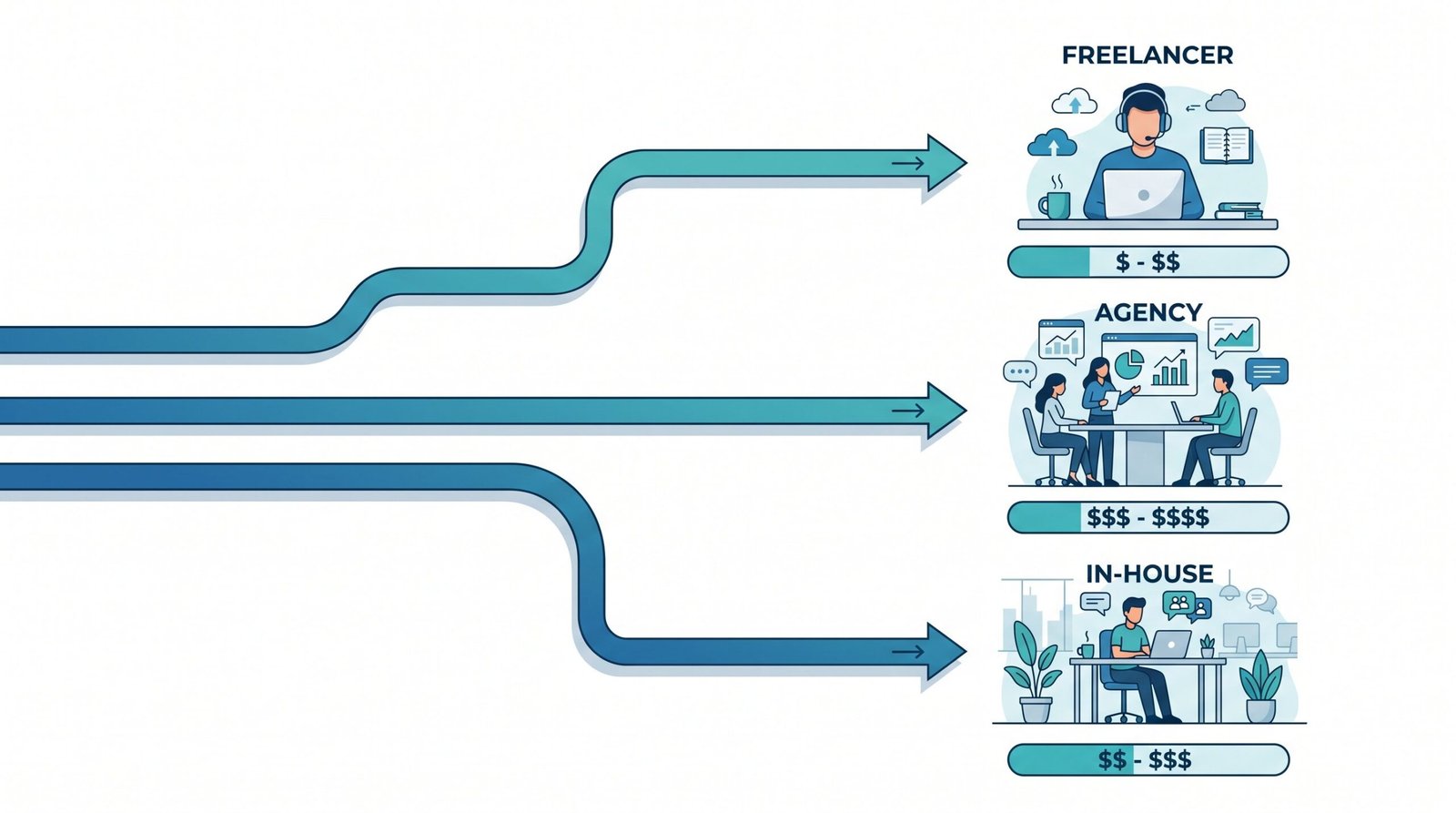
Once you’ve decided you need email copy, you have three structural choices. Each has tradeoffs, and the right one depends entirely on your scale, your existing team, and your appetite for management overhead.
| Option | Typical Cost | Best For | Pros | Cons |
|---|---|---|---|---|
| Freelance email copywriter | $1,500-$6,000/month or $500-$2,500 per project | SMBs, SaaS startups, founders who want a senior practitioner without agency overhead | Direct access to the person doing the work, lower cost than agency, flexible scope, senior expertise at junior price points | Limited capacity, vacation risk, one person can only specialize so deeply, you manage the relationship |
| Email marketing agency | $3,000-$15,000+/month | Mid-market and enterprise brands, ecommerce doing $1M+, businesses needing strategy plus execution plus design | Capacity, team of specialists, established processes, design and dev resources, redundancy | Higher cost, more layers between you and the work, sometimes junior writers on senior accounts, slower decision making |
| In-house email copywriter | $70K-$130K/year + benefits ($90K-$165K loaded cost) | Companies sending 8+ emails per week, brands where email is a primary revenue channel, teams of 50+ | Full institutional knowledge, dedicated capacity, full alignment with brand, no scope negotiations | High fixed cost, ramp time, single point of failure, only one voice and skill set, you also need to manage them |
The pattern I see most often: companies under $5M in annual revenue are best served by a freelance email copywriter or a small specialized agency. Hiring in-house too early is the most common expensive mistake. You end up paying $120,000 loaded for someone who doesn’t have enough work to justify the seat for the first nine months.
Agencies make sense when you need design, dev, strategy, and copy bundled, and when your scale justifies the overhead. Freelancers make sense when you want senior expertise and direct access to the practitioner doing the work, without paying for a project manager and an account director in the middle. If you want a deeper look at the freelance-versus-agency question generally, this guide on hiring a freelance copywriter covers the dynamics outside of email specifically.
How to Set Your Copywriter Up for Success
The biggest predictor of whether an email copywriter performs well isn’t the copywriter. It’s whether you give them what they need. Most failed engagements I’ve seen were failures of onboarding, not talent. Hand your writer the following on day one and you’ll save weeks:
- Brand voice document. Even if it’s three pages. Tone, vocabulary preferences, words you never use, brands whose voice you admire and brands whose voice you hate.
- Ideal customer profile (ICP). Who buys, why they buy, what they were trying to do before they found you, what they almost bought instead, what objections they raise.
- Sales call recordings. If you have any. Two or three calls give a copywriter more usable insight than 50 pages of marketing decks.
- Past email performance data. Which campaigns worked, which flopped, current open and click rates, revenue per recipient if you have it. Industry email open rate benchmarks are useful context, but your baseline matters more.
- Existing brand assets. Old emails, your website, sales pages, customer reviews, support tickets, social comments. Customer language is gold.
- Clear success metrics. Define what “this worked” means before the first email goes out. Revenue per email, click-through rate, sequence conversion rate. Whatever the metric, agree on it upfront.
- Compliance basics. Make sure your writer knows your unsubscribe policy and is familiar with CAN-SPAM Act compliance requirements, plus GDPR if you have EU subscribers.
The single highest-ROI hour you’ll spend with a new email copywriter is the kickoff call. Block 90 minutes, walk them through your business, your customer, your offer, and your goals. Skip this and you’ll pay for it in revisions.
When You’re Not Ready to Hire an Email Copywriter (Yet)
This is the section every other article on hiring an email copywriter leaves out, and it’s the most useful one. Hiring a copywriter before you have the right foundations is like hiring a chef before you’ve built a kitchen.
You’re probably not ready for an email copywriter if any of the following are true:
- You don’t have a meaningful email list yet. Below ~500 engaged subscribers, copy is a rounding error. Focus on list growth first: lead magnets, opt-in placement, traffic. A copywriter optimizing emails sent to 80 people is not the bottleneck.
- You haven’t defined your ICP. If you can’t describe in one paragraph who you serve and what problem you solve, no copywriter on earth can write your welcome sequence. They’ll write competently to a phantom audience and it won’t convert. Define the customer first.
- You’ve never sent a marketing email. Start with a few campaigns yourself, or hire a strategist. You need baseline data and a working ESP setup before copy is the lever.
- You don’t have a clear offer. If your product, service, or pricing changes monthly, copy will be obsolete before it ships. Stabilize the offer first.
- You can’t agree internally on the goal. If half your team wants to “build the brand” and the other half wants to “drive bookings this quarter,” the copywriter will be caught in the middle and the work will be diluted.
If any of these describe your situation, we suggest starting with an email marketing consultant who can help you build the foundation: ICP definition, list strategy, ESP setup, sender authentication, segmentation, and an initial campaign calendar. Once that scaffolding exists, a copywriter has something to write into. Without it, you’re paying for words that go nowhere.
FAQ
What is an email copywriter?
An email copywriter is a specialist who writes subject lines, body copy, and calls to action for marketing and lifecycle emails. Their job is to drive measurable outcomes like purchases, signups, demo bookings, or product activations. They typically write welcome sequences, promotional campaigns, nurture flows, cart abandonment emails, newsletters, and cold outreach for businesses sending to a subscriber list.
How much does an email copywriter charge?
Freelance email copywriters in the U.S. typically charge $75-$400 per individual email, $500-$2,500 per multi-email sequence, or $1,500-$6,000 per month on retainer. Agencies charge $3,000-$15,000 per month for full-service packages. Pricing depends on the writer’s niche expertise, results track record, and whether the scope includes strategy in addition to copy.
What’s the difference between an email copywriter and an email marketer?
An email copywriter writes the words: subject lines, body copy, and CTAs. An email marketer handles strategy and infrastructure: list segmentation, deliverability, automation logic, A/B testing, ESP configuration, and reporting. Some practitioners do both, but they’re distinct skill sets. Hire a copywriter when your channel works and your words don’t. Hire a marketer when your system is broken.
Do I need an email copywriter or an email marketer?
If you have an existing list, a working ESP, and clear performance data but your emails aren’t converting, hire a copywriter. If you don’t have a list strategy, your segmentation is a mess, your deliverability is poor, or you’ve never built an automated flow, hire an email marketer or consultant first. A copywriter optimizing copy on a broken system is wasted spend.
How do I evaluate email copywriting samples?
Read the samples aloud and ask: does it sound like it was written for a specific human, or like a generic template? Look at the CTAs (specific or vague?), the subject lines (working hard or just clever?), and the sequence logic (does email three build on email two?). Ask the writer to walk you through why a specific email worked. Their reasoning, not the writing itself, reveals whether they’re a craftsperson or a typist.
What should I look for when hiring an email copywriter?
Look for niche expertise that matches your business type (ecommerce, B2B SaaS, services), a portfolio with sequences (not just one-off emails), case studies with real metrics, fluency in your email tool stack, and a discovery process that includes ICP and offer questions. Avoid writers who quote prices in the first 10 minutes, lead with open rates, or guarantee specific results.
If your business is ready for email copy that actually converts, get in touch with Ian here. Ian works with a limited number of clients each year on a project or retainer basis, focusing on SMBs, SaaS companies, and service-based founders who want senior practitioner attention without agency overhead. If now isn’t the right time, the resources linked above will get you closer to it.
Recent Comments