

PPC Consultant: What They Do, What They Cost, and When to Hire One
A PPC consultant is an independent paid media expert who plans, builds, and optimizes pay-per-click campaigns across Google Ads, Meta, LinkedIn, and other platforms. Hire one when your monthly ad spend exceeds $1,500, your site converts, and you need senior strategy without the overhead of a full agency or in-house hire.
Most buyers searching for a PPC consultant are not actually shopping for paid media expertise. They are shopping for confidence. They have either burned cash on a campaign that did not work, inherited an account with no documentation, or watched a competitor scale past them on Google Search. They want someone who can look at the numbers, tell them the truth, and fix what is broken.
I have hired PPC consultants. I have worked alongside them inside companies and watched the good ones save accounts that were hemorrhaging money. I have also watched founders sign retainers with people who had no business being paid that much. The difference between a great consultant and an expensive one is rarely visible on the sales call. It shows up in the contract structure, the questions they ask in the first hour, and what happens 60 days in when the data starts coming back.
This guide is written for the person doing that hiring. Not for other consultants. Not for agencies marketing their services. For the founder, marketing director, or operator who needs to make a decision and does not want to be sold to.
What Does a PPC Consultant Do?
The short version: a PPC consultant runs your paid advertising so it generates revenue at a predictable cost. The long version depends entirely on which platforms you run and how mature your account is.
On Google Ads, day-to-day work covers Search campaigns (the text ads you see when you Google something), Shopping campaigns (the product grid for ecommerce), YouTube ads, Display, and Performance Max. Performance Max is Google’s automated campaign type that runs across all inventory, and it has become a particular minefield because Google’s machine learning can burn through budget fast if the inputs are wrong. A good consultant knows when to use Performance Max, when to run Standard Shopping instead, and when to cap automation entirely.
On Meta (Facebook and Instagram), the work shifts toward audience signals, creative testing, and the Conversions API setup. iOS 14 broke a lot of attribution, and most consultants worth hiring will start a Meta engagement by checking whether your Conversions API is firing correctly and your event match quality score is above 7. If it is not, no amount of creative optimization will save you.
LinkedIn Ads is its own discipline. The CPMs are eye-watering ($60-$100 for tight B2B audiences), so the consultant’s job is mostly about audience precision and message-to-market fit. If you are running LinkedIn for a SaaS company, you want someone who has spent real money on the platform, not someone treating it like Google Ads with a different login.
The day-to-day work breaks down roughly like this:
- Account audits and structural rebuilds (the first 2-4 weeks of most engagements)
- Keyword research, negative keyword management, and search query mining
- Ad copy and creative briefs (some consultants write copy, some hand off to a copywriter)
- Bid strategy selection and budget pacing
- Conversion tracking setup and audit (this is where most accounts fail)
- Landing page recommendations (the consultant rarely builds these, but flags problems)
- Reporting and weekly or biweekly performance reviews
The difference between a PPC consultant and a PPC agency is mostly about how the work is owned. A consultant typically does the work themselves. An agency assigns an account manager, who delegates execution to a junior team. You pay the agency partly for the senior strategy and partly for the layers of people checking the work. With a consultant, you get fewer layers and faster decisions, but you are also relying on one person’s judgment.
For most companies under $50K/month in paid spend, a consultant or small specialist team will give you more attention per dollar than an agency. Above that, the calculus changes because the volume of work starts to outstrip what one person can manage. If you also need broader marketing strategy beyond paid, a digital marketing consultant may be a better fit than a pure PPC specialist.
How Much Does a PPC Consultant Cost?
The honest answer: anywhere from $75/hour to $50,000/month, and the variance is mostly about experience and what is included.
Here is what the real market looks like in 2026 for independent PPC consultants and small specialist shops:
| Pricing Model | Typical Range | Best For | Watch Out For |
|---|---|---|---|
| Hourly rate | $75-$200/hour | Audits, troubleshooting, one-off projects | Vague scope, hours that creep, no defined deliverables |
| Monthly retainer | $1,500-$6,000/month | Ongoing campaign management, accounts spending $10K-$100K/mo | Retainers with no scope cap, auto-renewing 12-month contracts |
| Percentage of ad spend | 10-20% of spend | Larger accounts above $50K/month spend | This model misaligns incentives by paying the consultant more when you spend more, regardless of efficiency |
| Project-based | $2,000-$10,000 | Account restructures, new market launches, one-time builds | Scope creep, unclear handover, no post-launch support |
| Performance-based | Base + bonus on CPA/ROAS | Mature accounts with clean tracking | Easy to game by chasing short-term wins over long-term health |
Now look at rates by experience level. This is where buyers get confused, because the same job title covers wildly different skill levels.
| Tier | Hourly Rate | Monthly Retainer | Profile |
|---|---|---|---|
| Junior freelancer (1-3 years) | $50-$85/hour | $800-$2,000/month | Often ex-agency junior. Good for execution, less strong on strategy. |
| Mid-level freelancer (3-7 years) | $85-$150/hour | $2,000-$4,500/month | Solid across one or two platforms. Comfortable owning an account. |
| Senior consultant (7-15+ years) | $150-$300/hour | $4,500-$10,000/month | Strategic operator. Has managed $1M+ accounts. Selective about clients. |
| Small specialist agency (3-15 people) | N/A (retainer) | $5,000-$25,000/month | Team coverage, account manager + specialists. More process. |
| Enterprise agency (50+ people) | N/A (retainer) | $15,000-$100,000+/month | Full-service, multi-market, vendor-grade reporting. Slow to move. |
A reasonable rule of thumb: budget 10-20% of your monthly ad spend for management, but cap it. If your spend is $5,000/month, paying $2,000 for management (40%) is reasonable because the consultant is doing the same work they would for a $20K account. If your spend is $50,000/month, paying $5,000 (10%) is reasonable. Once you cross $100K/month, you should be negotiating fixed-fee retainers or hybrid structures, not paying a flat percentage that scales linearly with your spend.
For SaaS specifically, the math gets more nuanced because the LTV is usually high enough to justify aggressive bids on competitive terms. I have written more about this in our guide to paid acquisition for SaaS, but the short version is that SaaS companies often need a consultant who understands LTV-to-CAC ratios, not just ROAS.
The Percentage-of-Ad-Spend Trap
This is the section that no one selling PPC services wants you to read.
The standard agency pricing model in this industry, and one of the most common consultant pricing models, is a percentage of your monthly ad spend. Usually somewhere between 10% and 20%. On the surface this looks fair. The consultant is paid in proportion to the size of the account they are managing.
Look closer at the incentives.
How the Trap Works
If a consultant is paid 15% of your ad spend, they earn $3,000/month when you spend $20,000 on ads. If they get your account so efficient that you only need to spend $10,000 to hit the same revenue target, their fee drops to $1,500. They just took a 50% pay cut for doing better work.
The rational response to this incentive structure is to keep your spend high. Not necessarily to actively waste your money, but to never push hard for the efficiency gains that would reduce your spend. To recommend new campaigns that broaden coverage instead of cutting underperforming ones. To suggest expanding into new platforms before the core ones are fully optimized.
I have seen this play out at companies I have worked with. A consultant managing a $40K/month Google Ads account on 15% percentage-of-spend recommends adding LinkedIn Ads. The LinkedIn campaigns underperform. Instead of cutting them, the recommendation is to “let them run longer to gather data.” Six months later, $30K has been spent on LinkedIn with nothing to show for it. The consultant has earned an extra $4,500. The company has lost $30K plus opportunity cost.
None of this requires the consultant to be a bad actor. It just requires them to respond rationally to the incentives in their contract.
What to Watch For in Contracts
Read the fee structure carefully. Specific things to look for:
- No cap on the percentage fee. If your spend doubles, the fee doubles, even though the work has not.
- No minimum efficiency floor. The contract has no language about CPA targets, ROAS thresholds, or efficiency metrics.
- Auto-renewing 6 or 12-month terms. You are locked in if the relationship is not working.
- Vague scope language. “Manage and optimize campaigns” with no defined outputs or review cadence.
- Bonus on spend growth. Some contracts have explicit bonuses if the consultant grows your spend. This is a red flag.
When Percentage-of-Spend Is Acceptable
The percentage model is not always wrong. It can work in three specific situations:
First, when there is a clear efficiency mandate written into the contract. The consultant is paid 12% of spend, but only as long as ROAS stays above a defined threshold. Drop below, and the fee converts to a flat retainer until it is restored.
Second, when there is a cap. The fee is 15% of spend up to $10,000/month spend, then drops to 7% for spend above that. The consultant still scales their fee with account size, but they do not get paid linearly more for inflating budgets.
Third, when the consultant has a long track record with you and trust is already established. The incentive misalignment exists in any percentage contract, but it matters less when the operator has demonstrated good judgment over multiple years.
Alternative Structures That Align Incentives
The cleanest structures, in order of how well they align consultant and client incentives:
Flat monthly retainer with scoped deliverables. The consultant is paid the same whether you spend $10K or $50K. Their incentive is to keep you happy enough to renew, which means making your account work. This is the structure I prefer.
Hybrid: base retainer plus performance bonus. A flat fee that covers the work, plus a bonus paid when CPA goals are hit or ROAS thresholds are exceeded. This rewards results without putting all the risk on either side.
Percentage-of-spend with efficiency floor. Acceptable if structured correctly, as described above.
Pure performance-based. Sounds attractive, but in practice it pushes consultants to chase short-term wins, ignore brand campaigns, and avoid clients with messy data. Most senior consultants will not work this way.
PPC Consultant vs. PPC Agency vs. In-House: Which Is Right for You?
This comparison gets oversimplified. The real answer depends on where you are in your growth, how complex your media mix is, and how much marketing leadership you already have on the team.
| Factor | Solo PPC Consultant | PPC Agency | In-House PPC |
|---|---|---|---|
| Monthly cost | $1,500-$10,000 | $5,000-$50,000+ | $8,000-$15,000 (loaded salary) |
| Commitment | Monthly, often no contract | 3-12 month contracts | Full-time employee |
| Channels covered | Usually 1-3 platforms deeply | Multi-channel, deeper bench | Limited by hire’s expertise |
| Speed to start | 1-2 weeks | 3-6 weeks (onboarding process) | 2-4 months to hire and ramp |
| Accountability | One person, direct line | Account manager + team layers | Direct, but bound by internal politics |
| Strategic depth | High, if senior | Variable, often diluted | High for one channel, narrow scope |
| Best for | SMBs, Series A/B SaaS, focused ecommerce | $50K+/mo spend, multi-market | $100K+/mo sustained spend, mature marketing org |
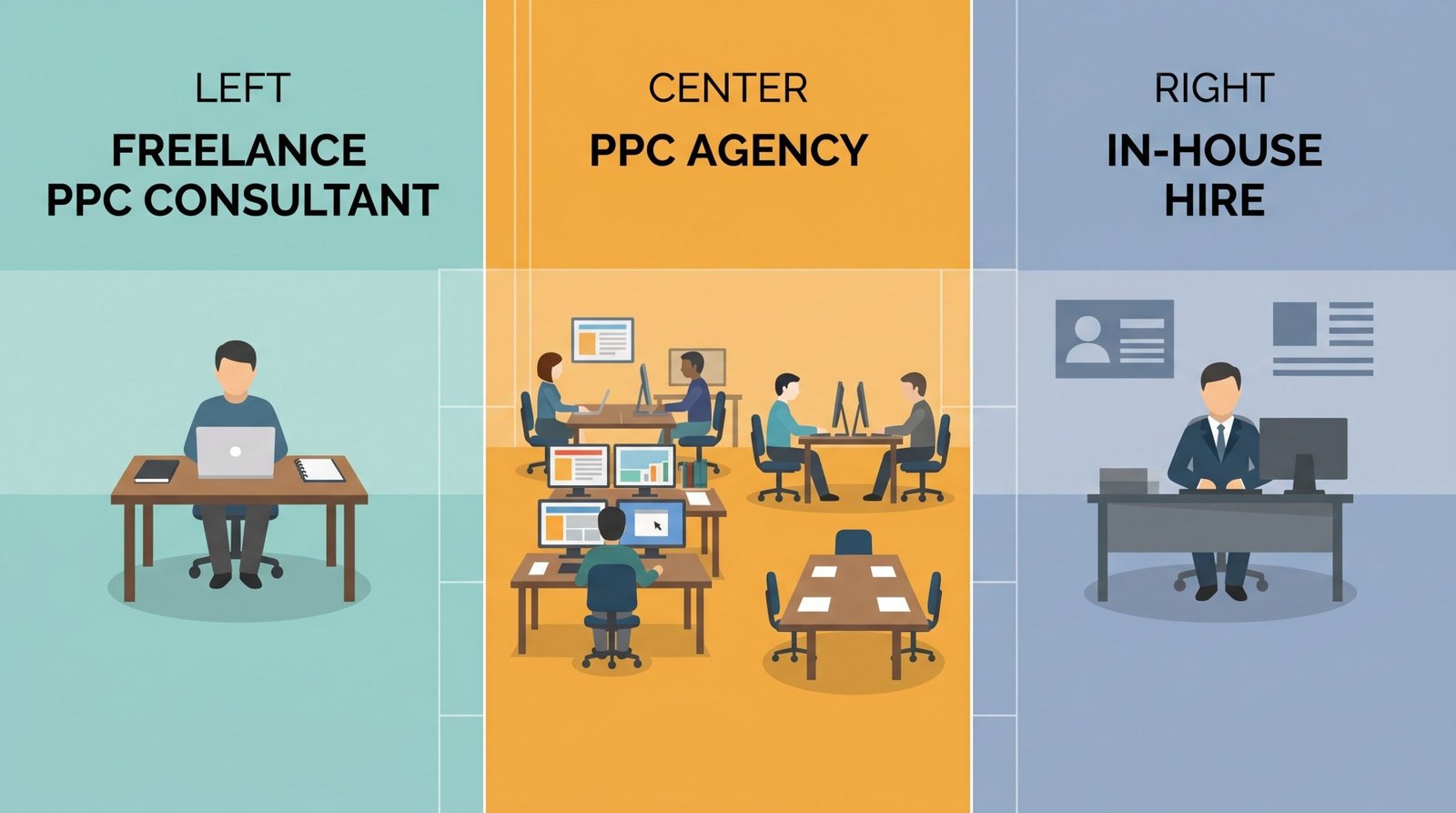
A pattern I see repeatedly: founders hire an agency too early. The minimum agency retainer (often $5K-$8K) is higher than they need, the account manager assigned is junior, and the work that actually happens does not justify the cost. A senior consultant at $3,500/month would have done more.
Conversely, when you cross $100K/month in spend and you are running across four or five platforms, a single consultant becomes a bottleneck. They cannot give every account the attention it needs, and you start needing the bench of a small agency or your own in-house lead. This is also when bringing in a fractional CMO can help, because the question is no longer just about PPC, it is about overall acquisition strategy.
When NOT to Hire a PPC Consultant
This is the section most agencies will never write, because they want you to hire them regardless of fit. Here are four specific scenarios where hiring a PPC consultant is the wrong move.
Your Site Does Not Convert Yet
PPC sends traffic to your site. If your site does not convert, paid traffic just amplifies the problem. You will spend money to send qualified visitors to a page that does not work, and then you will pay your consultant to optimize campaigns against a broken funnel.
How to know if your site converts: look at your organic traffic. If you have visitors arriving from search or referral, are any of them converting? If your conversion rate from non-paid sources is under 1% for a B2B SaaS site, under 2% for an ecommerce site, or under 5% for a lead-gen site, your site is the problem. Fix that first. Hire a conversion optimization specialist or a content marketing consultant who can rebuild your landing pages and value proposition before you turn on paid.
Your Ad Spend Is Under $1,500/Month
Below roughly $1,500-$2,000/month in ad spend, the math stops working. A reasonable consultant retainer is $1,500-$3,000/month. If your media spend is the same size as your consultant fee, you are paying 100% management overhead, and there is not enough data flowing through your account for the consultant to do meaningful optimization.
At this stage you have two better options. Run the ads yourself, learn the basics, and use Google’s own Keyword Planner and free tutorials to build a basic Search campaign. Or hire a consultant for a one-time setup ($1,500-$3,500) and then manage it yourself, with a quarterly checkup call.
You Need Brand Strategy, Not Paid Media
PPC is a distribution channel. It amplifies whatever message and positioning you already have. If your positioning is unclear, your value proposition is weak, or you do not know who your customer actually is, PPC will not fix this. It will just spread your fuzzy message faster.
I have seen companies spend six figures on Google Ads trying to “find product-market fit.” That is not what paid media does. Paid media validates demand for things people are already searching for. If the demand is not there, or if your positioning is wrong, no amount of bid optimization will save you. Work on the strategy first.
You Have No Landing Pages
Related but distinct from the “no conversion” problem. Some companies want to run PPC pointed at their homepage, or at a generic product page that was not designed for paid traffic. This rarely works at scale.
Good PPC requires dedicated landing pages built for specific search intents. If you do not have those, the consultant’s first month will be spent waiting for your dev or design team to build them, which is the wrong way to start an engagement. Get the landing pages built first. Then bring in paid traffic.
5 Red Flags When Vetting PPC Consultants
Watch for these specific signals in the sales conversation. None of them are dealbreakers in isolation, but two or more should make you walk away.
1. They promise a specific ROAS on Day 1. Anyone who tells you “we’ll hit 4x ROAS in month one” before they have seen your account, audited your tracking, or understood your margins is selling you. Real consultants will not commit to specific numbers until they have data. The honest answer to “what ROAS can we expect?” is “I cannot tell you until I see your account, your conversion data, and your benchmarks.”
2. No Google Ads or Meta Blueprint certification. Certifications are not proof of skill, but the absence of them after years in the industry is unusual. More importantly, if they have not bothered to keep their Google Ads certifications current, what else are they not keeping current?
3. They ask no questions about your conversion tracking. If you get to the second sales call and the consultant has not asked about your Google Tag Manager setup, your conversion events, or your GA4 configuration, run. Conversion tracking is where 70% of underperforming accounts go wrong. A consultant who does not interrogate this early is going to inherit a broken setup and not notice.
4. They will not share account access. If they manage your Google Ads account through their own MCC (manager account) and refuse to give you admin-level access, you are being set up for vendor lock-in. You should always have ownership of your own Google Ads account, with admin access to your own data.
5. Their reporting is a black box. Beware the “branded dashboard” that shows you a clean ROAS number but does not let you click through to the actual Google Ads data. Real consultants reporting will reference actual Google Ads metrics (impression share, search top IS, quality score, auction insights) because that is what they are looking at to do the work. If their report is all proprietary metrics, ask why.
A related but quieter red flag: the consultant does not mention compliance or disclosures at all. If you are running paid ads in regulated industries, or if you use affiliates, influencers, or testimonials in your ad creative, your consultant should know the FTC’s guidance on digital advertising disclosures cold. A consultant who has never thought about disclosures is one Federal Trade Commission letter away from being your problem.
6 Questions to Ask Before You Hire
These are the questions I would ask if I were hiring a PPC consultant tomorrow. Each one is designed to reveal something specific.
-
“Can I keep ownership of my Google Ads account if we stop working together?”
What this reveals: whether they are building lock-in. The right answer is yes, your account is your account, they just have manager access. Anyone who hedges on this is setting up a hostage situation.
-
“Walk me through how you’ll audit my conversion tracking in the first two weeks.”
What this reveals: whether they actually know how conversion tracking works. You want to hear about Google Tag Manager, server-side tracking, event match quality, attribution windows, and how they reconcile platform-reported conversions with your CRM data. If they hand-wave through this, they will hand-wave through the actual work.
-
“What does a typical reporting cadence look like, and what metrics do you focus on?”
What this reveals: their priorities. The right answer focuses on business metrics (cost per acquisition, customer LTV, payback period) and not just channel metrics (CTR, CPC). Anyone who only talks about clicks and impressions is operating at the wrong altitude.
-
“Tell me about a campaign you ran that did not work, and what you learned.”
What this reveals: self-awareness. Good consultants have failures and can talk about them. Bad consultants have only success stories. The specifics of the failure tell you whether they are honest and whether they actually learn from data.
-
“What’s your point of view on Performance Max?”
What this reveals: whether they actually have technical opinions or are just running plays from a checklist. There is no right answer here. Performance Max is a divisive topic. You want to hear a nuanced view: when they use it, when they do not, how they cap it, how they exclude branded traffic from it. Wishy-washy answers mean they are not opinionated, which means they are not senior.
-
“What does our engagement look like in months 4-6, after the initial optimization?”
What this reveals: whether they have a plan beyond the first 90 days. Some consultants are great at the initial rebuild but have no idea what to do once the easy wins are gone. You want someone who can articulate the steady-state work: ongoing testing, audience expansion, creative refresh, seasonal planning.
What to Expect in the First 90 Days
Real results take time. Anyone who promises immediate transformation is either lying or about to inherit such a broken account that any change looks dramatic. Here is what a properly run engagement actually looks like.
Week 1-2: Audit and Setup
The consultant is not running ads yet. They are auditing what exists. Specifically:
- Review of current Google Ads account structure, campaigns, ad groups, and search query reports
- Conversion tracking audit (this is where most consultants find the first set of problems)
- Google Analytics 4 setup review and event audit
- Review of historical performance: 90-day, 12-month, and seasonal patterns
- Landing page review and CRO recommendations flagged to your team
- Documentation of baseline metrics so progress can be measured later
By the end of week 2 you should have a written audit document, a list of things that need fixing before you spend more money, and a proposed plan for the first 60 days.
Month 1: Baseline Campaigns and Data Gathering
Now ads start running, but with intentional caution. The consultant is building a foundation, not chasing immediate ROAS. Expected work in month 1:
- Restructure or rebuild key campaigns based on the audit
- Implement fixes to conversion tracking (often this is week 2 work)
- Launch a small set of well-targeted campaigns to start generating clean data
- Daily monitoring, weekly or biweekly check-ins
- Negative keyword lists built and applied
- Initial creative tests launched
You should expect performance to be variable in month 1. New campaigns need at least 2-3 weeks of data before any meaningful optimization can happen. A consultant who is making major changes every few days in month 1 is over-optimizing on insufficient data.
Month 2: Optimization Based on Real Data
By month 2 you should have enough conversion data to start making informed decisions. This is when real optimization happens:
- Bid strategy refinements based on actual CPA data
- Keyword expansion based on what is converting
- Cutting underperforming campaigns and ad groups
- A/B testing of ad copy and creative
- Audience refinement on Meta and LinkedIn based on engagement and conversion patterns
- First serious conversation about budget reallocation between platforms
Performance should start trending in the right direction by the end of month 2. Not dramatically, but measurably. CPA should be moving toward your target, or you should have a clear analysis of why it is not (often this points to a landing page or product issue, not a PPC issue).
Month 3: Scaling What Works
By month 3, you should have a clearer picture of which channels, campaigns, and audiences are working. The work shifts from optimization to scaling:
- Budget increases on campaigns hitting CPA targets
- Expansion into new keyword themes that mirror successful ones
- New creative variants based on what is winning
- Possible expansion to a new channel if the core ones are stable
- A clear, written 90-day report covering what was done, what was learned, and the plan for months 4-6
This is the timeline if everything goes well. Add 30-60 days if you have a small account starting from low data volume, are in a long sales cycle B2B space where conversion data is slow, or have major landing page or product issues that need to be addressed in parallel. A senior SEO consultant can sometimes shorten the runway by improving the organic landing pages your paid traffic is hitting, which is why PPC and SEO often work better as a coordinated pair.
Frequently Asked Questions
What’s the difference between a PPC consultant and a PPC manager?
A PPC manager is typically an in-house employee or junior agency role responsible for the day-to-day execution of campaigns. They build ads, manage bids, and report on performance. A PPC consultant is usually an independent senior practitioner who provides strategic direction, conducts audits, and either executes the work themselves or directs a manager who does. Consultants are hired for judgment and experience. Managers are hired for execution.
How long does it take to see results from PPC?
Realistic expectations: minor performance improvements within 30 days as obvious waste is cut, meaningful directional results within 60 days as new campaigns gather data, and stable, scalable performance within 90 days. Anyone promising significant ROAS improvements in the first 30 days is either inheriting a badly mismanaged account or overselling. B2B SaaS with long sales cycles often need 4-6 months to see full attribution clarity.
Do I need a Google Ads certified consultant?
Certification is a useful baseline but not a complete signal of skill. Almost every working PPC professional has Google Ads certification because it is free and takes a few hours. The absence of certification is a yellow flag. The presence of certification does not prove the consultant is good. Look more at the depth of their conversation about your specific account challenges than at their certification badges.
What’s a good ROAS to aim for?
It depends entirely on your margins. For ecommerce with 50% gross margins, a 2x ROAS is breakeven and you need 3-4x to be profitable after accounting for fulfillment, customer service, and other costs. For SaaS, ROAS is the wrong metric. You should track CAC against LTV, with a target CAC payback period of under 12 months. For lead generation, the relevant metric is cost per qualified lead, not ROAS. Any consultant who tells you “aim for 4x ROAS” without asking about your margins is guessing.
How much should I budget for ads if I hire a PPC consultant?
A useful minimum is $3,000-$5,000/month in ad spend for a meaningful engagement. Below that, there is not enough data flowing through your account to support optimization. Realistic ranges: $3,000-$10,000/month for early-stage testing, $10,000-$50,000/month for established small businesses, $50,000+/month for scaling growth. Your management fee should typically be 10-20% of your spend, but capped so it does not scale linearly forever.
Can a small business afford a PPC consultant?
Yes, but only if you have at least $1,500-$2,000/month in ad spend to manage. Below that, your better options are: a one-time setup engagement ($1,500-$3,500) followed by self-management, a fractional or hourly arrangement (10-15 hours/month at $100-$150/hour), or a focused 90-day engagement to get the account into a good state and then move to a maintenance arrangement. Some senior consultants will work with smaller businesses on focused projects but will not take ongoing retainers below a certain threshold.
Working With Ian
If you are evaluating whether to hire a PPC consultant or what to look for in one, the framing matters more than the specific platform or vendor you choose. The right structure protects you from misaligned incentives, sets realistic expectations, and gives you ownership of your own data. If you want a second opinion on a current setup, want to audit a consultant you are considering hiring, or need help thinking through paid acquisition for your business, you can work with Ian directly. Most engagements start with a 60-minute strategy call to understand where you are and what would actually help.
Recent Comments