

If you’re reading this, you’re probably weighing whether to hire an SEO consultant, and you want a straight answer from someone who isn’t trying to sell you a retainer. I’ve spent years on both sides of this transaction: doing SEO consulting work for SaaS and B2B companies, and helping founders evaluate which SEO consultants to hire (and which to politely decline). This guide is what I wish more business owners had access to before signing a contract.
An SEO consultant is an independent specialist who helps a business rank higher in search engines like Google. They audit your site’s technical health, optimize content for target keywords, build authoritative backlinks, and track performance against revenue goals. Most charge $75-$200 per hour or $1,000-$4,000 monthly as a retainer.
Here’s the short version of what you’ll learn below: SEO consulting is worth the money for the right business at the right stage, and it’s a waste of cash for the wrong one. I’ll walk you through what an SEO consultant actually does day to day, real 2026 rate data, the questions you should be asking on a discovery call, and the warning signs that should send you running. I’ll also cover the scenarios where I’d tell you to skip hiring a consultant entirely, because I’ve seen too many companies pay for SEO when the bottleneck was somewhere else.
Search is still where buyers go to evaluate solutions. Research from Seoprofy puts the 748% median ROI from SEO over multi-year horizons, which is why founders keep asking about it. But that number assumes you’ve hired well and you have the right business fundamentals in place. Most SEO failures aren’t really SEO failures, they’re hiring failures or product failures. Let’s get into the details.
What Does an SEO Consultant Actually Do?
The job description varies wildly depending on who you ask, which is part of why hiring is hard. An SEO agency salesperson will describe one thing. A solo freelance practitioner will describe another. A senior in-house SEO will describe a third. What they all have in common is this: an SEO consultant’s job is to increase the qualified organic search traffic that turns into revenue for your business. Everything else is a means to that end.
In practice, the work splits into five recurring buckets. Some weeks I spend 80% of my time in one bucket and barely touch the others. The split depends on what your business needs and where the biggest leverage is. Let me break each one down.
Technical SEO audits and fixes
Technical SEO is the foundation. Before any content strategy or link building can move the needle, Google has to be able to crawl, render, and index your pages correctly. A solid audit looks at site architecture, page speed, mobile usability, structured data, internal linking, canonical tags, duplicate content, broken pages, and redirect chains. On a typical engagement, I’ll find anywhere from twenty to two hundred technical issues, then rank them by traffic impact. Fixing a robots.txt file blocking your product pages can recover thousands of monthly visits in a week. Fixing a slow web font might do nothing measurable.
This is also where the consultant earns their fee on day one. Technical issues are unsexy, but they’re often the highest leverage work because they unlock rankings the rest of your strategy assumed you already had. Google itself addresses this in Google’s own guidance on hiring an SEO professional, where they specifically call out site auditing as a core deliverable to expect from any consultant worth their rates.
On-page optimization
On-page is the work of making sure each page you publish targets a specific search intent and signals that intent clearly to Google. That includes title tags, meta descriptions, header structure, body content optimization, internal linking, image alt text, and schema markup. It also includes the harder editorial judgment calls: which keyword should this page rank for, which user question should it answer, and how do we phrase it so someone who lands here actually converts.
Good on-page work is roughly 60% strategy and 40% execution. Bad on-page work is keyword stuffing with synonyms and calling it a day. If a consultant talks about on-page optimization in terms of keyword density percentages, that’s a red flag I’ll come back to later.
Content strategy and gap analysis
Content is where most SEO programs either win or lose. The work here means mapping the keyword universe your buyers are searching, identifying which queries you’re already winning, which you’re losing to competitors, and which you haven’t tried to compete for yet. From that map, the consultant builds a content roadmap with ranked topics, target keywords, intent classifications, and suggested formats.
For SaaS companies in particular, content is the engine that compounds. I’ve written more about this approach in my breakdown of content marketing as part of a broader SEO strategy. The consultant’s job isn’t usually to write every piece of content themselves, although some do. It’s to direct the production: brief writers, edit drafts for SEO and editorial quality, and make sure published content actually targets queries that drive qualified pipeline.
Link building
Backlinks are still one of Google’s strongest ranking signals. A good consultant builds authoritative links to your most important pages through digital PR, guest posting, broken link reclamation, unlinked brand mention outreach, and strategic content that earns organic links. A bad consultant buys links from private blog networks and gets your site penalized.
Link building is also the most labor-intensive and the slowest-moving piece of SEO. Expect a typical consultant or small agency to land somewhere between five and twenty quality links per month for a focused campaign. Anyone promising one hundred do-follow links per month at a low price is selling something Google has been actively devaluing for a decade.
Tracking and reporting
The last bucket, and the one most consultants undersell, is measurement. A good SEO program tracks organic sessions, keyword rankings, conversions from organic, revenue attribution, indexation status, and backlink growth. The reporting should connect those numbers to the actual business goals, not just vanity metrics. If a consultant sends you a monthly report full of impressions and average position without ever connecting it to pipeline or revenue, they’re not really working for your business.
Types of SEO Consultants (and Which One Fits Your Business)
There are three real options when you go to hire SEO help: a freelance SEO consultant, an SEO agency, or an in-house SEO hire. Each one fits a different stage of business, budget, and complexity. Most founders I talk to default to the agency option because it feels safer, then end up frustrated when the deliverables feel generic. Here’s how the three options actually compare.
| Factor | Freelance SEO Consultant | SEO Agency | In-House SEO Hire |
|---|---|---|---|
| Cost range | $1,000-$4,000/month retainer or $75-$200/hr | $3,000-$15,000+/month retainer | $80,000-$160,000/year salary plus benefits |
| Best for | SaaS, B2B, founder-led companies with $1M-$20M revenue and a clear ICP | Larger enterprises, multi-market campaigns, brands needing full PR and content production | $10M+ companies where SEO is a core acquisition channel |
| Flexibility | Very high. Monthly contracts, can scope up or down quickly | Moderate. Usually six to twelve month contracts with defined deliverables | Low. A full-time hire with ramp time and overhead |
| Communication | Direct with the person doing the work | Account manager who relays to junior executors | In-house, but pulled into competing priorities |
| Speed to start | One to two weeks | Two to six weeks (onboarding cycle) | Three to six months (hiring and ramp) |
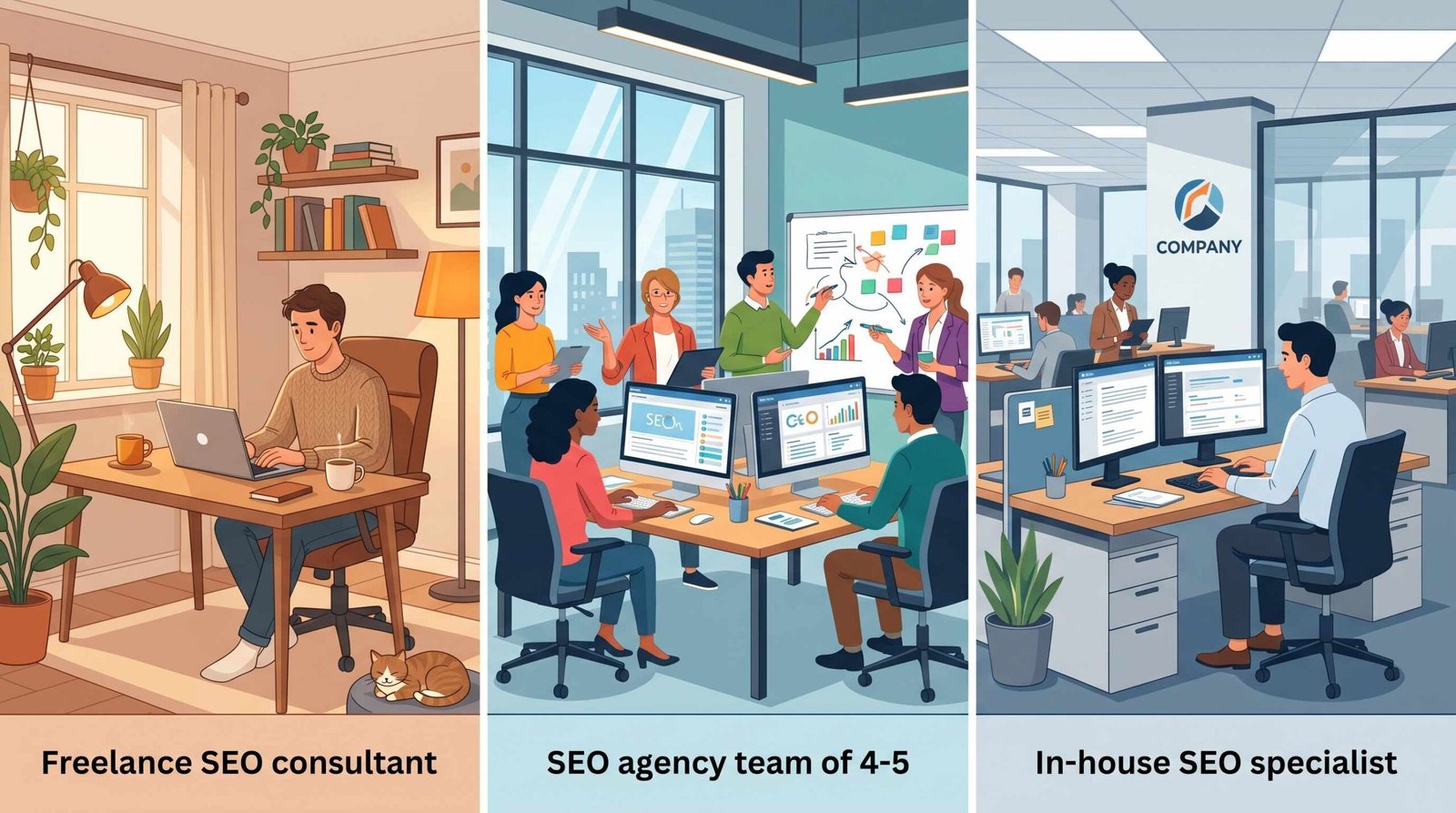
For most companies under $20M in revenue, a freelance SEO consultant is the right answer. You get the senior expertise without the agency overhead, and you get the flexibility to adjust scope as you learn what’s working. Agencies make sense when you genuinely need a team of specialists in parallel: a technical SEO, a content team, a digital PR group, and a paid media counterpart all in one shop. In-house hires make sense when SEO is your dominant acquisition channel and you’ve already proven the ROI with consulting help.
One nuance: some founders need broader help than pure SEO. If your bottleneck is also paid acquisition, lifecycle, and analytics, you might want a generalist digital marketing consultant who can connect SEO into the rest of the funnel rather than treating it as a standalone channel.
How Much Does an SEO Consultant Cost?
This is the question I get more than any other, and the honest answer is “it depends, but here’s the realistic range.” SEO consultant cost varies based on experience, niche, geography, scope of work, and the size of the business hiring them. Below are the rates I see consistently across the 2026 market, drawn from my own pricing, conversations with other practitioners, and what my clients have shopped competitively.
Hourly rates
Hourly engagements work for small audits, one-off strategy sessions, or specific technical fixes. Most experienced freelance SEO consultants charge between $75 and $200 per hour, with senior specialists in technical SEO or specialized verticals (legal, finance, SaaS) running $200-$350 per hour. Anything under $50 per hour is either a junior practitioner still learning or an overseas operator running templated work. Both can deliver value in narrow cases, but they’re not the same product as a senior consultant.
Monthly retainer pricing
Retainers are how most ongoing SEO consulting relationships work, because the work compounds over months. A freelance or boutique retainer typically runs $1,000-$4,000 per month for a small to mid-size business. That usually buys ten to twenty hours per month of senior strategy plus execution. Agency retainers run higher, $3,000-$15,000 per month for similar scope, because you’re also paying for account management, agency overhead, and a layered team. Enterprise SEO agency retainers can climb above $25,000 per month.
Project-based fees
Project fees show up most often for technical SEO audits, site migrations, and one-time strategic deliverables. A thorough technical SEO audit from a senior consultant runs $2,000-$10,000 depending on site complexity. A site migration consultation, where the consultant guides your team through a domain change or replatform, often runs $5,000-$15,000. A keyword research and content strategy project typically lands at $3,000-$7,000.
| Pricing Model | Freelance/Boutique | Mid-Tier Agency | Enterprise Agency |
|---|---|---|---|
| Hourly rate | $75-$200 | $150-$300 | $250-$500+ |
| Monthly retainer | $1,000-$4,000 | $3,000-$10,000 | $10,000-$50,000+ |
| Technical SEO audit | $2,000-$5,000 | $5,000-$10,000 | $10,000-$25,000 |
| Content strategy project | $3,000-$7,000 | $5,000-$15,000 | $15,000-$40,000 |
| Site migration consult | $5,000-$15,000 | $10,000-$25,000 | $25,000-$75,000 |
One thing worth flagging: cheap SEO is almost always more expensive than expensive SEO. I’ve cleaned up enough penalties and Google updates to know what happens when a $300-per-month operator from a marketplace touches your site. Budget for what good SEO actually costs, or wait until you can.
When You Need an SEO Consultant
You need an SEO consultant when search is, or should be, a meaningful part of your customer acquisition strategy, and you don’t have senior internal expertise to lead it. Specifically, I’d say the case for hiring is strong if any of the following are true for your business.
Your product or service category has search demand, which you can verify quickly with a keyword tool. Your buyers actively research solutions before talking to sales, which is true for most B2B and SaaS categories. You’ve already proven you can convert traffic into pipeline through paid channels, and now you want a more durable, lower-CAC source of leads. You have or can produce quality content at a steady cadence, because SEO is not a magic trick that works without content fuel. You can commit to a six to twelve month investment horizon before judging results, because that’s how long competitive SEO takes to compound.
If most of those check out, hiring a consultant will almost certainly pay back many times over. According to HubSpot’s marketing research, organic search consistently ranks as one of the highest-ROI channels for B2B businesses, and that ROI compounds in a way paid acquisition never will. The hard part is just getting through the first two quarters before the curve starts to bend upward.
For SaaS founders specifically, SEO is often the channel where you build defensible distribution. I’ve written more on how it fits into a broader SaaS marketing strategy alongside paid acquisition, lifecycle, and product-led growth. SEO rarely works as the only channel, but it’s frequently the one that quietly accumulates the most leverage over time.
When You DON’T Need an SEO Consultant
This is the section every SEO agency leaves out, because they sell SEO. I’ll be honest with you instead. There are several real scenarios where hiring an SEO consultant is premature, wasteful, or simply the wrong tool for the job. If any of these match your situation, save your money and fix the upstream problem first.
You don’t have product-market fit yet. If you’re still iterating on your core offering and your positioning is in flux, SEO will optimize for the wrong audience. You’ll rank for keywords you’ll later abandon and write content that doesn’t fit the version of your company that exists in eighteen months. Get to repeatable revenue first, then invest in SEO. Until then, you need conversations with prospects, not search traffic.
You need leads in under three months. SEO is a compounding channel, not a fast one. If you have a runway crisis or a quarterly revenue target that requires immediate pipeline, paid acquisition is your tool. Paid Google Ads, paid LinkedIn, paid retargeting. These can produce qualified leads within days. SEO might produce results in eight weeks for narrow technical wins, but the broader content and link strategy is a four to twelve month effort. Don’t ask a slow tool to do a fast job.
Your website has no conversion mechanism. If a visitor lands on your site, what are they supposed to do? If the answer is “uh, read about us and maybe email us,” you don’t have a website problem solvable by more traffic. You have a conversion problem. Build the lead capture, the trial signup, the demo form, or the checkout flow first. SEO without conversion is just a popularity contest.
You can’t produce content at any meaningful pace. Most SEO programs require at minimum two to four pieces of quality content per month to compete. If you don’t have an in-house writer, a content team, or budget to hire freelance writers, hiring an SEO consultant to direct content that never gets produced is wasting money. Build the production capacity first or budget for it in the engagement scope.
Your category has zero search demand. Some categories are truly too new or too niche to have search volume. If you’re creating an entirely new product category that no one is searching for, SEO is the wrong channel. You need outbound, content marketing for category creation, paid social, and partnerships. SEO will catch up later once a category forms.
You’re a tiny local business with five customers a week as your goal. A solo plumber, a small restaurant, a hyperlocal service business often doesn’t need a true SEO consultant. You need a Google Business Profile, a few directory listings, and review generation. That’s a one-time setup, not an ongoing retainer. A full SEO consultant is overkill for that scope.
I lose business every year by telling founders these things on discovery calls. I’m okay with that, because the alternative is taking their money for work that won’t pay off, and that’s how you build a reputation as the consultant nobody wants to hire twice.
How to Hire an SEO Consultant: What to Look For
Once you’ve decided you actually need one, the hiring process matters more than founders typically realize. The signal-to-noise ratio in SEO consulting is bad. There are excellent practitioners, and there are confident salespeople who’ve memorized the vocabulary. Here’s how I’d separate them.
Look for evidence of work, not credentials. Anyone can claim “ten years of experience.” Ask for two or three specific case studies with traffic and revenue context, not just screenshots of rising rankings. The best signal is a consultant who can walk you through a specific project: where the business started, what they did, what went well, what went wrong, and what the actual revenue impact was. If they can’t talk specifically about past work because of NDAs, they should still be able to describe situations and outcomes in detail.
Look for genuine curiosity about your business. The best discovery calls I’ve been on as a buyer involved a consultant asking detailed questions about my revenue model, ICP, sales cycle, current marketing mix, and competitive landscape before they ever talked about SEO. If a consultant launches into their methodology pitch without first understanding your business, they’re going to deliver a generic strategy.
Look for an opinion. Senior consultants have strong opinions about what to do and, more importantly, what not to do. If you ask a consultant “should we target this keyword?” and they say “yes, we could probably do that,” they’re hedging. If they say “no, that’s the wrong intent and here’s why,” they’re showing you how they think. You want the second one.
Questions to ask on the discovery call
I’d suggest bringing these specific questions to every consultant you interview. The answers will tell you most of what you need to know in 45 minutes.
- “What does a typical engagement look like in the first 30, 60, and 90 days?” The answer should sound like a real plan, not a sales pitch.
- “Can you walk me through a client engagement that didn’t work? What went wrong and what did you learn?” A consultant who can’t admit failure has either never failed (unlikely) or is going to hide it from you later.
- “How do you measure success? What KPIs would you report to me each month?” If they don’t mention revenue, conversions, or pipeline, that’s a problem.
- “Who is actually doing the work? Will I be talking to you, or will I be handed off to junior staff after onboarding?” Agencies will hedge this question. Freelancers will give you a direct answer.
- “What’s your view on link building in 2026? How do you approach it?” The answer should involve digital PR, real outreach, and earned mentions. If it sounds transactional, walk away.
- “What tools do you use, and what access will you need from us?” A real consultant uses Search Console, Google Analytics, and one of the major SEO platforms (Ahrefs, Semrush, or Sistrix). They’ll also need editor or owner access on those, not just a screenshot dashboard.
- “What can go wrong, and how do you protect against it?” Senior consultants know how Google updates, algorithm shifts, and competitive moves can disrupt rankings. They should have a thoughtful answer.
Red flags to walk away from
Some warning signs are non-negotiable. If you see any of these, end the conversation politely and keep looking.
Guaranteed rankings. Nobody can guarantee a number one ranking for a competitive keyword. Google’s algorithm is a moving target with hundreds of factors. Anyone who promises “page one in 30 days” is either lying or planning to use tactics that will get your site penalized.
No case studies, no references. If a consultant can’t produce any evidence of past results, even anonymized, you’re being asked to fund their learning curve.
No questions about your business. If their discovery call is mostly them talking about their methodology, the engagement will deliver generic work.
Vague deliverables. “Monthly SEO services” is not a deliverable. The proposal should specify what gets done, when, and what reporting you’ll receive.
Black hat tactics. Buying links from PBNs, doorway pages, hidden text, cloaking, scraped content. Anyone who proposes these is either ignorant or willing to torch your site for short-term wins.
Refusing to give you account access. Any consultant who sets up Search Console, Google Analytics, or other tracking tools under their own ownership instead of yours is creating a hostage situation. Your data should always live in your accounts.
Hard sell tactics. If they’re pressuring you to sign by end of week, “before the price goes up,” that’s not how senior consultants work. Walk.
What Results Should You Realistically Expect?
I’ll give you the timeline I give every founder I work with, because the expectations gap is where most SEO relationships die. SEO is not a fast channel, and it’s not a guaranteed channel. It is, for the right business, the highest-ROI marketing investment you can make on a multi-year horizon. Here’s what reasonable progress looks like.
Weeks 1-4: Audit, discovery, and quick technical wins. You should see indexation and crawl improvements. Some long-tail keywords may move up if there were obvious technical blocks.
Months 2-3: Content production begins, on-page optimization rolls out across priority pages, link building campaigns start. Traffic typically holds steady or shows early movement. Don’t expect breakout numbers yet.
Months 4-6: Compounding starts to show. New content gets indexed and begins ranking on page two or three for target queries. Backlinks from initial outreach start landing. You should see organic traffic up 20-50% over baseline.
Months 7-12: This is where good SEO programs separate from mediocre ones. Content that was on page two moves to page one. Authority builds. Branded search grows. Traffic should be up 50-200% over baseline depending on starting point and competitive density.
Year 2 and beyond: If the program is healthy, you’re seeing compounding traffic growth, declining customer acquisition costs from organic, and SEO becoming one of your most reliable acquisition channels. This is where the real ROI shows up.
If your consultant is selling you faster timelines than this for a competitive market, they’re either over-promising or planning to take shortcuts. Adjust your expectations to match what actually works.
Frequently Asked Questions
How much does an SEO consultant cost per month?
A freelance or boutique SEO consultant typically charges $1,000-$4,000 per month on retainer. Mid-tier agencies run $3,000-$10,000 per month. Enterprise SEO agencies can charge $10,000-$50,000 or more per month. The right budget depends on your business size, the competitiveness of your market, and how aggressive your growth plans are.
How long does it take for SEO to work?
Technical SEO fixes can show impact in four to eight weeks. Content and link building typically take four to twelve months to produce meaningful ranking and traffic gains. Most consultants quote “six months to see real traction” as a reasonable benchmark, but the bigger payoff usually comes in year two as content compounds.
Should I hire a freelance SEO consultant or an SEO agency?
For most businesses under $20M in revenue, a freelance SEO consultant offers better value: senior-level work at a lower price point with direct communication. Agencies make sense when you need a coordinated team of specialists (technical SEO, content, digital PR, paid search) operating in parallel, or when you’re running multi-market campaigns that require more capacity than one person can deliver.
What does an SEO consultant do day to day?
An SEO consultant runs technical audits, optimizes on-page content for target keywords, builds a content strategy and editorial roadmap, conducts link building outreach, and reports on performance against revenue goals. On any given day, that might mean auditing site speed, briefing a writer, reviewing draft content, doing outreach for a guest post placement, or analyzing the latest Google update’s impact.
Can I do SEO myself without hiring a consultant?
For very early-stage businesses with simple sites, basic SEO is learnable. You can read Google’s documentation, set up Search Console, optimize titles and meta descriptions, and write content targeting clear keywords. The point of diminishing returns hits fast though. Once you’re competing in a meaningful market, the gap between DIY SEO and senior consultant work compounds quickly and a consultant pays back many times over.
What’s the difference between an SEO consultant and a digital marketing consultant?
An SEO consultant focuses specifically on organic search performance. A digital marketing consultant covers a broader set of channels, including paid acquisition, email, lifecycle, analytics, and sometimes content and brand. If your bottleneck is search, hire an SEO consultant. If your bottleneck is the overall go-to-market strategy and channel mix, hire a generalist or, in some cases, a marketing automation consultant for the operational side.
If you’re looking for an SEO consultant who understands the full marketing picture, not just rankings, get in touch. I work with a small number of SaaS and B2B companies each year, focused on results that actually move revenue.
Recent Comments