

How to Hire a Freelance Digital Marketer: What to Look for in 2026
To hire a freelance digital marketer in 2026, define your marketing goals clearly, choose channel-specific specialists over generalists for execution work, evaluate candidates through case studies that show revenue impact (not just traffic), test their attribution thinking with direct questions about how they connect activity to business results, and start with a 4-6 week scoped project before committing to a retainer.

Hiring a freelance digital marketer sounds simple until you start interviewing candidates. Everyone has a portfolio. Everyone has case studies. Everyone claims they grew traffic by 300% or generated millions in pipeline for a previous client. After fifteen years in marketing consulting, I can tell you the difference between marketers who deliver business outcomes and those who deliver impressive-looking dashboards comes down to one thing: how they think about attribution.
Most hiring guides give you the same surface-level advice: check the portfolio, read reviews, look at testimonials. Useful, but insufficient. If you stop there, you’ll end up with a freelance digital marketer who optimizes for what’s easy to measure (clicks, rankings, follower growth) rather than what actually moves your business (qualified pipeline, customer acquisition cost, retention). This guide goes deeper into the evaluation criteria that separate good freelancers from great ones, and that protect your marketing budget from being burned on vanity metrics.
What Does a Freelance Digital Marketer Actually Do?
Before you start interviewing, get clear on what work you actually need done. The phrase “freelance digital marketer” covers a wider range of capabilities than most hiring managers realize, and the wrong fit costs you months of wasted spend.
Services vs. Strategy: The Distinction That Determines Who You Need
Most businesses conflate two very different roles. A freelance digital marketing specialist who executes runs campaigns, writes ad copy, builds email sequences, manages social platforms, optimizes landing pages, and ships work product day-to-day. A strategist, by contrast, determines which channels you should be in at all, how those channels should connect to your sales funnel, how you’ll measure success, and how marketing rolls up to broader business goals.
You may need one, the other, or both, but they are not interchangeable. Executive-level strategy consulting is a different engagement from channel-level execution. Hiring an execution specialist without a strategy in place produces wasteful spend: a paid search expert will run paid search, even if your business model is better served by content and partnerships. Hiring a strategist without execution capacity gives you a beautifully written 30-page plan that sits in a Google Drive folder and never gets implemented.
Be honest about which role you’re filling. If your internal team has a clear strategy and you need hands to execute, hire a specialist. If you’re unsure where to invest and how to measure, hire a strategist first, then bring in execution support after the plan is clear.
Generalist vs. Specialist: Which Fits Your Stage?
Early-stage companies under $2M in revenue typically benefit from generalists who can handle multiple channels at a basic level. You’re testing what works, you don’t yet know which channels deserve investment, and you can’t afford five specialists. A capable generalist freelance digital marketer can run an email program, manage a small paid budget, and produce content while you figure out where the real leverage is.
Growth-stage companies with established channels need the opposite. Once you know paid search is your primary acquisition channel, a generalist managing it part-time will leave money on the table. You want a paid search specialist who lives in Google Ads daily, knows the latest bidding strategy changes, and has tested every Performance Max permutation. The same applies to SEO, email, and CRO.
A note on the so-called full-stack freelance digital marketer who claims to do SEO, paid, email, and content well: this person is rare. Most who claim to do everything do some things adequately and others poorly. The marketers I trust most have a clear primary specialization and acknowledge what they don’t do.
Where to Find Qualified Freelance Digital Marketers
Professional Platforms and Directories
Each platform has tradeoffs. Here’s an honest breakdown of where to source candidates:
- LinkedIn: The largest pool of freelance digital marketers. Search by specialization plus “open to freelance” or “fractional CMO” or “consultant.” You get access to nearly every working marketer, but you have to do the outreach and vetting yourself.
- Toptal’s digital marketing network: Pre-vetted, generally senior-level talent. Premium rates (often 30-50% above market). Useful when you need someone reliably good and don’t want to filter through candidates.
- Clutch.co: Directory with verified reviews. Quality is variable, but the review process is more rigorous than most marketplaces. Good for finding freelancers and small studios with documented track records.
- Contra: No-commission freelancer hiring platform. The pool skews younger and more design-adjacent, but you’ll find digital marketers there at competitive rates.
- Direct referrals: The highest signal source by far. A freelance digital marketer recommended by a peer marketing director who has worked with them is worth ten platform candidates.
If you’ve never worked with freelance specialists before, consider how I’ve structured similar guidance in the post on how to hire a freelance copywriter. The vetting principles overlap, particularly around scoping a trial engagement.
Finding Specialists by Looking at Their Work
My favorite sourcing method bypasses platforms entirely: find the output first, then the person.
For SEO freelancers, search for sites ranking well in adjacent niches and check the author byline. Many SEO specialists who consult also write thought leadership pieces, and their author bios link to consulting services. The fact that they’re ranking in competitive spaces tells you more than any case study deck could.
For paid search and paid social specialists, browse LinkedIn for people at agencies you respect, then filter for those who recently went independent. A senior paid search manager who left a top-tier agency to freelance often brings agency-level rigor at freelance pricing for the first 12-18 months.
For email marketers, read the marketing newsletters you actually open. Authors who write well about lifecycle marketing, segmentation, and retention often consult on the side. Their writing is their case study.
For content strategists, find blogs that produce content you’d want for your own brand. Check the byline. Reach out.
This find-via-output approach selects for marketers whose work is visible, tested in market, and worth ranking, sharing, or subscribing to. It cuts through the platform noise.
How to Evaluate a Freelance Digital Marketer
Reading Case Studies Critically
A good case study includes five components: specific starting point (baseline metrics), specific outcome (final metrics with timeframe), methodology used (what they actually did), timeline (how long it took), and context (industry, company size, budget constraints, internal team dynamics). If any of these are missing, the case study is marketing collateral, not evidence.
What to be skeptical of: case studies that only show top-of-funnel metrics. “Grew organic traffic by 400% in 6 months” tells you nothing about whether that traffic converted, what it cost, or whether it drove revenue. Traffic without conversion context is marketing theater. I’ve seen freelance digital marketing specialists proudly present traffic charts for clients whose revenue was flat or declining during the same period. They optimized for the dashboard, not the business.
Ask candidates: “What was the revenue impact?” If they don’t know, ask why they don’t know. The answer reveals whether they were involved in the business-level conversation or were treated as a pure execution vendor. Both can be valid, but you want a marketer capable of the former.
The Attribution Question: How They Think About Results
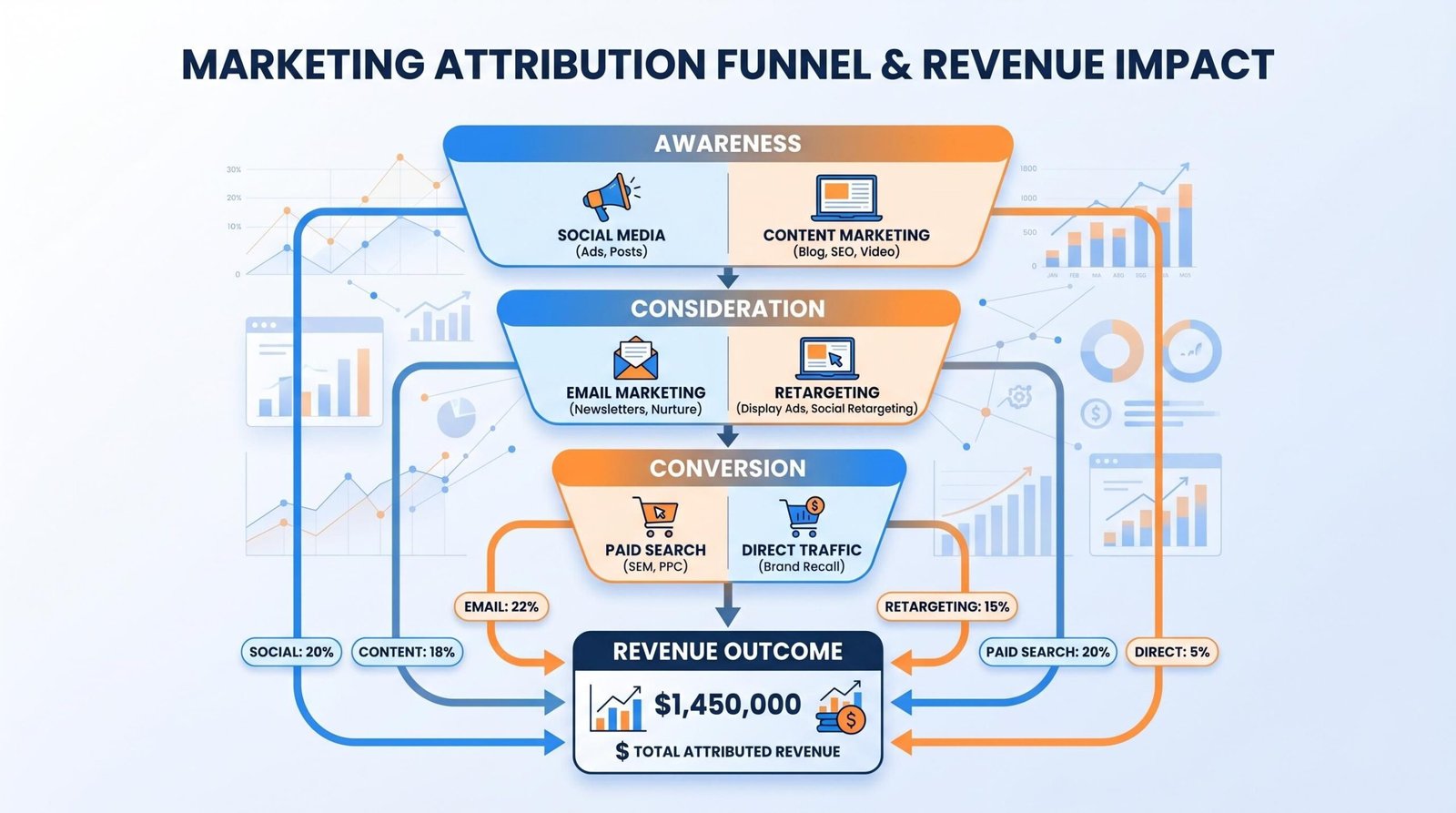
This is the single most important section in this entire guide. If you read nothing else, read this. Attribution thinking is the variable that separates digital marketers who drive ROI from those who drive impressive-looking but disconnected metrics.
Ask every freelance digital marketer candidate this question, exactly as written: “How do you determine which marketing channels are actually driving revenue for your clients?”
A good answer will reference multi-touch attribution models (whether linear, time-decay, position-based, or data-driven). It will discuss the limitations of first-click and last-click attribution and explain when each is acceptable as a simplifying assumption. It will mention UTM parameter discipline, the structural problem of dark social and direct traffic, the limitations of GA4’s default attribution windows, and the gap between platform-reported conversions and CRM-validated revenue. It will show healthy skepticism toward vanity metrics and acknowledge that no attribution model is perfect, just better or worse for specific decisions.
A bad answer references only last-click analytics. A worse answer just shows you traffic and ranking dashboards. A disqualifying answer says, “I don’t really get into attribution, I focus on what I can control.” That marketer will burn your budget on whatever is easiest to measure, regardless of whether it generates revenue.
The deeper point: a freelance digital marketer who can’t explain attribution is flying blind. They’ll optimize for what’s measurable (clicks, rankings, follower counts, impressions) rather than what matters (qualified pipeline, customer acquisition cost, revenue, retention). You’ll spend money for six months, receive reports full of improving green charts, and have no idea whether any of it connected to your business. Worse, when you ask, the marketer will get defensive because they can’t actually tell you.
Follow up with three specific probes:
- “Walk me through how you track the impact of your SEO work on lead generation, not just rankings or traffic.”
- “If a campaign has strong click-through but low conversion, how do you diagnose the problem? What’s your sequence of investigation?”
- “How do you report on marketing performance to non-marketing stakeholders, like a CFO or CEO who doesn’t care about CTR?”
Marketers who answer these well think in terms of business systems. They translate marketing activity into language a finance team will respect. They acknowledge what they can’t perfectly measure and propose proxies. Marketers who answer poorly retreat into channel jargon and avoid the revenue connection.
This single line of questioning, applied across three or four candidates, will sort them quickly. The freelancers who light up at the attribution question are the ones you want. Those who deflect or oversimplify are the ones who will produce reports full of improving metrics that mean nothing to your bottom line.
Red Flags in the Vetting Process
Watch for these specific warning signs:
- Guaranteed rankings or guaranteed results: No reputable freelance digital marketer guarantees outcomes. Google’s algorithm doesn’t take their requests. Anyone promising a #1 ranking is either lying or planning to use tactics that will get your site penalized.
- Single-channel insistence regardless of fit: If a candidate recommends the same solution (paid search, or TikTok, or email, or SEO) to every business they encounter, they’re selling what they sell rather than diagnosing what you need. Be wary of the freelancer whose hammer makes everything look like a nail.
- Can’t explain why they chose a specific tactic in their case study: “Why did you prioritize Google Ads over LinkedIn Ads for this client?” If they say “because that’s what I do” rather than walking you through the customer journey logic, they’re a technician, not a strategist.
- Hasn’t updated their knowledge in 2+ years: Digital marketing moves fast. The 2023 SEO playbook is partially obsolete in 2026. Ask what’s changed recently in their specialty and how they’ve adapted. A blank stare is disqualifying.
- Defensive about transparency in reporting: The right answer to “Can we see the raw data, not just your summaries?” is “Of course.” Defensiveness here predicts future opacity. Standards from organizations like the American Marketing Association emphasize transparent measurement, and any professional freelance digital marketer should welcome it.
Freelance Digital Marketer Rates in 2026
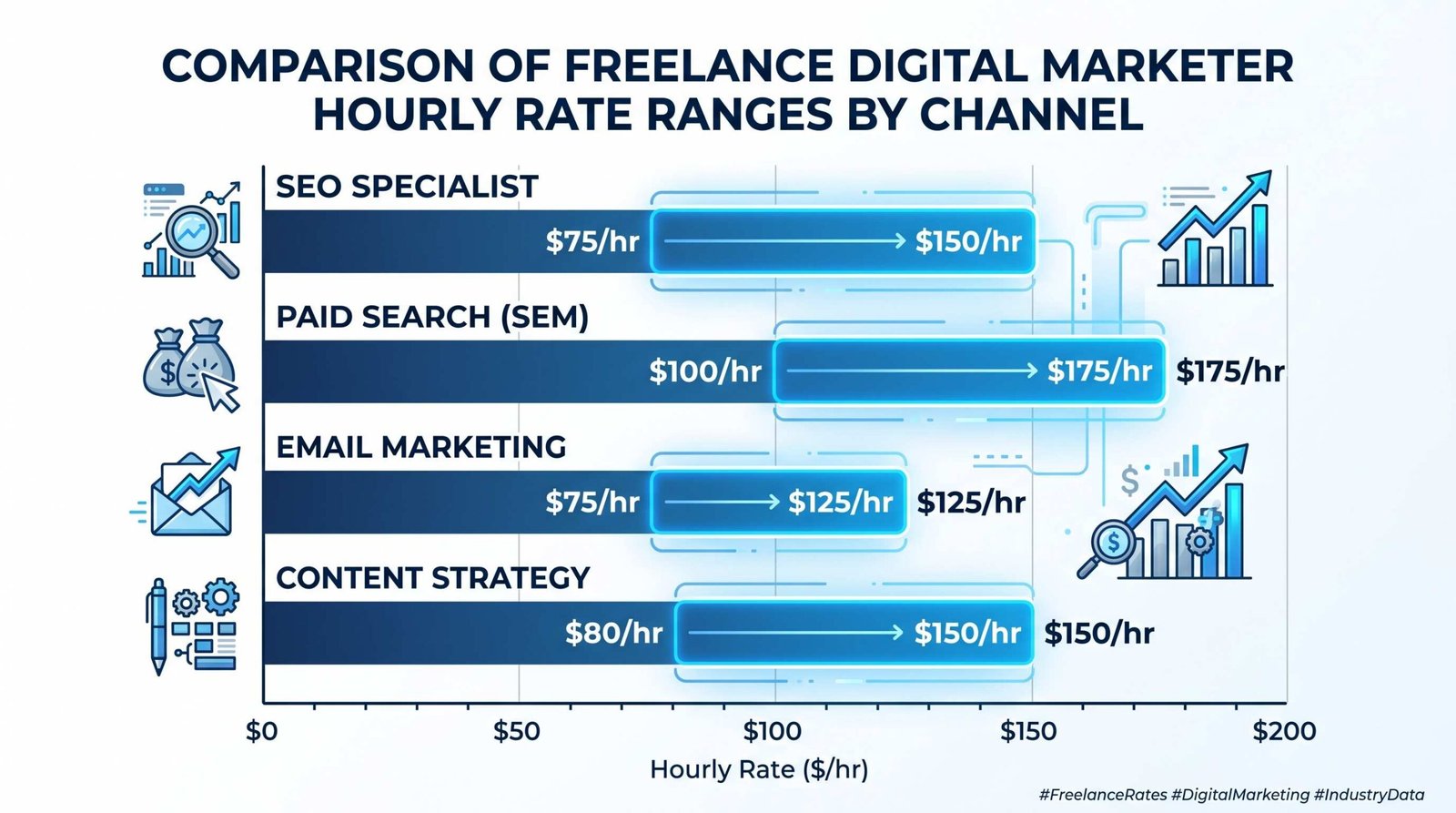
Rates vary significantly by experience, geography, and niche. The figures below reflect U.S.-based freelance digital marketers with 5+ years of experience working with B2B and DTC businesses in 2026. Data points are drawn from publicly available salary surveys, conversations with my own network, and rate cards I’ve reviewed over the past 12 months. For a broader rate benchmark, the Glassdoor salary database is a useful cross-reference.
| Marketing Channel / Specialization | Hourly Rate Range | Monthly Retainer Range | Project Rate (where applicable) |
|---|---|---|---|
| SEO Specialist | $95 – $200 | $3,500 – $9,000 | $3,000 – $7,500 (audit) |
| Paid Search (Google / Meta Ads) | $110 – $225 | $4,000 – $12,000 | $2,500 – $6,000 (campaign build) |
| Email Marketing | $85 – $175 | $2,500 – $7,500 | $3,000 – $8,000 (lifecycle sequence) |
| Content Strategy | $100 – $225 | $3,500 – $10,000 | $4,000 – $9,000 (content plan) |
| Social Media Management | $65 – $150 | $2,000 – $6,500 | Project rates uncommon |
| Full-Stack Digital Marketing | $125 – $250 | $5,500 – $14,000 | $5,000 – $12,000 (audit + roadmap) |
| Conversion Rate Optimization (CRO) | $135 – $275 | $4,500 – $11,000 | $3,500 – $9,500 (test program) |
A few notes on interpreting these freelance digital marketer rates. Senior specialists in competitive niches (B2B SaaS, fintech, healthcare) command the upper end. Generalists and those serving small local businesses cluster at the lower end. Retainer rates assume 20-40 hours of monthly work; expect a discount of 10-20% versus hourly pricing in exchange for predictable commitment. Project rates are most common in audit, strategy, and one-time build engagements. Ongoing optimization is almost always retainer-based.
If a freelance digital marketing specialist quotes you significantly below these ranges, ask why. The answer might be legitimate (early career, hungry for portfolio work, niche specialization with lower competition), or it might be a signal that they don’t know what they’re worth, which often correlates with the depth of their work.
Freelance Digital Marketer vs. Marketing Agency: When to Choose What
The freelance digital marketer vs agency question is one I get from clients every month. Both models have legitimate uses; the right choice depends on your stage, complexity, and internal capability.
Freelancers offer lower cost (typically 40-60% less than equivalent agency engagement), direct access to the person doing the work (no account manager filter), flexible scope (you can scale up or pause without contractual penalties), faster onboarding and offboarding, and a cleaner feedback loop. They work best for companies with existing internal marketing strategy who need execution depth in one or two channels, or for early-stage companies running lean tests.
Agencies offer project management overhead (a feature, not a bug, for complex multi-stakeholder campaigns), team breadth covering multiple specializations under one roof, consistent delivery even when individual contributors leave (continuity through the agency relationship), and structured processes for QA, brand consistency, and cross-channel coordination. They work best for large multi-channel campaigns requiring tight orchestration, enterprises with significant brand-safety requirements, and companies that genuinely need more than one specialist working simultaneously.
My honest take after consulting with hundreds of growing companies: most should try a vetted freelance digital marketer before moving to agency retainers. The cost is lower, you learn faster about what actually drives results in your specific business, and you avoid the agency tendency to apply templated approaches across very different clients. Move to an agency when complexity exceeds what one freelancer can coordinate, not because the agency pitch sounded more impressive.
Setting Up the Engagement for Success
Scope of Work, KPIs, and Reporting Cadence
Define what success looks like before you sign anything. This is the part that nine out of ten engagements skip, and it’s the part that causes nine out of ten engagement disputes six months later.
KPIs should connect to business outcomes, not just marketing metrics. The right KPIs are leads generated, MQLs, SQLs, conversion rate, customer acquisition cost, payback period, and revenue influenced. The wrong KPIs (in isolation) are traffic, impressions, engagement rate, follower growth, and click-through rate. The marketing metrics matter as diagnostic inputs, not as the primary scorecard. A marketer who quietly substitutes the second list for the first is setting up a future argument.
Define reporting cadence explicitly: weekly async updates (Slack or Loom) showing what shipped and what’s queued, monthly strategic review meetings (60-90 minutes) covering performance, learning, and next priorities. Define “good reporting” in writing. You want to see what worked, what didn’t, what you learned, and what the next priority is, with the marketer’s interpretation, not a dashboard of green metrics with no interpretation.
If you’re building out a broader digital strategy alongside the freelance engagement, my digital marketing services page outlines how strategy work integrates with execution support.
Starting with a Scoped Project Before Retainer
We suggest a 4-6 week scoped project before committing to a monthly retainer. Specific examples: a comprehensive SEO audit with a 90-day roadmap, a paid search campaign build with the first 30 days of optimization, a six-email lifecycle sequence with copy and segmentation logic, or a conversion rate optimization audit with three prioritized tests. The deliverable should be substantial enough to evaluate the marketer’s process and output quality, but contained enough that ending the engagement after the project is clean.
During the trial project, you see their actual work process, their communication style, their responsiveness, and whether their output quality matches their pitch. You also learn whether they ask good questions about your business or just execute what they were told. The latter type is a freelance digital marketing specialist; the former is a partner.
The best freelancers expect the trial structure and welcome it because they know they’ll convert most of them to retainers. Those who insist on long-term retainer commitments upfront, without offering a trial, are a yellow flag. Either they’re financially insecure (which limits their ability to focus on your work), or they’re worried their initial output won’t justify continued engagement. Both signals are worth taking seriously.
Frequently Asked Questions About Hiring a Freelance Digital Marketer
How much does a freelance digital marketer charge?
Freelance digital marketer rates in 2026 typically range from $85 to $275 per hour depending on specialization and experience, with monthly retainers ranging from $2,000 to $14,000. SEO and email specialists tend to fall in the middle of these ranges, while CRO and senior full-stack consultants command premium pricing. Project-based engagements range from $2,500 to $12,000 depending on scope.
What’s the difference between a freelance digital marketer and an agency?
A freelance digital marketer is an individual contractor working directly with you, while an agency is a team of specialists coordinated through account management. Freelancers cost 40-60% less, provide direct access to the person executing the work, and offer flexible scope. Agencies provide breadth, project management overhead, and continuity, at higher cost and with more layers between you and the work.
Do I need a full-time digital marketer or will a freelancer suffice?
If marketing is core to your business and demands more than 30 hours per week of dedicated attention, a full-time hire usually makes economic sense. If your needs are 20 hours per week or less, or if you need senior expertise in a specific channel without paying senior salary, a freelance digital marketer is typically the better choice. Many growing companies use freelancers for two to four years before hiring in-house.
How long does it take to see results from a freelance digital marketer?
Channel matters significantly. Paid search and paid social can show meaningful results in 4-8 weeks. Email marketing improvements show in 30-60 days. CRO programs need 60-90 days to produce statistically valid test results. SEO is the slowest, with meaningful organic traffic and ranking changes taking 4-9 months. Any freelance digital marketer who promises faster results in a channel is either overselling or planning shortcuts that won’t last.
What should be in a freelance digital marketing contract?
A solid contract includes: scope of work with specific deliverables, KPIs and how they’ll be measured, reporting cadence and format, payment terms and rate structure, intellectual property ownership (your data, your accounts, your assets stay yours), confidentiality clauses, termination terms (typically 30 days’ notice on retainer engagements), and access provisions (you own the Google Ads account, the freelancer is granted access, not the reverse).
How do I measure if my freelance digital marketer is performing?
Measure against the business outcomes you defined at the start, not the marketing metrics they choose to report. Are qualified leads, pipeline, or revenue trending in the right direction? Can your freelance digital marketer explain why metrics moved (not just report that they did)? Are they generating insights you didn’t already have? Strong performers improve your understanding of your own marketing, not just the numbers on a dashboard.
Recent Comments