

Growing companies hit a wall around $1M to $10M ARR where the marketing function stops being something a smart founder can run on the side, but the business still can’t justify a $290,000-a-year hire. You need someone senior. You need someone who’s done this before. And you need that person available now, not after a six-month search.
That’s the problem a fractional CMO solves. You get an experienced marketing executive embedded in your business for a fraction of the cost of a full-time hire, with the strategic horsepower to set direction, fix what’s broken, and build the team you actually need. It’s become one of the most efficient ways to bring senior marketing leadership into a growth-stage company.
But it’s not the right answer for every business. I’ve turned down engagements where I knew a fractional CMO wasn’t what the company needed. This guide will walk you through what a fractional CMO actually does, what it really costs, how to evaluate one, and just as importantly, when hiring one is the wrong move.
A fractional CMO is a senior marketing executive who works with a company on a part-time, contract basis, typically 10 to 20 hours per week. They provide the strategic leadership of a full-time Chief Marketing Officer, including marketing strategy, team management, and executive reporting, but at a fraction of the cost. Most engagements run on monthly retainers between $5,000 and $15,000.
What Is a Fractional CMO?
A fractional CMO is an experienced marketing leader, usually someone who has held a full-time VP or CMO seat at multiple companies, who works with you on a retainer basis instead of as a W-2 employee. The “fractional” part refers to time commitment, not seniority. You’re getting an executive-grade operator, just not 40 hours a week.
The engagement structure varies. Some clients want 10 hours a week of strategic oversight, weekly leadership meetings, and quarterly planning. Others want a heavier 15 to 20 hour commitment where the fractional CMO is running the full marketing function, hiring managers, sitting in on board meetings, and owning the marketing P&L. The arrangement is almost always month-to-month or quarterly, with no equity, no benefits, and a clean exit if it isn’t working.
Here’s what makes a fractional CMO different from the other options on the table. A marketing consultant typically delivers a project, a deck, or a recommendation, then leaves. A fractional CMO stays embedded in your operation, owns outcomes, and reports to your leadership team like any other executive. An agency executes campaigns; a fractional CMO decides which campaigns to run and why. A senior freelance marketing consultant may overlap in skills, but a fractional CMO operates with executive scope, including responsibility for the team, the budget, and the C-suite relationship.
The simplest way to think about it: a fractional CMO is the marketing executive you’d hire full-time if you had unlimited budget, working with you part-time at a price you can actually afford. They sit in the executive seat, set the strategy, manage the team, and answer to the CEO and board. They just don’t sit at your office every day.
Fractional CMO vs. Your Other Options
Most founders considering a fractional CMO are also considering three alternatives: a full-time hire, an agency, or a freelancer. Each makes sense in different scenarios. Here’s how they stack up.
| Option | Cost Range | Time Commitment | Strategic vs. Tactical | Best For | Key Trade-off |
|---|---|---|---|---|---|
| Fractional CMO | $5K–$15K/month | 10–20 hrs/week | Strategic with oversight of tactical | $1M–$50M ARR companies needing senior direction | Not full-time; you share their attention |
| Full-Time CMO | $290K–$305K/year all-in | 40+ hrs/week | Strategic + people leadership | $25M+ ARR with complex marketing org | High cost, long ramp, hard to fire |
| Marketing Agency | $3K–$50K+/month | Project-based | Tactical execution | Companies with a strategy who need execution capacity | Limited strategic ownership, multiple-client attention |
| Freelance Marketer | $75–$200/hour | Variable | Specialist tactical | Specific deliverables (SEO, paid ads, content) | No strategic oversight, no team management |
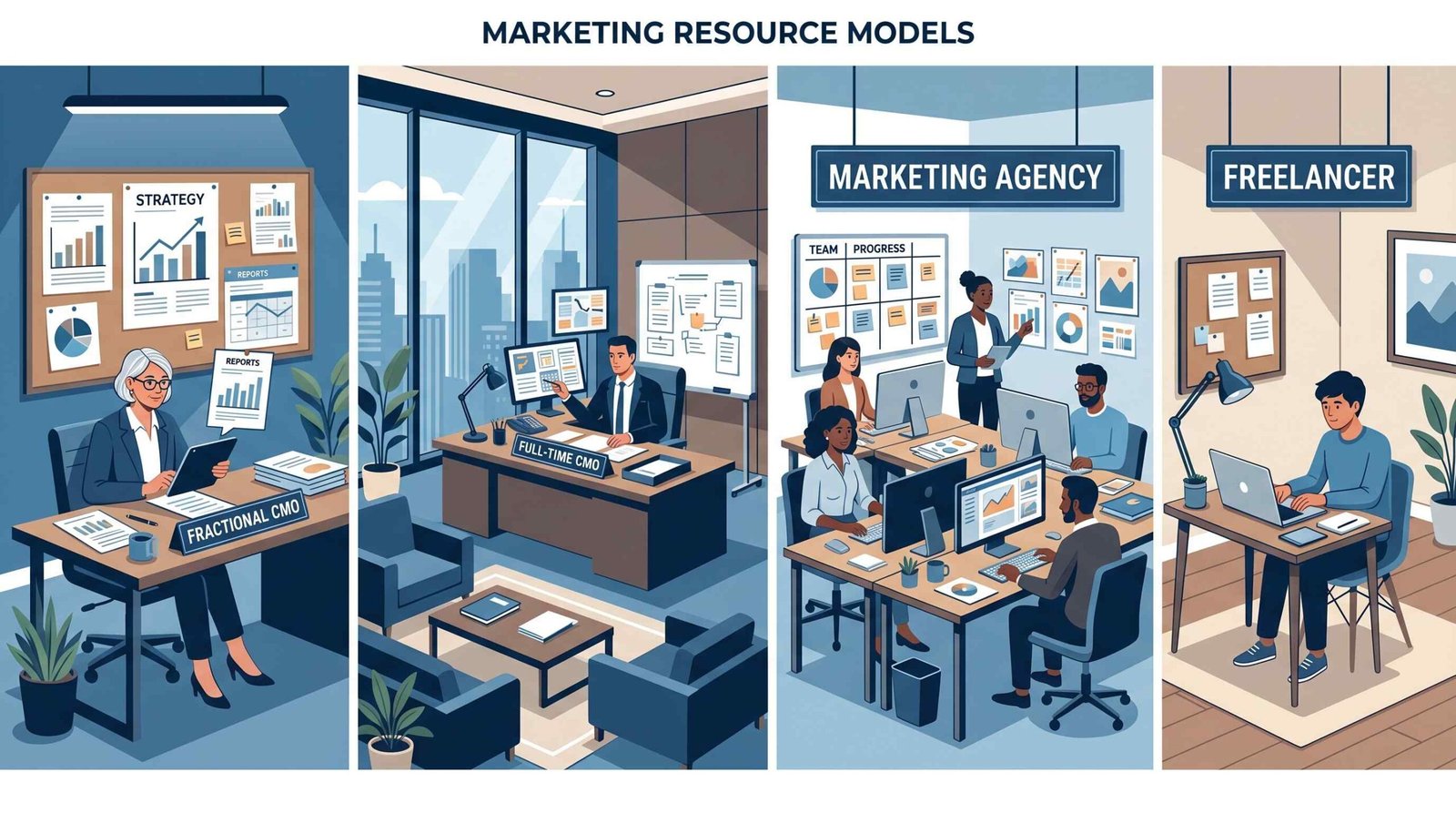
A full-time CMO makes sense when your marketing org is large enough to justify a dedicated executive, you have a complex go-to-market motion across multiple segments, and you need someone whose full attention is on your business. Below about $25M ARR, that math rarely works. You end up paying for capacity you don’t use.
An agency is the right choice when you already have strategic direction and you need executors. The best agencies are very good at running paid acquisition, building content engines, or producing creative. They’re not designed to set your company’s marketing strategy, and most won’t be honest about that.
A freelancer fills a specialist gap. If you need a senior freelance SEO consultant or someone to manage your paid social, a freelancer is faster and cheaper than a fractional CMO. But a freelancer won’t run your team, won’t sit in board meetings, and won’t tell you that your positioning is the actual problem.
The fractional CMO sits between these. You get the strategic seat without the full-time cost, and you keep the option to add agencies or freelancers underneath. In most engagements I run, my job is partly to figure out which of those external partners we should actually be working with.
What a Fractional CMO Actually Does (Day by Day)
Generic answers like “provides strategic leadership” don’t help you decide if you need one. Here’s what the work actually looks like, broken down by phase.
First 30 Days
The first month is almost entirely diagnostic. When I take on a new client, the first thing I’m doing is interviewing every relevant stakeholder: the CEO, sales leadership, customer success, product, and every member of the existing marketing team. I’m looking for the gap between what the company thinks is happening in marketing and what’s actually happening. Those two pictures are almost never the same.
Then comes the audit. Channel performance over the trailing 12 months, CAC by source, content inventory, brand audit, website conversion data, tech stack review, and a hard look at the marketing team’s capabilities. I’m not building a strategy yet. I’m getting honest about where the business is. By the end of week four, the CEO should have a written assessment that says: here’s what’s working, here’s what’s broken, here are the three things we should focus on, and here’s what we’re going to stop doing.
Days 31 to 90
This is where the roadmap gets built. The marketing strategy lands, with quarterly priorities, channel investment levels, team structure recommendations, and the KPIs we’re going to track. If there’s a need for a SaaS marketing strategy overhaul, this is when that work gets done. We’re also picking the early wins, the projects that will produce visible results inside 90 days and build credibility with the broader team.
Team coaching kicks in around day 45. I’ll often start running weekly 1:1s with the senior marketers on the team, partly to develop them and partly because I need to know who’s strong, who’s struggling, and who needs to be replaced. Vendor reviews happen here too. Agencies that aren’t producing get put on notice or cut.
Ongoing
Once the roadmap is in motion, the work shifts to oversight, optimization, and executive alignment. Weekly campaign reviews. Monthly metrics reporting to the CEO. Quarterly board updates if the company is investor-backed. Hiring decisions when we need to add capacity. Vendor management for paid media, agencies, and freelancers. And ongoing coaching for the team leads who are now running the day-to-day. Many of my clients end up needing a marketing automation consultant or specialist underneath the strategy I’m running, and part of my job is to identify and manage those specialists.
What a fractional CMO does NOT do is also worth being explicit about. They don’t write your blog posts, they don’t build your email automations, and they don’t run your paid ads day to day. If you need someone to execute, you need to hire executors. The fractional CMO designs the system and ensures the executors are doing the right work. They are also not cheap junior talent. The whole point of bringing in a fractional CMO is the seniority. If your budget pressure makes you want to negotiate hard on hourly rate, that’s usually a signal that you don’t actually need a fractional CMO yet.
How Much Does a Fractional CMO Cost?
Pricing varies based on seniority, time commitment, and scope, but the market has settled into fairly predictable bands.
| Engagement Type | Typical Rate | What’s Included |
|---|---|---|
| Hourly | $200–$400/hr | On-call advisory, ad hoc strategic input, occasional working sessions |
| Monthly retainer (10–15 hrs/week) | $5,000–$10,000/mo | Marketing strategy, weekly team oversight, executive reporting |
| Monthly retainer (15–20 hrs/week) | $10,000–$15,000/mo | Full marketing function leadership, hiring, vendor management, board reporting |
| Project / defined scope | $15,000–$50,000 | Specific deliverable: product launch, brand refresh, GTM strategy, marketing audit |
Now compare that to the full-time math. According to Built In’s 2026 data, the average CMO base salary of $225,908 is just the starting point. Once you layer in bonus, equity, and employer-side costs, the picture gets uglier. The Bureau of Labor Statistics tracks the employer cost of employee compensation, and benefits, payroll taxes, and other employer-paid items typically add 28 to 35 percent on top of base salary. Add bonus and equity grants for an executive-level hire, and you’re looking at a true loaded cost of $290,000 to $305,000 per year.
A fractional CMO at $10,000 per month works out to $120,000 per year. That’s roughly 59 percent savings at equivalent seniority level. You’re getting seniority without the salary, with the additional benefit that you can scale the engagement up or down, or end it entirely, without severance, without legal risk, and without the org chart upheaval of a full-time departure.
Factors that move pricing within these ranges include the seniority and track record of the operator (a former public-company CMO costs more than someone with a single VP tour), the time commitment you’re asking for, industry specialization (SaaS, fintech, healthcare, and DTC tend to command premiums for relevant operators), and scope complexity. A multi-product company with international operations is a heavier lift than a single-product startup, and the rate reflects that.
One more thing on cost: be wary of anyone quoting below $5,000 per month for a true fractional CMO engagement. Either they’re not actually senior enough to deliver executive value, or they’re stretched across so many clients that you’ll get a sliver of their attention. The math has to work for both sides.
When to Hire a Fractional CMO
Here are the situations where I consistently see a fractional CMO produce outsized value. If two or three of these describe your business, it’s probably time to start interviewing.
You’re past roughly $1M ARR and marketing feels reactive. You’re spending money, you’re running campaigns, but everything feels like fire-fighting. There’s no quarterly plan that holds up past week three. This is the most common scenario I see. The business has grown past what founder-led marketing can sustain, but no one has stepped into the strategic seat.
You have a marketing team but no one setting direction. You’ve hired a content marketer, a paid media manager, maybe a marketing ops person. They’re all working hard. None of them are senior enough to set the company’s marketing strategy, and they’re spending half their time asking each other and the CEO what to do. This team needs a leader, not another individual contributor.
You’re preparing for a raise, an acquisition, or a market expansion. Investors and acquirers look hard at marketing infrastructure. If your CAC story is messy, your attribution is broken, or your pipeline forecasting is fiction, you’ll pay for it in valuation. A fractional CMO can clean up the marketing story before you have to tell it to a board or a buyer.
Your CAC is rising and you don’t know why. I get calls from founders who describe the same situation: they have a team, they’re spending on ads, and they have no idea which channel is actually working. They know efficiency is declining but they don’t know if it’s a channel problem, a positioning problem, a sales problem, or a product problem. Figuring that out is exactly what a fractional CMO does in their first 30 days.
You’ve tried agencies but aren’t getting strategic direction, just execution. The agency runs campaigns. The campaigns produce numbers. But no one is connecting those numbers to a strategy that ties to the business goals. This is one of the most common reasons founders bring in a fractional CMO: they realize they need someone above the agency, not another agency.
You’re a SaaS company that has outgrown founder-led marketing. SaaS has specific challenges around content marketing for SaaS companies, product-led growth motions, retention metrics, and the interplay between marketing and customer success. These are nuanced enough that a generalist may not be enough, and a fractional CMO with SaaS depth becomes a high-leverage hire.
When NOT to Hire a Fractional CMO
This is the section every other article on this topic skips, and it’s the one I think matters most. A fractional CMO isn’t right for every business, and the wrong engagement burns money and trust on both sides. Here’s when to look elsewhere.
You need execution bandwidth, not strategic direction. If you already have a clear strategy and what you actually need is more hands to run campaigns, write content, or manage ads, you don’t need a fractional CMO. Hire a marketer, hire an agency, hire a freelancer. A fractional CMO will be expensive overkill, and frankly, they’ll be bored.
You’re below $500K ARR and budget is the real bottleneck. At that stage, the answer is rarely “more strategic thinking.” It’s more likely product-market fit, founder-led sales, or scrappy growth experiments the founder runs themselves. Paying a fractional CMO $5,000 to $10,000 a month at $400K ARR is a misuse of capital. Spend that money on demand generation and figure out the playbook yourself first.
You want someone to run everything full-time without paying for full-time. This is the most uncomfortable conversation I have with prospective clients. They want CMO-level attention every day, every meeting, every decision, but they want to pay $7,500 a month for it. That math doesn’t work. A fractional CMO can give you 15 hours a week of executive attention; they cannot give you 40. If you need 40, you need a full-time hire, even if it stretches the budget.
You haven’t defined what success looks like. I’ve turned down engagements because the founder couldn’t answer the question “what does good look like in 90 days?” If you don’t know what you’re trying to achieve, no CMO, fractional or otherwise, can succeed. The first step isn’t hiring a marketing leader. It’s getting clear, internally, on what outcome you’re paying for.
You’re looking for someone to validate decisions you’ve already made. Some founders hire a senior marketer hoping they’ll confirm the playbook the founder already wants to run. The best fractional CMOs will tell you when they think you’re wrong. If you’re not actually open to changing direction, you don’t want a fractional CMO. You want a contractor who’ll do what you tell them.
Your marketing team is dysfunctional in ways that require structural change first. If your team is broken because of organizational issues, unclear roles, conflict between sales and marketing, or chronic underinvestment, a fractional CMO can help, but only after leadership commits to fixing those structural problems. Otherwise the engagement becomes therapy instead of strategy.
How to Find and Evaluate a Fractional CMO
The best fractional CMOs rarely show up on the first page of search results. They’re working, not marketing themselves. Here’s how to find good ones.
LinkedIn is the obvious starting point. Search for people whose title includes “Fractional CMO” or “Fractional Chief Marketing Officer,” and look at their work history. You want someone with at least one full-time VP or CMO tour, ideally in a company stage and industry similar to yours. Referrals from investors, board members, and other founders are usually the highest-signal source. Investors in particular have seen dozens of fractional CMOs across portfolio companies, and they know who delivers.
Fractional talent networks are another route. Platforms like Toptal, Catalant, Expert DOJO, and Chief Outsiders curate fractional executive talent. The vetting varies, so do your own due diligence regardless of the platform. Some networks lean toward generalists; others have deep specialists in SaaS, ecommerce, or healthcare. Mention your industry early in conversations to make sure you’re talking to someone with relevant pattern matching.
Once you’re in conversations, ask these questions:
- What does your first 30 days typically look like?
- How do you handle a situation where the existing team resists change?
- What’s your process when a channel isn’t working and you don’t know why?
- Can you share a case where a marketing strategy you led failed? What happened, and what did you learn?
- How many other clients are you serving right now, and how do you handle priority conflicts?
- What does our engagement look like in month six if things are going well? What if they aren’t?
The last question is a good filter. A real operator can describe what success looks like in six months and what they’d do if it wasn’t materializing. A pretender can’t.
Red flags I tell founders to watch for: overpromising on timelines (anyone guaranteeing pipeline lift in 30 days is either lucky or lying), no existing frameworks or process for how they actually work, vague answers when you ask for specifics on past results, insisting on being an employee rather than a contractor (a real fractional CMO wants the flexibility of contractor status), and references that come only from people who reported to them rather than peers and CEOs they worked alongside. The strongest signal is a CEO from a former engagement willing to get on the phone and tell you what it was actually like.
Measuring Fractional CMO Performance
Set KPIs from day one. The engagement should have written milestones, not vibes. Here’s the framework I use with new clients.
Day 30 checkpoint. Marketing audit complete and delivered in writing. Stakeholder interviews done. Team assessment finished. A draft roadmap presented to the CEO with three to five proposed priorities. If you don’t have these by day 30, something is wrong.
Day 60 checkpoint. Top two or three growth levers identified and agreed. First campaigns or initiatives live. Team alignment around the new roadmap, with any required org changes already underway. Initial baseline metrics established so you can actually measure progress in month three.
Day 90 checkpoint. Measurable progress on agreed KPIs. Depending on your business, that might be a clearer CAC trend, pipeline growth, attribution clarity, or improved channel efficiency. It doesn’t have to be a hockey-stick result, but the direction of travel should be obvious, and the data should be honest.
Review cadence matters. Weekly check-ins with the CEO during the first 90 days, then a monthly business review with the leadership team, and a quarterly deeper review on strategy and team. When to extend, restructure, or end the engagement comes down to two questions: are we hitting the milestones we agreed to, and is the working relationship strong? If both are yes, extend. If milestones are slipping but the relationship is strong, restructure the scope. If neither is true, end it cleanly. Good fractional CMOs make that easy. They’ll often be the first to raise the question.
FAQ
What’s the difference between a fractional CMO and a marketing consultant?
A fractional CMO sits in an executive seat and owns outcomes; a marketing consultant delivers a project and leaves. The consultant typically produces a deliverable like a brand strategy, a marketing plan, or an audit, then hands it off. A fractional CMO stays embedded, runs the marketing function, manages the team, reports to the CEO, and remains accountable for ongoing results. Same skill set, different commitment level and scope of responsibility.
How long does a fractional CMO engagement typically last?
Most engagements run 6 to 18 months, with a clear 90-day initial period followed by extensions on a quarterly or monthly basis. Some are shorter, especially project-scoped work like a launch or rebrand. Some run multiple years when the fractional CMO is essentially serving as a long-term marketing leader. The right length depends on your business stage, the maturity of your marketing function, and whether you eventually plan to hire a full-time CMO.
Can a fractional CMO manage a full marketing team?
Yes, and in many engagements that’s the primary value. A fractional CMO handles hiring decisions, runs 1:1s with senior team members, sets performance expectations, manages vendor and agency relationships, and represents the team in executive meetings. The size of team they can manage scales with their time commitment. At 10 hours a week, expect oversight of three to five people; at 20 hours a week, a team of eight to twelve is realistic.
Is a fractional CMO right for a startup?
It depends on stage. Pre-seed and seed-stage startups with minimal ARR usually shouldn’t hire a fractional CMO; founder-led marketing and a strong individual contributor will produce more value at that stage. Post-Series A startups, or bootstrapped companies past $1M ARR, are the sweet spot. At that stage you’ve got revenue, a team forming, and the need for senior direction without the cost of a full-time hire.
What should I expect in the first 30 days of working with a fractional CMO?
Expect a heavy diagnostic phase, not visible execution. The first 30 days should include stakeholder interviews across leadership and the marketing team, a thorough audit of channel performance and tech stack, a candid team assessment, and a written summary of what’s working and what isn’t. By day 30 you should have a draft roadmap and a clear set of priorities. If you’re not seeing this, push back on the engagement.
How do I know if I need a fractional CMO or just a senior marketing manager?
The simplest test is whether you need someone to set strategy or execute on a strategy that already exists. A senior marketing manager runs the plan you give them; a fractional CMO writes the plan. If your CEO is currently making most marketing strategy decisions and that’s working, hire a manager. If the strategy itself is the missing piece, or if you need someone who can credibly report to the board, you need a fractional CMO.
Can a fractional CMO help with SaaS-specific marketing challenges?
Yes, and many fractional CMOs specialize specifically in SaaS because the playbook is distinct. SaaS marketing involves recurring revenue dynamics, product-led growth motions, content engines, retention and expansion metrics, and a tight loop with customer success. A fractional CMO with SaaS depth brings pattern recognition across these areas, which is hard to replicate with a generalist. We suggest asking specifically about past SaaS engagements and the metrics they moved.
If you’ve read this far, you probably already have a hunch about whether a fractional CMO makes sense for your business. The decision usually comes down to three things: do you have the revenue to justify the investment, do you have a real strategic gap rather than an execution gap, and do you have the clarity to define what success looks like? If yes to all three, this is probably the most leveraged hire you can make right now.
If you’re still on the fence, that’s reasonable. Most founders are. The right move is to have a conversation with one or two operators, ask the questions in this guide, and see whether the answers map to what your business actually needs.
If you’re weighing this decision and want a second opinion from someone who’s been in that seat, feel free to reach out via Ian’s site. Happy to talk through whether a fractional CMO is the right move for you, even if the honest answer turns out to be no.
Recent Comments