

Social Media Copywriter: What They Do and How to Hire One
Social media moves at a pace that punishes generic writing. A post lives for hours, sometimes minutes, and the words have to do almost all the work. Yet most businesses staff social media like it’s an afterthought: a junior manager juggling six platforms, a founder squeezing out captions between meetings, or an agency churning out posts that read like they were assembled from a template library.
Not every business needs a dedicated social media copywriter. But many do, and most of them don’t realize it until their engagement rates have been flat for a year. I’ve spent the better part of a decade helping founders and marketing teams figure out where their content is leaking, and a huge share of those problems come down to one thing: nobody owns the words on social.
This guide is for the business owner or marketing lead trying to decide whether to hire one, how much to budget, and what to look for. Not for someone trying to become one.

A social media copywriter writes the text that appears in social media posts, ads, bios, and captions, optimized for engagement on specific platforms. They’re different from social media managers, who handle strategy and scheduling, in that their focus is the words themselves: the hook, the body, the call to action. A good one knows that what works on LinkedIn dies on TikTok, and writes accordingly.
What a Social Media Copywriter Actually Does
The job is narrower than most clients assume and harder than most writers admit. A social media copywriter produces:
- Captions for organic posts, written for the specific cadence and tone of each platform. Instagram captions can run long and personal. LinkedIn posts open with a hook and a hard return. Twitter/X demands brevity and rhythm.
- Ad copy for paid social, which is a different beast entirely. You’re writing against a meter: every word costs money, and the wrong opening line can tank a $5,000 ad spend before lunch.
- Bio and profile copy, which most companies treat as a formality but is actually one of the highest-leverage assets you own. A founder’s LinkedIn bio gets more eyes per week than most homepage About sections.
- Hashtag and keyword strategy, especially for TikTok and Instagram, where the algorithm reads your caption as a discovery signal.
- Platform-specific hooks. The first line of an Instagram Reel caption, the headline of a LinkedIn carousel, the opening tweet of a thread. These are micro-copy decisions that determine whether anything below them gets read.
Good social copy sounds like a person talking, not a brand broadcasting. It has a clear hook in the first 80 characters, a payoff somewhere in the middle, and a call to action that doesn’t sound like every other call to action on the platform. Bad social copy reads like it was written to fill a slot in a content calendar, which is usually exactly what it was.
The distinction matters because social media is where over 5 billion people spend time daily, and the bar for cutting through has risen every year. A decade ago, you could post anything and get reach. Now you compete with creators who treat copywriting as their primary craft.
Social Media Copywriter vs. Social Media Manager: The Key Difference
Here’s where companies waste money. They hire a social media manager expecting copywriting, and what they get is scheduling, analytics dashboards, and competitor screenshots. Then they wonder why nothing’s working.
A social media manager runs the operation. They set the calendar, schedule posts, monitor mentions, report on metrics, coordinate with paid media, and handle community management. Strategy and execution. A social media copywriter writes the words. That’s the deliverable.
Some practitioners do both. Most specialize, because the skill sets diverge as you get senior. A senior manager is a strategist and operator. A senior copywriter is a writer with a deep feel for platform mechanics. When you ask one person to do both, you usually get a 7/10 at each instead of a 10/10 at one.
When I work with founders who are frustrated by their social presence, the first question I ask is who actually writes the posts. If the answer is “we kind of share it around” or “the agency handles it,” I already know what the problem is. Nobody owns the voice. The same dynamic shows up when teams try to handle their own SEO without a clear owner, which is why I usually suggest bringing in an SEO consultant at the same time you’re thinking about social hires. The two functions need to share a voice.
Signs Your Business Needs a Social Media Copywriter
You don’t need a long diagnostic to figure this out. Five signals tell you almost everything.
1. Your posts get impressions but terrible engagement rates. If you’re hitting 5,000 impressions and 11 likes, the algorithm is showing your content and people are scrolling past. That’s a copy problem, not a reach problem. The hook is failing.
2. Your team writes copy by committee. When three people review every caption and nothing sounds consistent, you don’t have a voice problem, you have an ownership problem. Voice requires one person making decisions, ideally a writer who understands the brand and the platform.
3. Your paid social CTRs are embarrassing. A reasonable benchmark for Facebook and Instagram ads is 0.9-1.5% CTR. LinkedIn sits lower, around 0.4-0.6%. If you’re consistently below that, your creative isn’t the problem; your copy is. I’ve seen the same image quadruple performance with new ad copy.
4. Your brand voice on social doesn’t match your website voice. Your homepage sounds like a polished SaaS pitch, your LinkedIn sounds like a marketing intern, and your Instagram sounds like a different company entirely. This happens when nobody owns the voice across surfaces. HubSpot’s marketing data shows consistent brand presentation increases revenue by up to 23%, and social is usually the surface that breaks first.
5. You keep pushing social posting to next week. If posts keep slipping because nobody on the team wants to write them, that’s a structural signal. Writing well for social is genuinely hard work, and unless someone’s job is to do it, it falls to whoever has the least leverage to say no.
How Much Does a Social Media Copywriter Cost?
Rates vary widely, and the variance is mostly experience. Here’s what the market actually looks like in 2026:
| Experience Level | Hourly Rate | Per-Post Rate | Typical Engagement |
|---|---|---|---|
| Entry-level (0-2 years) | $25-$40/hr | $25-$60/post | Junior writer, often a generalist taking social work to build a portfolio. Needs direction and brand voice guidance. |
| Mid-level (3-5 years) | $50-$85/hr | $75-$150/post | Solid platform-specific instincts, can run multiple voices, comfortable with paid copy. Most freelancers fall here. |
| Senior (5+ years) | $90-$150/hr | $200-$400/post | Strategic writer who can develop voice guidelines, handle high-stakes ad campaigns, and coach junior team members. |
Pricing structures fall into three buckets:
Per-project works for one-time needs: launch campaigns, profile rewrites, content sprints. You’ll pay a premium per word but have no ongoing commitment.
Retainer is the most common arrangement for ongoing social work. A typical mid-level retainer in the $2,500-$5,000 per month range covers roughly 15-25 polished posts across one or two platforms, plus voice oversight and light strategy input. Senior retainers run $6,000-$12,000 monthly and usually include paid ad copy, A/B testing input, and platform-level strategy.
Hourly works for ad-hoc support or when you’re not sure how much work you’ll need. Useful for trial periods, less useful for predictable monthly output.
Pricing red flags: if someone quotes you $5 per post or $300 for a month of unlimited social content, you’re getting recycled templates and generic filler. Nobody who can actually write for social works at those rates. The same instinct applies when you’re hiring any freelance copywriter: cheap copy almost always costs more later, because you end up rewriting it or replacing the writer.
Freelance Social Media Copywriter vs. In-House vs. Agency
The right choice depends on your stage, your volume, and how much voice consistency matters to you. Here’s the trade-off in plain terms:
| Freelance Copywriter | In-House Manager | Agency | |
|---|---|---|---|
| Cost | $2,500-$8,000/mo retainer | $60,000-$95,000/yr fully loaded | $5,000-$15,000/mo |
| Flexibility | High. Scale up or pause monthly. | Low. Hiring and firing has friction. | Medium. Contracts typically 3-6 months. |
| Expertise Depth | Deep on copy, narrower on strategy. | Broad but variable by hire. | Broad team, but senior writers rarely touch your account. |
| Speed to Start | 1-2 weeks. | 2-4 months to hire and ramp. | 3-6 weeks (onboarding and account setup). |
| Best For | Founders and SMBs who need quality copy without headcount. | Companies with 50+ employees, high content volume, internal IP concerns. | Brands wanting full-service social (strategy, design, paid, copy) under one roof. |
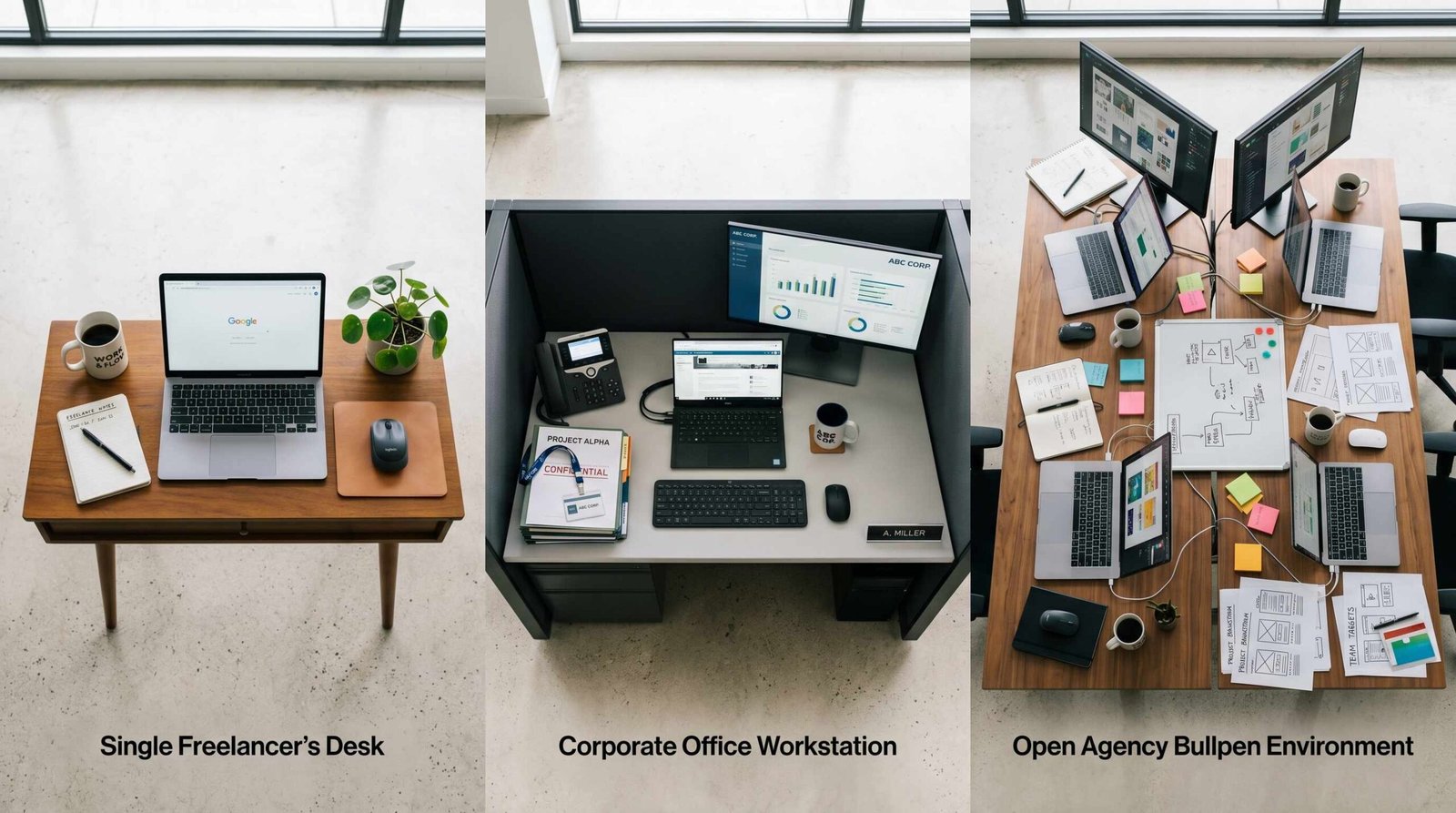
My honest take: most businesses under 30 employees should hire a freelance social media copywriter, not an agency or a full-time manager. The agency model is built for accounts that can absorb the overhead, which means you’re usually getting handed off to a junior writer two weeks in. The in-house model only pays off when you’re producing enough volume to keep one person busy 40 hours a week, which is more than most teams realize.
A freelance writer who specializes in your industry gets you to good output faster, with less management overhead, and you can change the arrangement if it isn’t working. The flexibility alone is worth the slight premium per hour over a junior in-house hire. When founders ask me about freelance marketing consultant arrangements, this is usually the framework I walk them through.
What to Look for in a Social Media Copywriter (Portfolio and Red Flags)
A portfolio review takes 15 minutes if you know what you’re looking at. Most clients don’t, which is why they hire on vibes and regret it three months in.
Portfolio must-haves:
- Platform variety. If they only show Instagram captions, they probably only write Instagram captions. You want someone who can prove they understand the rhythm of two or three platforms, because cross-platform consistency is half the job.
- Engagement results, not just screenshots. Pretty posts mean nothing without context. Did this post drive a 6% engagement rate when the account average was 1.2%? Did this ad copy cut CPL in half? Real writers track outcomes.
- Brand voice range. Can they write for a serious B2B fintech and also a DTC skincare brand? Voice flexibility is a skill, and a portfolio that shows only one tone of voice usually means the writer can only do one thing.
- Long-form samples alongside short. A LinkedIn carousel, a thread, a longer Instagram caption. Short-form discipline shows up clearly in longer pieces.
Red flags I see constantly:
- Portfolio is mostly static images with no readable copy.
- Every sample is from a single industry (suggests they only know one voice).
- No paid social work in the portfolio if you need paid copy.
- Heavy reliance on “engagement-bait” hooks (“Tag someone who needs this!”) instead of substantive copy.
- Can’t explain why a specific post performed well. If they can’t articulate the craft, they’re guessing.
Three questions to ask in the interview that separate good from average:
- “Walk me through a post you wrote that underperformed and what you’d change.” Anyone who says “I haven’t really had any underperform” is either lying or hasn’t written enough.
- “How would you write differently for LinkedIn vs. Instagram for the same product?” If they describe the same approach with different formatting, they don’t understand platform mechanics.
- “What’s your process for learning a new brand voice?” Listen for specifics: voice docs, audits, sample exchanges, kickoff calls. Generic answers mean they don’t have a process.
Where to Find a Social Media Copywriter
The platforms you use to find a writer shape who you’ll find. Race-to-the-bottom freelance marketplaces will give you 200 applicants in an hour, and 195 of them will be generalists who write social copy as a side hustle. That’s fine if you want $20-per-post output. It’s not fine if you want results.
The channels that actually work:
LinkedIn. The best social media copywriters tend to post on LinkedIn, because that’s where their target buyers are. Search for “social media copywriter” or “freelance social copywriter” and review their actual posts before you reach out. Their feed is their portfolio.
Direct referrals. Ask other founders or marketing leads in your network. The best freelance writers are usually booked through referrals, not job boards. Social Media Examiner’s industry report consistently shows that the businesses getting the most ROI from social are the ones investing in specialists, and those specialists are rarely advertising on Upwork.
Specialized freelance platforms. Sites like Superpath, MarketerHire, and We Work Remotely attract writers who treat freelancing as a career, not a side gig. You’ll pay more per hour but get vetted talent.
Newsletter and content communities. Writers who run their own newsletters are usually strong copywriters by definition. Browse Substack, Beehiiv, and writing-focused communities for people whose own writing makes you stop scrolling.
How you write the brief matters as much as where you post it. A strong brief gives the writer your business context, your audience, the platforms involved, samples of copy you like (and don’t), and what success looks like. A weak brief asks for “engaging social content” and expects miracles. The writers worth hiring will read your brief and screen you out if it’s vague, because vague briefs predict bad client relationships.
If you’re hiring with an eye toward a broader function, like a content marketing strategy that connects social to blog, email, and SEO, write that into the brief. Writers who can think across surfaces are more expensive, but the multiplier on hiring one is significant. The same logic applies when fitting social into a wider SaaS marketing strategy: a writer who understands the funnel writes social copy that does more than entertain.
FAQ
How much does it cost to hire a social media copywriter?
A freelance social media copywriter typically costs $25-$40 per hour at the entry level, $50-$85 per hour at mid-level, and $90-$150 per hour for senior writers. On a retainer basis, expect $2,500-$5,000 per month for mid-level support and $6,000-$12,000 for senior, full-service engagements. Per-post rates run $75-$150 mid-level and $200-$400 for senior writers.
What’s the difference between a social media copywriter and a social media manager?
A copywriter writes the actual words in your posts, captions, and ads. A manager runs the operation: scheduling, analytics, community management, and overall strategy. Some practitioners do both, but most specialize. If your problem is that posts aren’t performing or your voice is inconsistent, you need a copywriter. If your problem is that posting is chaotic and you have no reporting, you need a manager.
How do I know if I need a social media copywriter?
Five signals suggest you need one: low engagement despite decent impressions, inconsistent brand voice across platforms, paid social CTRs below industry benchmarks, copy written by committee with no clear owner, and social posting that keeps getting deprioritized because nobody wants to write it. If two or more of these apply, hiring a copywriter usually pays for itself within 90 days.
What should I look for in a social media copywriter portfolio?
Look for platform variety (not just one channel), engagement results with context (not just screenshots of pretty posts), brand voice range across different industries or tones, and at least some paid social work if you need ad copy. Red flags include portfolios that are mostly visual with no readable copy, single-industry samples, and an inability to explain why specific posts performed well.
How many hours per week does a social media copywriter typically need?
For a small business posting on 2-3 platforms with 4-6 posts per week, expect 8-12 hours of copywriter time weekly. That includes research, drafting, revisions, and platform-specific adaptation. Heavier ad-driven accounts or multi-brand operations can need 20-30 hours. Most freelancers structure this as a retainer rather than tracking hours, which keeps the focus on output rather than time spent.
Should I hire a freelance social media copywriter or an agency?
For most businesses under 30 employees, a specialist freelancer beats an agency on both cost and senior-level attention. Agencies are built for accounts large enough to absorb their overhead, which usually means your day-to-day work gets handed to a junior writer. Freelancers give you direct access to the person writing your copy, faster onboarding, and the flexibility to scale up or pause without renegotiating contracts.
The Bottom Line
The best social copy doesn’t feel like marketing. It feels like a sharp friend telling you something useful in a format the platform happens to reward. That’s what you’re hiring for: judgment about voice, instinct for what stops the scroll, and the discipline to do it consistently across months and platforms. Most teams don’t have that talent in-house, and most agencies won’t put their best writers on your account. A specialist freelance social media copywriter is the highest-leverage hire I see clients make in the under-$10K-per-month marketing budget range.
If you’re weighing whether to hire a social media copywriter, or looking for someone to handle your broader content strategy across social, SEO, and email, reach out here. I work with founders and marketing leads to figure out where their content is leaking and what to do about it. Sometimes that means writing for you directly. Sometimes it means helping you hire the right person. Either way, we’ll get the words working harder.
Recent Comments